
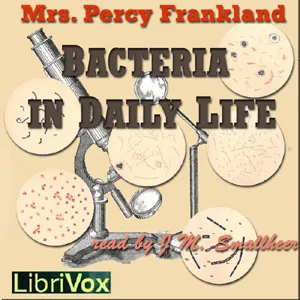
Om den här boken
The author provides a fascinating look at the emerging science of bacteriology at the start of the twentieth century including early progress in understanding and preventing diseases such as tuberculosis and diphtheria. The book also includes chapters on the spread of disease through close contact with infected persons as well as from contaminated drinking water and milk. Water purification methods as well as the stability of various disease-causing organisms to extremes of heat and cold is discussed. The final chapter includes a very interesting discussion of the development of anti-venoms for the treatment of snake bite and related poisons. (summary by J. M. Smallheer)
NY Times Book Review April 4, 1903:
Mrs. Frankland's book is a popular presentation in lively style of what the ordinary unscientific person should know of bacteria as they immediately affect daily life. She has managed to invest her subject with astonishing interest and to produce a work that any sane man or woman can read without weariness. Beginning with Latour's discovery of the fact that yeasty fermentation is due to minute vegetable growths, she traces rapidly the development of bacteriological knowledge through the age of Victoria. As a matter of fact the announcement of Latour's discovery and the accession of Victoria to the throne came very close together in the same year.
Following this historical disquisition is a presentation in successive chapters of these subjects: "What We Breathe," "Sunshine and Life," "Bacteriology and Water," "Milk Dangers and Remedies," "Bacteria and Ice," and "Poisons and Their Prevention." The most practical chapter for the householder is that on milk. The most novel and interesting is perhaps that on poisons and their prevention. This chapter deals largely with snake venom, and its revelations are marvelous. Next in practical value to the chapter on milk is that on water. It is satisfactory to find the author assuming that boiled water may be regarded as sterile. Interesting and important also is the fact that an analysis of many natural mineral springs shows them to be nearly free from bacteria. The resistance of bacteria to cold is one of the most striking things set forth in the book, and the destructive power of sunshine is another.
Kapitel
Nästa kapitel startar av sig självt. Den här webbläsaren kommer ihåg var du var.
- 1Bacteriology in the Victorian Era25:04 · uppläst av J. M. Smallheer
- 2Bacteriology in the Victorian Era, con't.18:53 · uppläst av J. M. Smallheer
- 3What We Breathe24:34 · uppläst av J. M. Smallheer
- 4What We Breathe, con't.16:18 · uppläst av J. M. Smallheer
- 5Sunshine and Life23:07 · uppläst av J. M. Smallheer
- 6Sunshine and Life, con't.12:03 · uppläst av J. M. Smallheer
- 7Bacteriology and Water32:37 · uppläst av J. M. Smallheer
- 8Milk Dangers and Remedies22:53 · uppläst av J. M. Smallheer
- 9Milk Dangers and Remedies, con't.20:22 · uppläst av J. M. Smallheer
- 10Bacteria and Ice24:47 · uppläst av J. M. Smallheer
- 11Some Poisons and Their Prevention29:21 · uppläst av J. M. Smallheer
- 12Some Poisons and Their Prevention, con't.36:12 · uppläst av J. M. Smallheer
Du kanske också gillar
 Black Beauty (The Autobiography of a Horse)Anna Sewell6 h 14 min
 Origin of Species by Means of Natural SelectionCharles Darwin24 h 22 min
 9/11 Commission ReportThe 9/11 Commission23 h 20 min
 Blue Fairy BookAndrew Lang13 h 52 min
 Black Beauty (version 2)Anna Sewell5 h 42 min
 Life on the MississippiMark Twain14 h 47 min
 Wind in the WillowsKenneth Grahame6 h 30 min
 Federalist PapersAlexander Hamilton, John Jay, James Madison21 h 11 min

