
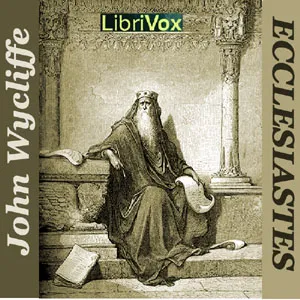
O této knize
“... an alemaunde tre schal floure, a locuste schal be maad fat, and capparis schal be distried; for a man schal go in to the hous of his euerlastyngnesse...” - Eccl. xii, 5 (see Note below).
Traditionally composed by Solomon sometime around 950-970 BCE but dated on linguistic evidence somewhere in the third century, this meditation on the futility of mankind’s striving can bring comfort to those of firm or fragile faith, or of no faith at all. The text used here is a revision of Wycliffe's original translation, made by his follower John Purvey in the mid-1390s. Wycliffe's chapter divisions in some cases differ from those of later versions (the King James, for example).
The Preacher, in his musings on the human condition, enlivens his melancholy observations with flashes of angry despair, resentment and even grim humour, all powerfully conveyed by Wycliffe’s translation.
Note: The King James Version avoids a direct reference to the aphrodisiac qualities of capparis (caper-berries) in its rendering: “the Almond tree shall flourish, and the grashopper shall be a burden, and desire shall faile...” (Introduction by Martin Geeson)
Kapitoly
Další kapitola začne sama. Tento prohlížeč si pamatuje, kde jste skončili.
- 1Chapter 14:35 · čte: Martin Geeson
- 2Chapter 27:14 · čte: Martin Geeson
- 3Chapter 35:02 · čte: Martin Geeson
- 4Chapter 46:42 · čte: Martin Geeson
- 5Chapter 53:13 · čte: Martin Geeson
- 6Chapter 63:31 · čte: Martin Geeson
- 7Chapter 76:31 · čte: Martin Geeson
- 8Chapter 84:42 · čte: Martin Geeson
- 9Chapter 95:46 · čte: Martin Geeson
- 10Chapter 104:30 · čte: Martin Geeson
- 11Chapter 113:06 · čte: Martin Geeson
- 12Chapter 124:33 · čte: Martin Geeson
Mohlo by se vám líbit
 Beyond Good and EvilFriedrich Nietzsche8 h 2 min
 As a Man ThinkethJames Allen54 min
 PrinceNiccolò Machiavelli5 h 54 min
 Acres of DiamondsRussell Conwell4 h 29 min
 Alcibiades IPlato (Πλάτων)2 h 15 min
 Way of PeaceJames Allen2 h 5 min
 Christmas Poetry and Hymn CollectionVarious1 h 25 min
 Communist ManifestoFriedrich Engels, Karl Marx1 h 36 min

