
About this book
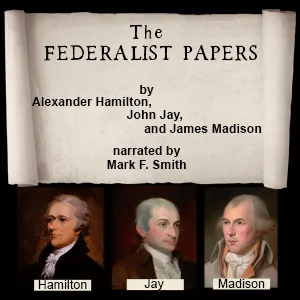
“The Federalist Papers” are a collection of 85 linked essays that explain the construction of the U.S. government and why it was built that way. The Papers are regarded as the best pipeline into understanding the U.S. Constitution and the founding principles of the government it would establish.
I have endeavored here to present these essays, not as articles in a newspaper, but as you might have experienced them if you had sat in a comfortable tavern with a tankard in hand, and listened while these ardent men ranged in front of a friendly fireplace as they attempted to convince you of their arguments.
Following the Revolutionary War, the newly-independent United States of America were organized under the Articles of Confederation. This well-intentioned document was faulty to the purpose, and the new nation rapidly found itself in dire financial distress.
Consequently, in 1787 a Constitutional Convention was called to produce a new blueprint for the government. After completion, that plan was sent to the States in September of that year for ratification, but it immediately came under fire for the powers it granted to the central government.
In New York, views on either side were heated. To persuade the public to support the Constitution for ratification, Alexander Hamilton (who had been a delegate to the Convention) and John Jay (who had helped negotiate the treaty with Great Britain that ended the War), began a series of anonymous essays to educate the citizenry in how the government would be arranged, and why those choices had been made. Later, when Jay was rendered unable to continue by an attack of rheumatism, Virginian James Madison (another Convention delegate who was in New York, serving in the Confederation Congress) was recruited to fill in.
Each wrote essays that were signed “Publius,” the name of a general who had helped to found Rome, to conceal their identities, which might have led to difficulties as Hamilton and Madison had been inside the deliberations at the Convention. These essays were published serially in New York newspapers, eventually reaching the total of 85.
(Summary by Mark Smith)
Chapters
The next chapter starts by itself. Your place is remembered in this browser.
- 1General Introduction12:34 · read by Mark F. Smith
- 2Concerning Dangers From Foreign Force and Influence14:25 · read by Mark F. Smith
- 3The Same Subject Continued12:35 · read by Mark F. Smith
- 4The Same Subject Continued13:32 · read by Mark F. Smith
- 5The Same Subject Continued11:30 · read by Mark F. Smith
- 6Concerning Dangers From Dissensions Between the States17:16 · read by Mark F. Smith
- 7The Same Subject Continued17:32 · read by Mark F. Smith
- 8The Consequences of Hostilities Between the States15:36 · read by Mark F. Smith
- 9The Union as a Safeguard Against Domestic Faction and Insurrection15:38 · read by Mark F. Smith
- 10The Same Subject Continued23:30 · read by Mark F. Smith
- 11The Utility of a Union in Respect to Commercial Relations and a Navy19:02 · read by Mark F. Smith
- 12The Utility of a Union in Respect to Revenue16:29 · read by Mark F. Smith
- 13Advantage of a Union in Respect to Economy in Government7:41 · read by Mark F. Smith
- 14Objections to the Proposed Constitution From Extent of Territory Answered15:55 · read by Mark F. Smith
- 15The Insufficiency of the Present Confederacy to Preserve the Union22:34 · read by Mark F. Smith
- 16The Same Subject Continued15:29 · read by Mark F. Smith
- 17The Same Subject Continued12:25 · read by Mark F. Smith
- 18The Same Subject Continued16:52 · read by Mark F. Smith
- 19The Same Subject Continued16:12 · read by Mark F. Smith
- 20The Same Subject Continued12:42 · read by Mark F. Smith
- 21Other Defects of t he Present Confederation15:21 · read by Mark F. Smith
- 22The Same Subject Continued25:23 · read by Mark F. Smith
- 23The Necessity of a Government as Energetic as the One Proposed to the Preservation of the Union13:44 · read by Mark F. Smith
- 24The Powers Necessary to the Common Defense Further Considered14:03 · read by Mark F. Smith
- 25The Same Subject Continued15:02 · read by Mark F. Smith
- 26The Idea of Restraining the Legislative Authority in Respect to the Common Defense, Considered17:51 · read by Mark F. Smith
- 27The Same Subject Continued11:07 · read by Mark F. Smith
- 28The Same Subject Continued12:18 · read by Mark F. Smith
- 29Concerning the Militia16:32 · read by Mark F. Smith
- 30Concerning the General Power of Taxation14:45 · read by Mark F. Smith
- 31The Same Subject Continued13:10 · read by Mark F. Smith
- 32The Same Subject Continued11:37 · read by Mark F. Smith
- 33The Same Subject Continued13:20 · read by Mark F. Smith
- 34The Same Subject Continued16:17 · read by Mark F. Smith
- 35The Same Subject Continued16:37 · read by Mark F. Smith
- 36The Same Subject Continued19:52 · read by Mark F. Smith
- 37Concerning the Difficulties of the Convention in Devising the Proper Form of Government21:56 · read by Mark F. Smith
- 38The Same Subject Continued, and the Incoherence of the Objections to the New Plan Exposed24:57 · read by Mark F. Smith
- 39The Conformity of the Plan to Republican Principles19:18 · read by Mark F. Smith
- 40On the Powers of the Convention to Form a Mixed Government, Examined and Sustained23:18 · read by Mark F. Smith
- 41General View of the Powers Conferred By the Constitution26:40 · read by Mark F. Smith
- 42The Powers Conferred by the Constitution Further Considered20:35 · read by Mark F. Smith
- 43The Same Subject Continued25:28 · read by Mark F. Smith
- 44Restrictions on the Authorities of the Several States21:52 · read by Mark F. Smith
- 45The Alleged Danger From the Powers of the Union to the State Governments16:07 · read by Mark F. Smith
- 46The Influence of the State and Federal Governments Compared18:56 · read by Mark F. Smith
- 47The Particular Structure of the New Government and the Distribution of Power Among Its Different Parts20:45 · read by Mark F. Smith
- 48These Departments Should Not Be So Far Separated As To Have No Constitutional Control Over Each Other14:42 · read by Mark F. Smith
- 49Method of Guarding Against the Encroachments of Any One Department By Appealing to the People Through a Convention12:37 · read by Mark F. Smith
- 50Periodical Appeals to the People Considered9:12 · read by Mark F. Smith
- 51The Structure of the Government Must Furnish the Proper Checks and Balances Between the Different Departments14:46 · read by Mark F. Smith
- 52The House of Representatives13:44 · read by Mark F. Smith
- 53The House of Representatives, Continued16:43 · read by Mark F. Smith
- 54The Apportionment of Members Among the States15:24 · read by Mark F. Smith
- 55The Total Number of the House of Representatives15:18 · read by Mark F. Smith
- 56The Total Number of the House of Representatives, continued11:52 · read by Mark F. Smith
- 57The Alleged Tendency of the New Plan to Elevate the Few at the Expense of the Many Considered in Connection with Representation16:25 · read by Mark F. Smith
- 58Objection That the Number of Members Will Not Be Augmented as the Progress of Population Demands15:46 · read by Mark F. Smith
- 59Concerning the Power of Congress to Regulate the Election of Members13:57 · read by Mark F. Smith
- 60The Same Subject Continued16:13 · read by Mark F. Smith
- 61The Same Subject Continued11:16 · read by Mark F. Smith
- 62The Senate17:35 · read by Mark F. Smith
- 63The Senate Continued22:45 · read by Mark F. Smith
- 64The Powers of the Senate17:57 · read by Mark F. Smith
- 65The Powers of the Senate Continued14:35 · read by Mark F. Smith
- 66The Power of the Senate to Set as a Court for Impeachments Further Considered16:08 · read by Mark F. Smith
- 67The Executive Department13:00 · read by Mark F. Smith
- 68The Mode of Electing the President11:10 · read by Mark F. Smith
- 69The Real Character of the Executive19:12 · read by Mark F. Smith
- 70The Executive Department Further Considered22:39 · read by Mark F. Smith
- 71The Duration in Office of the Executive12:27 · read by Mark F. Smith
- 72The Same Subject Continued, and the Re-Eligibility of the Executive Considered15:05 · read by Mark F. Smith
- 73The Provision for the Support of the Executive, and the Veto Power16:51 · read by Mark F. Smith
- 74The Command of the Military and Naval Forces, and the Pardoning Power of the Executive7:42 · read by Mark F. Smith
- 75The Treaty-Making Power of the Executive14:16 · read by Mark F. Smith
- 76The Appointing Power of the Executive14:08 · read by Mark F. Smith
- 77The Appointing Power Continued and Other Powers of the Executive Considered14:25 · read by Mark F. Smith
- 78The Judiciary Department21:48 · read by Mark F. Smith
- 79The Judiciary Continued7:57 · read by Mark F. Smith
- 80The Powers of the Judiciary18:31 · read by Mark F. Smith
- 81The Judiciary Continued, and the Distribution of the Judicial Authority27:04 · read by Mark F. Smith
- 82The Judiciary Continued11:28 · read by Mark F. Smith
- 83The Judiciary Continued in Relation to Trial By Jury22:36 · read by Mark F. Smith
- 84The Judiciary Continued in Relation to Trial By Jury19:19 · read by Mark F. Smith
- 85Certain General and Miscellaneous Objections to the Constitution Considered and Answered28:17 · read by Mark F. Smith
- 86Concluding Remarks19:33 · read by Mark F. Smith
You may also like
 Federalist PapersAlexander Hamilton, John Jay, James Madison21 h 11 min
 State of the Union Addresses by United States Presidents (1790 - 1816)John Adams, Thomas Jefferson, James Madison, George Washington7 h 35 min
 Game of Life and How to Play ItFlorence Scovel Shinn2 h 41 min
 Beyond Good and EvilFriedrich Nietzsche8 h 2 min
 Your Invisible PowerGenevieve Behrend1 h 40 min
 Alexander the GreatJacob Abbott5 h 57 min
 As a Man ThinkethJames Allen54 min
 PrinceNiccolò Machiavelli5 h 54 min
