
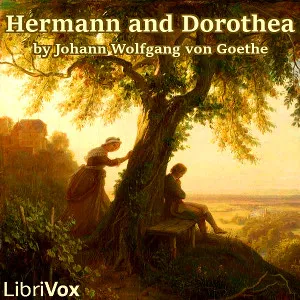
Σχετικά με αυτό το βιβλίο
There are few modern poems of any country so perfect in their kind as the "Hermann and Dorothea" of Goethe. In clearness of characterization, in unity of tone, in the adjustment of background and foreground, in the conduct of the narrative, it conforms admirably to the strict canons of art; yet it preserves a freshness and spontaneity in its emotional appeal that are rare in works of so classical a perfection in form.
The basis of the poem is a historical incident. In the year 1731 the Archbishop of Salzburg drove out of his diocese a thousand Protestants, who took refuge in South Germany, and among whom was a girl who became the bride of the son of a rich burgher. The occasion of the girl's exile was changed by Goethe to more recent times, and in the poem she is represented as a German from the west bank of the Rhine fleeing from the turmoil caused by the French Revolution. The political element is not a mere background, but is woven into the plot with consummate skill, being used, at one point, for example, in the characterization of Dorothea, who before the time of her appearance in the poem has been deprived of her first betrothed by the guillotine; and, at another, in furnishing a telling contrast between the revolutionary uproar in France and the settled peace of the German village.
The characters of the father and the minister Goethe took over from the original incident, the mother he invented, and the apothecary he made to stand for a group of friends. But all of these persons, as well as the two lovers, are recreated, and this so skillfully that while they are made notably familiar to us as individuals, they are no less significant as permanent types of human nature. The hexameter measure which he employed, and which is retained in the present translation, he handled with such charm that it has since seemed the natural verse for the domestic idyl—witness the obvious imitation of this, as of other features of the poem, in Longfellow's "Evangeline."
Taken as a whole, with its beauty of form, its sentiment, tender yet restrained, and the compelling pathos of its story, "Hermann and Dorothea" appeals to a wider public than perhaps any other product of its author. - Summary by Introduction of the book
Κεφάλαια
Το επόμενο κεφάλαιο ξεκινά μόνο του. Αυτός ο browser θυμάται πού σταματήσατε.
- 1Introductory Note2:40 · ανάγνωση: Foon
- 2Calliope Fate and Sympathy - Hermann and Dorothea15:21 · ανάγνωση: Foon
- 3Terpsichore - Hermann18:47 · ανάγνωση: Foon
- 4Thalia - The Citizens7:57 · ανάγνωση: Foon
- 5Euterpe - Mother and Son17:35 · ανάγνωση: Foon
- 6Polyhymnia - The Citizen of the World17:20 · ανάγνωση: Foon
- 7Clio - The Age22:22 · ανάγνωση: Foon
- 8Erato - Dorothea15:27 · ανάγνωση: Foon
- 9Melpomene - Hermann and Dorothea8:00 · ανάγνωση: Foon
- 10Urania - Prospect24:11 · ανάγνωση: Foon
Μπορεί να σας αρέσει επίσης
 Leiden des jungen WertherJohann Wolfgang von Goethe4 ώ. 56 λεπ.
 Erotica RomanaJohann Wolfgang von Goethe45 λεπ.
 Elective AffinitiesJohann Wolfgang von Goethe8 ώ. 27 λεπ.
 Faust, Der Tragödie erster TeilJohann Wolfgang von Goethe6 ώ. 0 λεπ.
 AchilleisJohann Wolfgang von Goethe1 ώ. 30 λεπ.
 Autobiography of Goethe Volume 1Johann Wolfgang von Goethe19 ώ. 12 λεπ.
 Aus meinem Leben. Dichtung und WahrheitJohann Wolfgang von Goethe51 ώ. 52 λεπ.
 Faust IJohann Wolfgang von Goethe4 ώ. 18 λεπ.


