
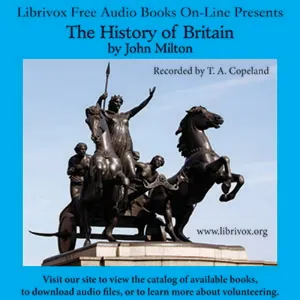
Tentang buku ini
A reader of this history, encountering the frequent references to “my author,” meaning the current source, will be reminded of DON QUIXOTE and of THE MORTE D'ARTHUR, for Milton employs a style that might be called dissertational rather than novelistic; he carefully identifies his sources and often quotes from them. However, much of the scholarly documentation has been omitted from the reading—all except footnotes indicating the years—to avoid cumbersome interruptions.
What will be obvious to a listener, though, is that Milton uses earlier chronicles with discretion. He doubts the very existence of Arthur and proposes an ingenious explanation of the origin of his supposed father's name, Uther. When obliged to cite George Buchanan, the world-renowned neo-Latin author and tutor (later detractor) of Mary Queen of Scots, he regularly uses more than a grain of salt, in view of that scholar’s Scottish bias.
And as he carefully weighs the reliability of his sources, so he offers his candid opinion of the wisdom and integrity of historical figures. He sneers at the story of King Canute’s famously commanding the rising tide of waves to retire, but not for the reason one might suppose. Boadicea gets low marks, Alfred high ones—but not without some reservations. And in a long digression comparing the government of Britain, newly freed from Roman domination, to the British republic under Cromwell (for which, as Secretary of the Foreign Tongues, Milton was the voice), his criticism is so frank and savage that the passage had to be suppressed during his lifetime. Such personal opinions are what make this book entertaining and useful for the serious study of the author’s thought and personality.
The endearingly affectionate life of the author, written by his elder nephew, Edward Philips, offers much first-hand information although its facts are not always accurate and its coverage spotty. One learns nothing, for example, about Milton’s visit to the home of Galileo, but Philips's discussion of the role his cousins played in their father’s scholarly pursuits is detailed and affords no basis to the myth that he ever dictated his poetry to his daughters. (Summary by T. A. Copeland)
Bab
Bab berikutnya mulai otomatis. Browser ini mengingat sampai mana kamu mendengarkan.
- 1History of Britain, Book 11:02:38 · dibacakan oleh Thomas A. Copeland
- 2History of Britain, Book 2a1:07:42 · dibacakan oleh Thomas A. Copeland
- 3History of Britain, Book 2b1:07:13 · dibacakan oleh Thomas A. Copeland
- 4History of Britain, Book 3a30:18 · dibacakan oleh Thomas A. Copeland
- 5History of Britain, Book 3b30:17 · dibacakan oleh Thomas A. Copeland
- 6History of Britain, Book 3c32:29 · dibacakan oleh Thomas A. Copeland
- 7History of Britain, Book 4a41:56 · dibacakan oleh Thomas A. Copeland
- 8History of Britain, Book 4b41:42 · dibacakan oleh Thomas A. Copeland
- 9History of Britain, Book 4c36:29 · dibacakan oleh Thomas A. Copeland
- 10History of Britain, Book 5a54:14 · dibacakan oleh Thomas A. Copeland
- 11History of Britain, Book 5b56:01 · dibacakan oleh Thomas A. Copeland
- 12History of Britain, Book 6a43:49 · dibacakan oleh Thomas A. Copeland
- 13History of Britain, Book 6b37:10 · dibacakan oleh Thomas A. Copeland
- 14History of Britain, Book 6c56:28 · dibacakan oleh Thomas A. Copeland
- 15History of Britain: Life of Milton59:36 · dibacakan oleh Thomas A. Copeland
Mungkin kamu juga suka
 Paradise LostJohn Milton9 jam 41 mnt
 Paradise Lost (version 2)John Milton10 jam 59 mnt
 Paradis PerduJohn Milton14 jam 37 mnt
 AreopagiticaJohn Milton2 jam 1 mnt
 Of EducationJohn Milton31 mnt
 Poems Written During the Civil War and the Protectorate 1642-1658John Milton27 mnt
 Paradise RegainedJohn Milton1 jam 41 mnt
 Adam and EveJohn Milton17 mnt


