
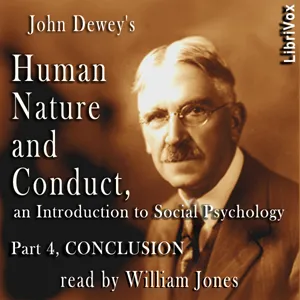
Sobre este livro
John Dewey, an early 20th Century American philosopher, psychologist, educational theorist. This project encompasses Part 4 of 4 of his book Human Nature and Conduct, An Introduction to Social Psychology, published in 1922. Dewey's uses the words "HABIT" and "Impulse" as a specialized catch-all words to describe how a person and his/her objective environment interact. This interaction is the basis for moral and ethical judgments. Dewey writes: "All habits are demands for certain kinds of activity; and they constitute the self.” In other places he also asserts that "Habits are Will." In the third part of the book, Dewey describes how we make ethical judgments (Dramatic Rehearsal) on the occasions which call upon the exercise of intelligence, and the relationship among aims, goals, means and ends, and emotions.
In this fourth section he ties together the preceding concepts and conclusions
Part 4: Conclusion
Section I: The Good of Activity
Better and worse; morality a process; evolution and progress; optimism; Epicureanism; making others happy.
Section II: Morals are Human
Humane morals; natural law and morals; place of science.
Section III: What is Freedom?
Elements in freedom; capacity in action; novel possibilities; force of desire.
Section IV: Morality is Social
Conscience and responsibility; social pressure and opportunity; exaggeration of blame; importance of social psychology; category of right; the community of religious symbol.
Soloist supplementary note: Very important but sometimes overlooked is his concept in Part 3 of the book of "Dramatic Rehearsal" which to me means: when we are deliberating over a course of action, we don't just tote up an arithmetic series of "if I do THIS, then THIS will happen, and then THIS will happen, etc. and weigh out the pluses and minuses" as a Utilitarian would do. No, what we do, says Dewey, is that at every step of divining what the future will hold, we examine how we FEEL about the situation. For example, if we're planning a chess move, we don't think to ourselves merely "if I make THIS move, I'll weaken my king side, but I'll gain a pawn" No, instead we think "if I make THIS move, I'll weaken my king side {Dang it all to hecky darn! }, but I'll gain a pawn {Yaaaay! hoorah! }". The force of our subjective and emotive intensity sway the final decisions.
~ Summary by William Allan Jones, Soloist
Capítulos
O próximo capítulo começa sozinho. Este navegador lembra onde você parou.
- 11. The Good of Activity34:52 · lido por William Allan Jones
- 22. Morals are Human15:39 · lido por William Allan Jones
- 33. What is Freedom?22:34 · lido por William Allan Jones
- 44. Morality is Social38:17 · lido por William Allan Jones
Você também pode gostar
 Human Nature and Conduct - Part 2, The Place of Impulse In ConductJohn Dewey2 h 53 min
 How We ThinkJohn Dewey8 h 54 min
 Democracy and Education: An Introduction to the Philosophy of EducationJohn Dewey16 h 20 min
 Human Nature And Conduct - Part 1, The Place of Habit in ConductJohn Dewey2 h 43 min
 Moral Principles in EducationJohn Dewey1 h 12 min
 Human Nature and Conduct - Part 3, The Place of Intelligence In ConductJohn Dewey3 h 52 min
 Essays in Experimental LogicJohn Dewey11 h 26 min


