
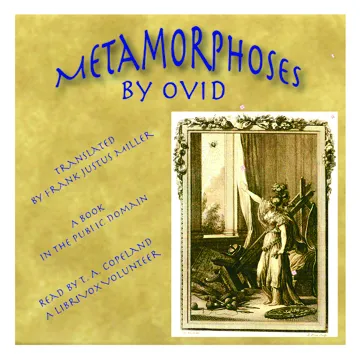
Om denne bog
Ovid represents his work as a celebration of mutability in the form of a history of the world's notable transformations. It is a compendium of Greek and Roman mythology, valuable not only as a guide to the study of ancient literature and religion but also as an aid to understanding and appreciating later literature since it has been studied and often alluded to by educated Western writers.
Mutability is not only the subject of the poem but the essence of Ovid’s narrative technique. The subject matter permits the poet to alternate between exciting action scenes and detailed psychological portraits in the form of interior monologues, especially of women tortured by indecision. The pace of the narrative varies greatly as he lingers here, rushes there, some stories occupying five pages, others five lines. The tone too varies greatly, for the characters have unique voices that alter according to emotion and audience, and the narrative voice itself also changes unpredictably. One story of violence, like the death of Hercules, may be treated with great dignity throughout, while another, like the brawl between the Lapiths and the centaurs, practically revels in grotesque horror. Every reader can recall the centaur who, although disemboweled, keeps fighting until he trips, entangled in his own guts.
Tone can undergo drastic changes as well, even within a single tale. The descent of Orpheus to Hades is a study in high camp. After huddling the tragic details of the beginning into a few brief, factual sentences, the author quotes the lover's song to the infernal powers. Although to ordinary readers it may seem pedestrian, the author insists that it was so surpassingly beautiful as to halt the rotation of Ixion's wheel, draw tears down the cheeks of the Furies themselves (those old sentimental sadists), and even make Sisyphus sit down on his stone to weep (What? Sisyphus take a rest?). Yet the story very soon shifts from bathos to pathos. It is as if Ovid makes fun of an old chestnut just to show that he can turn even this into a tear-jerker.
Brief moments of pathos flash out unexpectedly here and there like fireflies. One can never forget with what fortitude Polyxena bares her breast to the sacrificial knife and uses her last motion to cover her legs with her robe. Similar tender moments abound; compare this detail from a battle: "But he, even in death, with his eyes swimming in the black darkness, looked round for Athis, fell down by his side, and bore to the shadows this comfort, that in death they were not divided."
Ovid follows a roughly chronological organization, but inclusion is more important to him than continuity. If between tales he can cram in a compressed tale or two, he does so, with a semblance of transitions, but when it comes to narrative connections between episodes of a single story, even to explain motivation or character development—that of Medea is a prime example—he simply does not take the trouble. He generally assumes the…
Kapitler
Næste kapitel starter af sig selv. Denne browser husker, hvor du var.
- 1Introduction10:35 · læst op af Thomas A. Copeland
- 2Book 11:00:30 · læst op af Thomas A. Copeland
- 3Book 2, pt 130:56 · læst op af Thomas A. Copeland
- 4Book 2, pt 236:29 · læst op af Thomas A. Copeland
- 5Book 356:03 · læst op af Thomas A. Copeland
- 6Book 41:00:24 · læst op af Thomas A. Copeland
- 7Book 549:28 · læst op af Thomas A. Copeland
- 8Book 652:49 · læst op af Thomas A. Copeland
- 9Book 7, pt 130:23 · læst op af Thomas A. Copeland
- 10Book 7, pt 233:50 · læst op af Thomas A. Copeland
- 11Book 8, pt 140:49 · læst op af Thomas A. Copeland
- 12Book 8, pt 224:25 · læst op af Thomas A. Copeland
- 13Book 91:01:02 · læst op af Thomas A. Copeland
- 14Book 1056:24 · læst op af Thomas A. Copeland
- 15Book 1158:32 · læst op af Thomas A. Copeland
- 16Book 1246:42 · læst op af Thomas A. Copeland
- 17Book 13, pt 133:56 · læst op af Thomas A. Copeland
- 18Book 13, pt 240:38 · læst op af Thomas A. Copeland
- 19Book 14, pt 132:51 · læst op af Thomas A. Copeland
- 20Book 14, pt 231:02 · læst op af Thomas A. Copeland
- 21Book 15, pt 133:52 · læst op af Thomas A. Copeland
- 22Book 15, pt 233:00 · læst op af Thomas A. Copeland
Du vil måske også kunne lide
 Resúmen en Prosa de las MetamorfosisPublius (Ovid) Ovidius Naso1 t. 51 min.
 Metamorphoses (Howard Version)Publius (Ovid) Ovidius Naso12 t. 5 min.
 FastiPublius (Ovid) Ovidius Naso5 t. 32 min.
 HeroidesPublius (Ovid) Ovidius Naso5 t. 14 min.
 Sappho: A New RenderingPublius (Ovid) Ovidius Naso, Sappho36 min.
 Shakespeare's Ovid, Being Arthur Golding's Translation of the MetamorphosesPublius (Ovid) Ovidius Naso19 t. 18 min.
 Art of WarSun Tzu 孙武1 t. 12 min.
 OdysseyHomer11 t. 18 min.


