
About this book
The Nobel Prizes are international awards bestowed once a year by Scandinavian committees for cultural and scientific advances. They were established in 1895 by the Swedish chemist Alfred Nobel, the inventor of dynamite. The prizes in Physics, Chemistry, Physiology or Medicine, Literature, and Peace were first awarded in 1901.
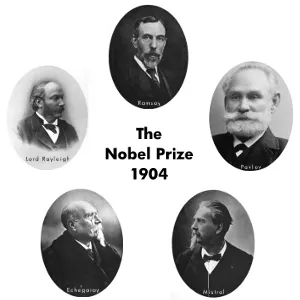
The Laureats of 1904 were:
in Physics: Lord Rayleigh (John William Strutt, 1842 - 1919), "for his investigations of the densities of the most important gases and for his discovery of argon in connection with these studies";
in Chemistry: Sir William Ramsay (1852 - 1916), "for his discovery of the inert gaseous elements in air, and his determination of their place in the periodic system";
in Physiology or Medicine: Ivan Petrovich Pawlow (1849 - 1936), "in recognition of his work on the physiology of digestion, through which knowledge on vital aspects of the subject has been transformed and enlarged";
in Literature: Frédéric Mistral (one half, 1830 - 1914), "in recognition of the fresh originality and true inspiration of his poetic production, which faithfully reflects the natural scenery and native spirit of his people, and, in addition, his significant work as a Provençal philologist",
and José Echegaray y Eizaguirre (one half, 1832 - 1916), "in recognition of the numerous and brilliant compositions which, in an individual and original manner, have revived the great traditions of the Spanish drama";
in Peace: Institut de droit international (Institute of International Law), "for its efforts as an unofficial body to formulate the general principles of the science of international law.".
This multilingual collection contains the presentation speeches for the Laureats, their biographies, as well as the famous "Nobel lectures" for the three scientific awards. The presentation speeches, originally given in Swedish, were translated by the Nobel Foundation into the mother tongue of the Laureats. (Summary by Availle and Wikipedia)
Chapters
The next chapter starts by itself. Your place is remembered in this browser.
- 1Distribution des Prix Nobel en 19044:50 · read by Nadine Eckert-Boulet
- 2Physics - Presentation Speech6:21 · read by TriciaG
- 3Physics - Biography5:19 · read by TriciaG
- 4Physics - Nobel Lecture21:48 · read by TriciaG
- 5Chemistry - Presentation Speech7:29 · read by Sean Michael Hogan
- 6Chemistry - Biography6:40 · read by Sean Michael Hogan
- 7Chemistry - Nobel Lecture25:10 · read by Sean Michael Hogan
- 8Medizin/Physiologie - Festrede zur Verleihung19:52 · read by Kalynda
- 9Medizin/Physiologie - Biographie6:38 · read by Kalynda
- 10Medizin/Physiologie - Nobel Vortrag49:01 · read by Availle
- 11Littérature I - Discours de Présentation13:06 · read by Nadine Eckert-Boulet
- 12Literatura II - Discurso de Entrega14:11 · read by Karen Savage
- 13Littérature I - Biographie4:40 · read by Nadine Eckert-Boulet
- 14Literatura II - Biografía3:05 · read by Karen Savage
- 15Paix - L'Institut de Droit International5:41 · read by Nadine Eckert-Boulet
You may also like
 1891 CollectionVarious5 h 51 min
 LibriVox 8th Anniversary CollectionVarious21 h 12 min
 Poems Every Child Should KnowMary E. Burt, Various8 h 7 min
 Love Letter Collection 2008Various44 min
 Christmas Poetry and Hymn CollectionVarious1 h 25 min
 20 Short Science Fiction StoriesVarious10 h 5 min
 LibriVox 7th Anniversary CollectionVarious12 h 45 min
 American Rivals of Sherlock HolmesVarious12 h 24 min


