
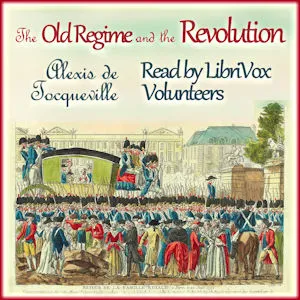
About this book
A calm, philosophical inquiry into the causes of the French Revolution, and the working of the Old Regime. In this work, M. de Tocqueville has daguerreotyped French political society under the old monarchy; shown us where the real power lay, and how it affected individual Frenchmen in the daily avocations of life; what was the real condition of the nobility, of the clergy, of the middle classes, of the "people", of the peasantry; wherein France differed from all other countries in Europe; why a Revolution was inevitable. The information derived under these various heads, it may safely be said, is now first printed. It has been obtained, as M. de Tocqueville informs us, mainly from the manuscript records of the old intendants' offices and the Council of State. Of the labor devoted to the task, an idea may be formed from the author's statement, that more than one of the thirty odd chapters contained in the volume, alone cost him a year's researches.
"I trust," says M. de Tocqueville in his Preface, "that I have written this work without prejudice; but I can not say I have written without feeling. It would be scarcely proper for a Frenchman to be calm when he speaks of his country, and thinks of the times in which we live. I acknowledge, therefore, that in studying the society of the Old Regime in all its details, I have never lost sight of the society of our own day."
The work abounds with allusions to the Empire and the Emperor. It need hardly be added, that these allusions are not eulogistic of the powers that be. Napoleon has seldom been assailed with more pungent satire or more cogent logic. - Summary by Harper & Brothers, Publishers
Chapters
The next chapter starts by itself. Your place is remembered in this browser.
- 1Preface17:56 · read by Tom Shoesmith
- 2Contradictory Opinions formed upon the Revolution when it broke out7:58 · read by Tom Shoesmith
- 3That the fundamental and final Object of the Revolution was not, as some have supposed, to destroy religious and to weaken political Authority8:26 · read by Tom Shoesmith
- 4That the French Revolution, though political, pursued the same Course as a religious Revolution, and why6:46 · read by Tom Shoesmith
- 5How the same Institutions had been established over nearly all Europe, and were every where falling to pieces8:48 · read by Tom Shoesmith
- 6What did the French Revolution really achieve?5:34 · read by Ty Lasky
- 7Why the feudal Rights were more odious to the People in France than any where else20:42 · read by JaboVercing
- 8That we owe “Administrative Centralization,” not to the Revolution or the Empire, as some say, but to the old Regime16:20 · read by Tom Shoesmith
- 9That what is now called “the Guardianship of the State” (Tutelle Administrative) was an Institution of the old Regime17:43 · read by Tom Shoesmith
- 10That administrative Tribunals (la Justice Administrative) and official Irresponsibility (Garantie des Functionnaires) were Institutions of the old Regime8:55 · read by Tom Shoesmith
- 11How Centralization crept in among the old Authorities, and supplanted without destroying them6:20 · read by Tom Shoesmith
- 12Of official Manners and Customs under the old Regime17:50 · read by Tom Shoesmith
- 13How the Capital of France had acquired more Preponderance over the Provinces, and usurped more Control over the Nation, than any other Capital in Europe8:45 · read by Tom Shoesmith
- 14That Frenchmen had grown more like each other than any other People7:58 · read by Tom Shoesmith
- 15That these Men, who were so alike, were more divided than they had ever been into petty Groups, each independent of and indifferent to the others26:52 · read by Tom Shoesmith
- 16How the Destruction of political Liberty and Class Divisions were the Causes of all the Diseases of which the old Regime died20:40 · read by Tom Shoesmith
- 17Of the kind of Liberty enjoyed under the old Regime, and of its Influence upon the Revolution24:24 · read by Tom Shoesmith
- 18How the Condition of the French Peasantry was worse in some respects in the Eighteenth Century than it had been in the Thirteenth, notwithstanding the Progress of Civilization31:08 · read by Tom Shoesmith
- 19How, toward the middle of the Eighteenth Century, literary Men became the leading Politicians of the Country, and of the Effects thereof18:29 · read by Tom Shoesmith
- 20How Irreligion became a general ruling Passion among Frenchmen in the Eighteenth Century, and of the Influence it exercised over the Character of the Revolution15:49 · read by Tom Shoesmith
- 21How the French sought Reforms before Liberties21:24 · read by Tom Shoesmith
- 22That the Reign of Louis XVI. was the most prosperous Era of the old Monarchy, and how that Prosperity really hastened the Revolution18:39 · read by Tom Shoesmith
- 23How Attempts to relieve the People provoked Rebellion14:15 · read by Tom Shoesmith
- 24Of certain Practices by means of which the Government completed the revolutionary Education of the People8:55 · read by Tom Shoesmith
- 25How great administrative Changes had preceded the political Revolution, and of the Consequences thereof18:08 · read by Tom Shoesmith
- 26How the Revolution sprang spontaneously out of the preceding Facts14:10 · read by Tom Shoesmith
- 27Appendix19:56 · read by Tom Shoesmith
- 28Preface (Version 2)21:29 · read by Wayne Cooke
You may also like
 Democracy in America Vol. IAlexis de Tocqueville17 h 43 min
 Democracy in America Vol. IIAlexis de Tocqueville12 h 3 min
 State of Society in France Before the Revolution of 1789Alexis de Tocqueville11 h 11 min
 Black Beauty (The Autobiography of a Horse)Anna Sewell6 h 14 min
 Origin of Species by Means of Natural SelectionCharles Darwin24 h 22 min
 9/11 Commission ReportThe 9/11 Commission23 h 20 min
 Blue Fairy BookAndrew Lang13 h 52 min
 Black Beauty (version 2)Anna Sewell5 h 42 min


