Certified: The CompTIA Linux+ Audio Course
by Jason Edwards
Latest episode
Welcome to the Linux+ Audio Course
Welcome to the Linux+ Audio Course
About this podcast
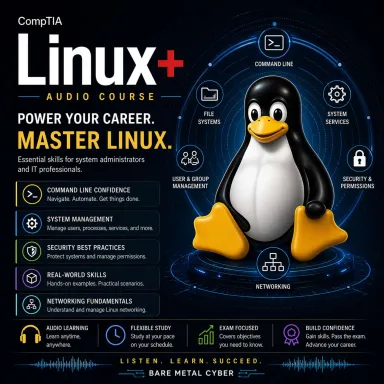
Linux+ for People With Jobs is a practical, audio-first course that teaches you to think and work like a real Linux administrator—without burying you in theory or trivia. You’ll learn the commands, concepts, and workflows the exam expects, but more importantly, you’ll build the habits that keep systems stable in production: verifying assumptions, making safe changes, and troubleshooting with a calm, repeatable process. Every episode is designed to help you study efficiently, retain what matters, and walk into the exam with confidence that actually transfers to the job.
Episodes
The newest 20 of 106 episodes
- Welcome to the Linux+ Audio Course · 1 minLinux+ for People With Jobs is a practical, audio-first course that teaches you to think and work like a real Linux administrator. You’ll learn the commands, concepts, and…
- Episode 105 — Memory pressure: swapping, OOM, killed processes, memory leaks · 15 min · Episode 105Linux+ includes memory pressure because it produces symptoms that mimic application bugs, random crashes, and performance degradation, and administrators must recognize the…
- Episode 104 — CPU and load: high CPU, load average, context switching, slow startup · 14 min · Episode 104Linux+ tests performance diagnosis because “system is slow” demands you identify which resource is constrained and which metric actually indicates the bottleneck. This episode…
- Episode 103 — Secure connectivity breakage: SSH, certs, repos, ciphers, negotiation issues · 15 min · Episode 103Linux+ includes secure connectivity breakage because encrypted connections fail in distinct ways, and administrators must diagnose without weakening security unnecessarily. This…
- Episode 102 — Permission failures: ACLs, attributes, account access, why it used to work · 15 min · Episode 102Linux+ tests permission failures because they are common, high-impact, and often misdiagnosed when administrators look only at the final file and ignore the full access path…
- Episode 101 — SELinux failures: policy vs context vs booleans, how to think, not panic · 16 min · Episode 101Linux+ tests SELinux failures because they expose whether you can troubleshoot secure systems without disabling controls. This episode frames SELinux problems in three buckets…
- Episode 100 — Link problems: link down, negotiation failures, can’t ping server reasoning · 15 min · Episode 100Link-layer problems are on Linux+ because they are the first gate in network troubleshooting, and failures here can masquerade as routing, DNS, or application issues if you skip…
- Episode 99 — Interface issues: MTU mismatch, bonding, dual-stack surprises · 18 min · Episode 99Linux+ tests interface-level issues because they produce confusing symptoms that look like application failures until you recognize the network layer problem. This episode…
- Episode 98 — DHCP failures and IP conflicts: symptoms and best-next-step logic · 14 min · Episode 98Linux+ includes DHCP failures and IP conflicts because they are common causes of widespread “network is down” reports, and they require disciplined diagnosis. This episode…
- Episode 97 — DNS vs routing vs firewall: fast isolation with minimal commands · 15 min · Episode 97Linux+ often tests network failures by making multiple causes plausible, then rewarding the candidate who isolates the layer quickly. This episode teaches fast isolation between…
- Episode 96 — System and service failures: systemd unit failures, PATH misconfig, missing drivers · 15 min · Episode 96Linux+ tests system and service failures because they represent the intersection of configuration, dependencies, and runtime reality. This episode frames three common categories…
- Episode 95 — Package and dependency breakage: what fails, what to check first · 18 min · Episode 95Linux+ includes package and dependency breakage because software management is a common source of outages, and administrators must troubleshoot quickly without turning a partial…
- Episode 94 — Mount and write failures: won’t mount, read-only, partition not writable · 16 min · Episode 94Linux+ tests mount and write failures because they are common operational incidents and they require you to distinguish between device issues, filesystem issues, and permission…
- Episode 93 — Disk full puzzles: filesystem full vs inode exhaustion vs runaway logs · 17 min · Episode 93Linux+ frequently uses “disk full” as a puzzle because the same error message can come from different constraints, and the correct fix depends on which constraint is actually…
- Episode 92 — Corruption and weird crashes: kernel or data corruption, segmentation faults · 17 min · Episode 92Linux+ includes corruption and crash symptoms because administrators must recognize when behavior indicates deeper integrity problems rather than simple misconfiguration. This…
- Episode 91 — Boot failures: GRUB misconfig, kernel panic, and first-response triage · 16 min · Episode 91Linux+ treats boot failures as a high-value troubleshooting domain because the system is unusable until you can identify the failing stage and choose a safe recovery action. This…
- Episode 90 — Alerting design: thresholds, events, notifications, logging, aggregation patterns · 12 min · Episode 90Linux+ tests alerting design because good operations is not “more alerts,” it is the right alerts that drive the right actions at the right time. This episode explains thresholds…
- Episode 89 — Data collection concepts: SNMP, traps, MIBs, agent vs agentless · 13 min · Episode 89Linux+ includes monitoring data collection because the value of monitoring depends on how metrics and events are gathered and how reliable that gathering is. This episode…
- Episode 88 — Monitoring language: SLA vs SLI vs SLO and what healthy means · 12 min · Episode 88Linux+ includes monitoring concepts because administrators must describe and measure health in a way that supports decisions, not just collects metrics. This episode defines SLA…
- Episode 87 — AI best practices for ops: safe use cases, verification, governance, prompt habits · 12 min · Episode 87Linux+ touches AI best practices because operators increasingly use AI to accelerate troubleshooting and documentation, and the exam’s security mindset applies to how you use…