

Notas do episódio
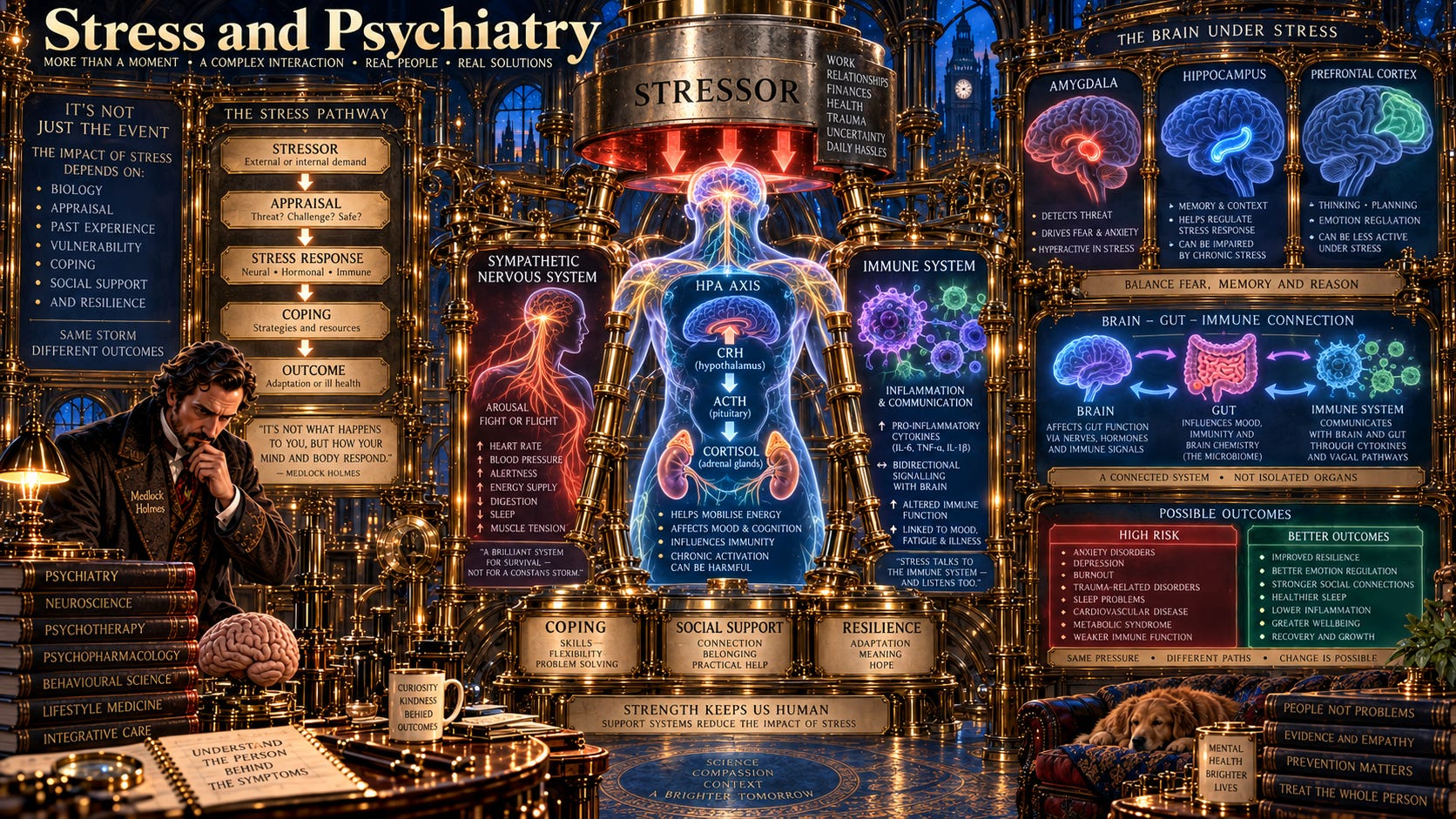
and resilience.
Medlock Holmes enters The Stress Laboratory, where an enormous brass apparatus is being subjected to pressure.
At first, the mystery appears straightforward: apply enough force and eventually something breaks.
But Holmes quickly discovers that human beings do not behave like identical pieces of metal.
Two people can encounter the same loss, illness, humiliation or threat and follow completely different trajectories. One develops depression. Another becomes anxious. A third experiences transient distress and recovers. Another appears initially unaffected but becomes unwell after repeated adversity. Some people even emerge with greater confidence and new capacities.
The crucial question therefore becomes:
Why does the same stressor produce such different outcomes?
The chapter begins by disentangling a word that has become so broad that it can obscure rather than clarify. Stress may refer to the event, the physiological response, the subjective experience or its consequences. It is often more useful to distinguish:
STRESSOR → STRESS RESPONSE → DISTRESS → ADAPTATION
A stressor is the challenge. The stress response is what the organism does about it.
And that response evolved for a reason.
A threat to equilibrium activates systems designed to mobilise the organism rapidly. The sympathetic nervous system releases catecholamines. Heart rate and cardiovascular activity increase. Attention shifts towards threat. Energy becomes available for immediate action.
Running alongside this rapid pathway is the slower neuroendocrine cascade:
STRESSOR → HYPOTHALAMUS → CRH → PITUITARY → ACTH → ADRENAL CORTEX → CORTISOL
Cortisol mobilises energy and supports cardiovascular activity while temporarily reducing expenditure on functions less immediately important for survival, including growth, reproduction and aspects of immunity. Negative feedback normally regulates the system through the hypothalamus, pituitary and hippocampus.
Holmes therefore discovers his first principle:
The stress response is not inherently pathological. It is an adaptive system designed to restore equilibrium.
The difficulty begins when the system is excessive, prolonged, repeatedly activated, poorly regulated or operating in a vulnerable individual.
And there is no single universal stress response. Physical stressors preferentially recruit brainstem and hypothalamic systems, whereas psychological stressors engage networks involving the amygdala, hippocampus and prefrontal cortex. Acute stress produces rapid changes; chronic stress can produce more sustained alterations in neuronal activity and gene expression.
This leads Holmes from the laboratory into a much larger room labelled VULNERABILITY AND RESILIENCE.
Early models treated stress almost like an infectious agent: enough exposure should produce illness. But human responses vary enormously.
A better model is:
OUTCOME = STRESSOR × VULNERABILITY × APPRAISAL × COPING × SUPPORT × RESILIENCE
Vulnerability can arise from…
Site: drmanaankarray.substack.com


