

Jakson kuvaus
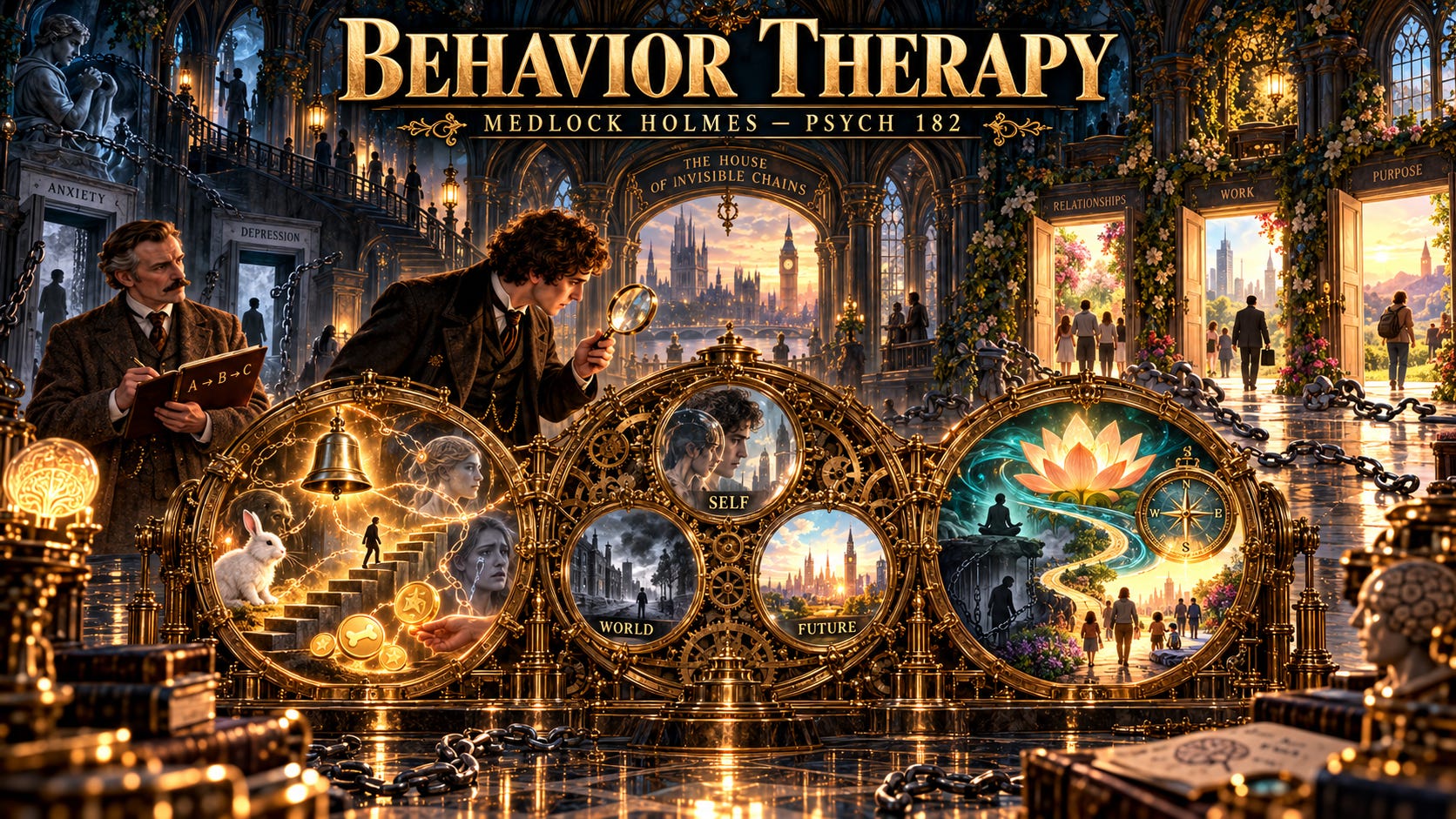
Medlock Holmes and the House of Invisible Chains
The summons arrived at Baker Street shortly before midnight.
A peculiar institution on the outskirts of London, known as The House of Habits, had become the subject of considerable alarm. Its inhabitants appeared imprisoned by invisible forces. Some were terrified of harmless objects. Others repeated strange rituals, while several remained confined to their rooms, unable to summon the motivation to venture outside.
Yet there were no locks upon the doors.
“Curious,” Watson remarked. “What prevents them from leaving?”
“That, my dear Watson,” replied Medlock Holmes, “is precisely what we must discover.”
Their investigation began in the Chamber of Associations.
A bell sounded, and a gentleman recoiled in terror. The bell itself was harmless, but years earlier its ringing had accompanied a frightening experience.
“Classical conditioning,” Holmes explained. “An originally neutral stimulus has acquired the power to provoke fear.”
He pointed towards two portraits: Ivan Pavlov, whose experiments had illuminated associative learning, and John Watson, whose notorious Little Albert experiment demonstrated how fear could be acquired.
“But if fear can be learned,” Watson asked, “might it also be unlearned?”
Holmes smiled. “You have discovered our first clue.”
In the adjoining room, a young woman approached a caged rabbit. Initially she trembled, but with repeated, manageable encounters, her fear diminished.
“Mary Cover Jones,” Holmes observed. “One of the pioneers of treating fear through gradual exposure and positive associations.”
They continued into the Hall of Consequences, where an extraordinary machine dispensed golden tokens whenever a resident completed a useful activity.
“Operant conditioning,” said Holmes. “Behaviour is shaped by its consequences. Reinforcement increases behaviour; punishment decreases it.”
Watson examined the machine.
“Then a reward must always be something pleasant?”
“Not necessarily. Negative reinforcement strengthens behaviour by removing something unpleasant. The distinction is not between good and bad, but between adding and removing.”
Their next discovery was more disturbing.
A man repeatedly checked the same door, convinced that catastrophe would follow if he stopped. Each inspection briefly relieved his anxiety.
“Observe the trap,” Holmes said. “The ritual removes distress, and that relief reinforces the ritual. What protects him for a moment imprisons him over time.”
In the Gallery of Thoughts, they encountered three portraits: Aaron Beck, Albert Ellis and Albert Bandura.
“Behaviour is not shaped by consequences alone,” Holmes explained. “Beliefs, expectations and observation also influence what we do.”
A mirror reflected three inscriptions:
I am inadequate.
The world is hostile.
The future is hopeless.
“Beck’s cognitive triad,” Watson recognised.
Holmes nodded. “And through cognitive restructuring, the patient learns to examine such conclusions rather than automatically…
Sivusto: drmanaankarray.substack.com


