

Notas del episodio
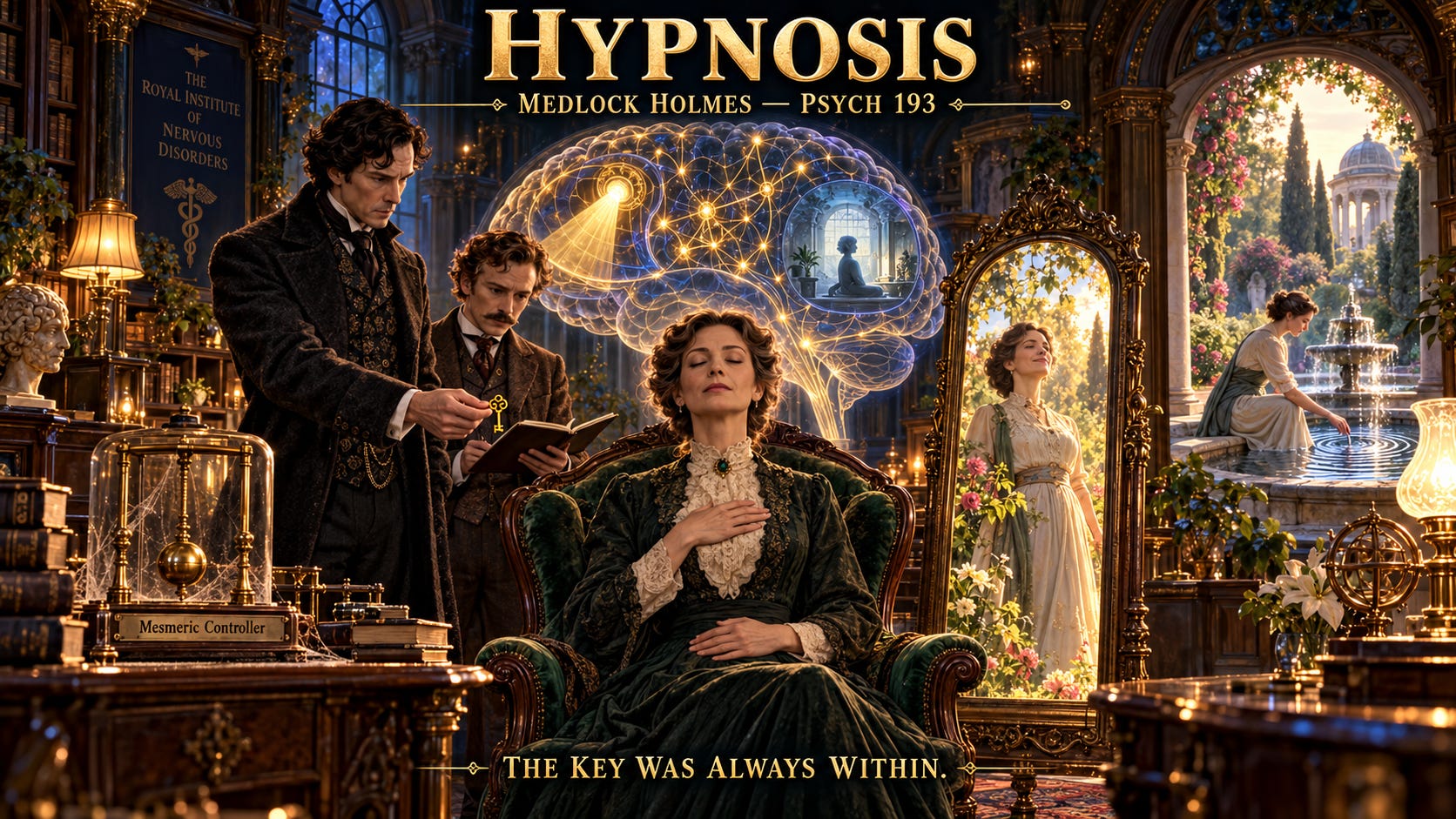
Medlock Holmes and the Unlocked Mind
The invitation arrived at Baker Street inside a black envelope sealed with crimson wax.
Mr Holmes, I require your assistance in a most extraordinary matter. A patient claims that her pain disappears when she is hypnotised, yet returns when she opens her eyes. My colleagues insist that she is either deceiving us or being deceived herself.
It was signed by Dr Nathaniel Vale, physician to the Royal Institute of Nervous Disorders.
Watson read the letter twice.
“Surely, Holmes, if a person can be made to feel no pain simply through suggestion, there must be some trick involved.”
“That, Watson, is precisely the assumption we must investigate.”
They arrived at the Institute to find a large auditorium. At its centre stood an ornate chair surrounded by brass instruments, a swinging pendulum and a peculiar machine labelled THE MESMERIC CONTROLLER.
“Good heavens,” Watson exclaimed. “What manner of apparatus is this?”
“A monument to misunderstanding, I suspect.”
Dr Vale introduced them to Mrs Eleanor Whitmore, a forty-two-year-old schoolteacher who had suffered persistent abdominal pain for several years. Investigations had identified irritable bowel syndrome, but the pain, bloating and fear of unpredictable symptoms had profoundly restricted her life.
“I have stopped visiting friends,” she explained. “I rarely travel. Even when the pain is mild, I spend the day waiting for it to return.”
Vale gestured towards the pendulum.
“During hypnosis, Mrs Whitmore reports that her abdomen becomes comfortable. Afterwards, the discomfort sometimes returns. I cannot explain it.”
Holmes examined the pendulum.
“Tell me, Doctor, does the pendulum possess medicinal properties?”
“Of course not.”
“Then why have you placed it at the centre of the treatment?”
“Because it induces the trance.”
“Or perhaps because it gives the audience something to watch.”
Holmes turned towards Mrs Whitmore.
“Madam, when you are reading a particularly absorbing novel, have you ever failed to notice someone calling your name?”
“Frequently.”
“And when you are deeply engaged in music, does time sometimes seem to pass differently?”
“Yes.”
“Then you already possess the capacity upon which hypnosis draws: focused attention, absorption and responsiveness to suggestion.”
Watson frowned.
“But surely she must surrender her will to the hypnotist?”
“Quite the opposite. Clinical hypnosis is not mind control. The patient’s participation is fundamental.”
Holmes removed the pendulum and invited Mrs Whitmore to sit comfortably.
“Would you be willing to try a brief exercise? You may stop whenever you wish.”
She agreed.
“Choose a place where you feel safe.”
“My grandmother’s garden,” she whispered.
“Describe it.”
“There are roses, an old stone bench and a fountain.”
“Attend to the sound of the water. Notice the movement of the leaves. Allow your attention to settle there.”
Her breathing became slower.
“Now imagine the muscles around your abdomen softening, like the surface of…
Web: drmanaankarray.substack.com


