

Notas do episódio
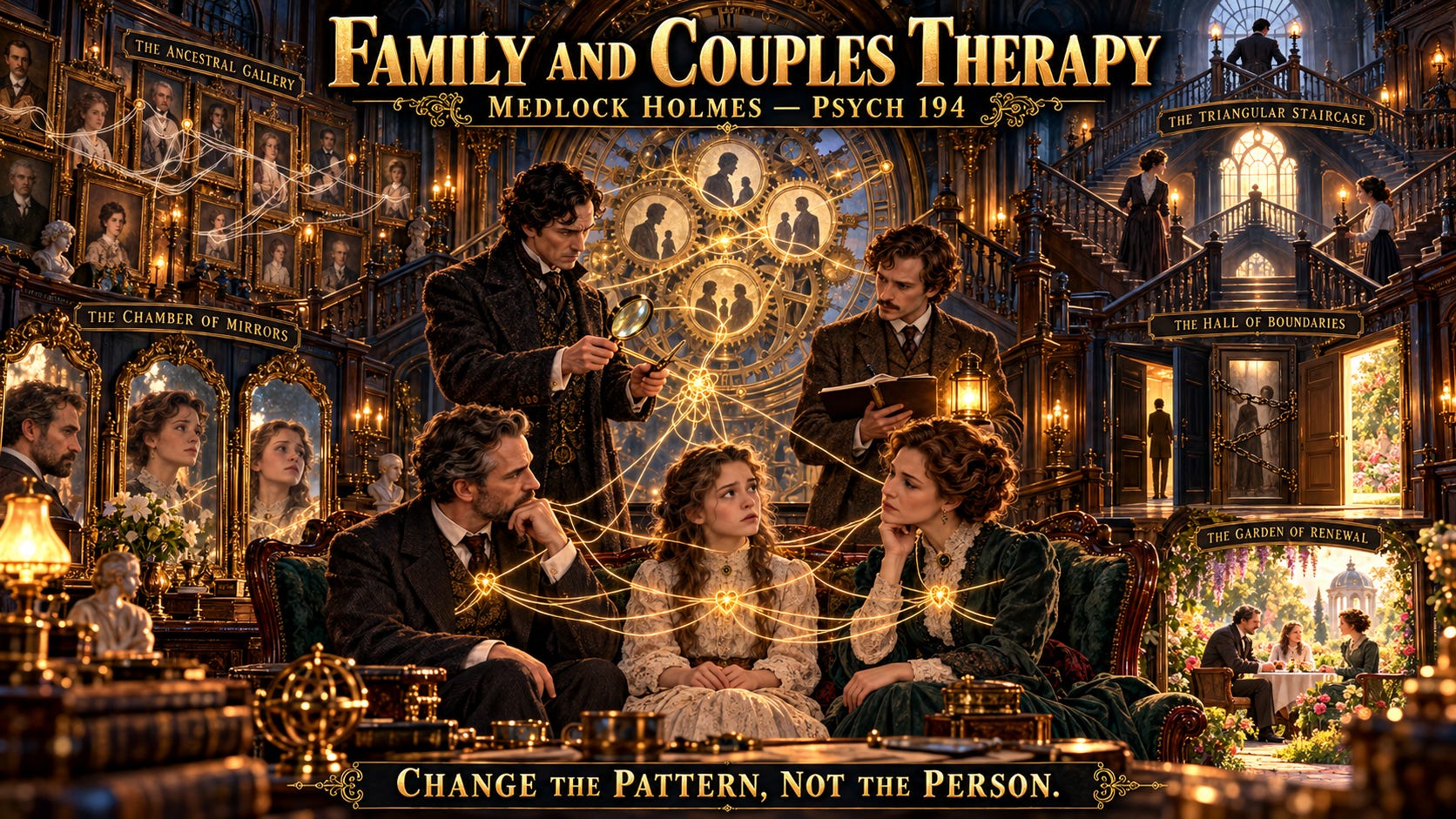
Medlock Holmes and the House of Invisible Threads
The telegram arrived at Baker Street shortly after midnight.
Mr Holmes, our daughter has become impossible. She refuses school, quarrels with her mother and spends her evenings locked in her bedroom. We have consulted three physicians. None has found a remedy. Please investigate.
It was signed by Mr Edmund Ashcroft of Blackthorn House.
“Another troubled adolescent,” Watson remarked.
“Perhaps,” replied Holmes. “But I am intrigued by the wording.”
“What wording?”
“Our daughter has become impossible. They have already identified the culprit before the investigation has begun.”
The following afternoon, Holmes and Watson arrived at Blackthorn House, a sprawling Victorian mansion overlooking the Thames.
Inside, they encountered an extraordinary sight.
The entrance hall contained an enormous clock, its intricate brass gears visible behind glass. Each gear was connected to another by fine silver threads. When one moved, several others shifted.
“A remarkable mechanism,” Watson observed.
“Indeed. Remember it.”
In the drawing room sat Edmund Ashcroft, his wife Margaret and their fifteen-year-old daughter, Clara.
“Clara is the problem,” Edmund announced. “She has missed twelve days of school.”
“Because I cannot bear being there,” Clara replied.
“She is being dramatic,” Margaret interrupted.
“You never listen!” Clara shouted.
Edmund rose.
“That is enough!”
Margaret turned towards Holmes.
“You see what we endure?”
Holmes raised his hand.
“Before we decide who is responsible, might I ask each of you what happens when Clara refuses school?”
Edmund answered first.
“I tell her she must attend.”
“And then?”
“Margaret intervenes.”
“Because he shouts at her!”
“And what happens next?”
“We argue,” Edmund admitted.
Clara looked towards the floor.
“And what do you do while your parents argue?” Holmes asked.
“I go upstairs.”
“Does the argument continue?”
“Usually not. They start worrying about me instead.”
Watson leaned forward.
“Then Clara’s difficulties have become the centre of the household.”
“Precisely,” Holmes said. “But we must be careful not to conclude that she is causing the conflict, or that the conflict is the sole cause of her distress. We are investigating a pattern, not assigning guilt.”
Holmes produced a sheet of paper and drew three circles.
The Ashcroft Family’s Repeating Cycle
Illustrative systemic formulation, not proof of the cause of Clara’s symptoms.
“Your family has been caught in a sequence,” Holmes explained. “Each person’s response influences what happens next.”
“So whose fault is it?” Edmund demanded.
“That is the wrong question.”
Holmes turned to Clara.
“When did school become difficult?”
“After Grandfather died. Then Father started working late, and Mother was always worried. I began feeling sick before school.”
Margaret’s eyes filled with tears.
“We never realised how frightened she was.”
“Families encounter transitions,” Holmes said. “Bereavement, adolescence, illness, retirement and the…
Site: drmanaankarray.substack.com

