

Poznámky k epizodě
In the current year, it certainly feels like we’re all hurtling into a Dystopian cyberpunk future. Doesn’t it?
Being chauffeured through a decaying urban center in a self-driving taxi is no longer an unsettling novelty. Your smartwatch vibrates as you doomscroll videos of soldiers fleeing drones across a forlorn battlefield, warning you that your heart rate variability is non-optimal. You take Nootropic cognitive enhancers for the edge you desperately need at work; hopefully the soulless megacorporation you work for won’t replace you with AI agents. An ad pops up for the exact thing you mentioned to your girlfriend, in bed last night, while you thought your phone was off.It’s not just you; it’s getting weirder out there—we’re just a few holidays away from your socially awkward cousin bringing a robot girlfriend home. (Yes, I just em-dashed—UNAPOLOGETICALLY—I em-dashed before AI did and will continue to dose my hyphens with Viagra whenever I damn well please).
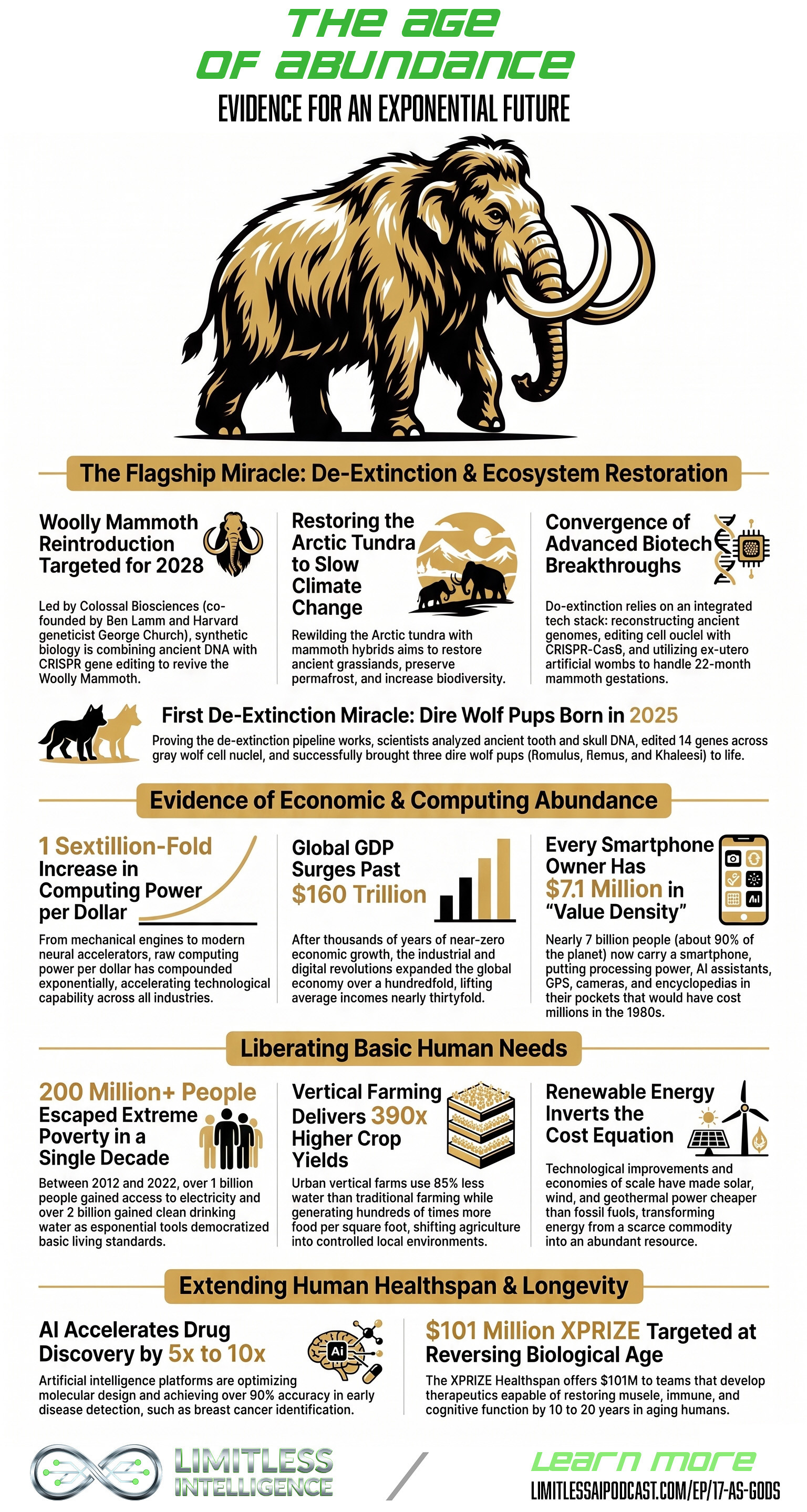
For decades, science fiction has issued us a warning: Don’t succumb completely to the siren song of technology. A warning we’ve collectively failed to heed. That siren song serenades us with the promise of abundance. Abundant energy, food, information, and health. Abundance that might just be... for all of us.
Like you, I don’t quite doomscroll, but often find myself mesmerized by and bemoaning the techno-absurdistan of modernity. It seems like everything, everywhere is getting worse--technology is making life for us humans too weird, too fast. But maybe the popular pessimism about progress (pervasive in nearly any media we consume and then confirmed by our anecdotal experiences) is dead wrong. As a pragmatic realist who leans optimistic when I can, I wanted a dose of optimism about the future, so I cracked open We Are As Gods, A Survival Guide for the Age of Abundance, by Peter H. Diamandis (whose face will probably appear if you do a Google: techno-optimist) and Steven Kotler, whose work on flowstate has been of keen interest to me as a Biohacker.
I got the dose of optimism I wanted from We Are As Gods, and I’ll second-hand deal it to you here. But I got more: inspiration to endure and aspire because--spoiler alert--the age of abundance is not for all, but for the avaricious.
We are as gods
Yes, really, as gods—lowercase g because the book opens with a comparison of dozens of godlike powers from our mythology to what modern technology now enables. Omniscience (all-knowing): you’ve now got that in your pocket with Google and the AI assistant on your phone. Omnipresence: as I broadcast my words, image, and voice to you wirelessly via the internet, I’m, in a sense, present there with you. The blind are made to see, and the deaf hear via neural implants. Resurrection of the dead--happens in hospitals all the time. And even immortality, an attribute long reserved for deities and demigods, is increasingly within the grasp of mere humans (take your NMN!)
Diamandis and Kotler introduce us to the…
Web: jonathanroseland.substack.com


