

Show notes
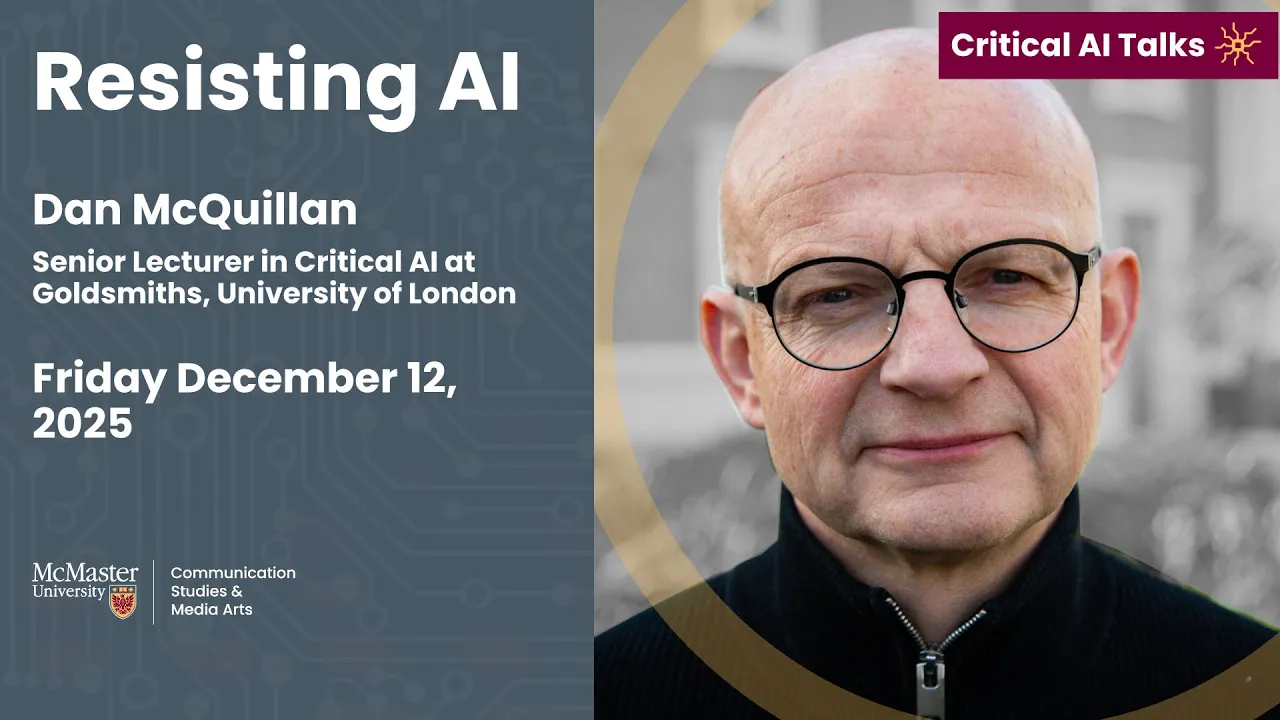
'Resisting AI' with Dan McQuillan
Technology and AI are often thought of as being neutral, objective, technical, or apolitical. Our conversation with Dan McQuillan will examine the political stakes of AI, asking what can and should be done—particularly by students and universities.
About the speaker
Dr. Dan McQuillan is a Senior Lecturer in Critical AI at Goldsmiths, University of London. After a Ph.D in Experimental Particle Physics, Dan worked with people learning disabilities & mental health issues, created websites with asylum seekers, ran social tech camps in Kyrgyzstan and Sarajevo and worked for Amnesty International and the NHS. He is the author of 'Resisting AI - An Anti-fascist Approach to Artificial Intelligence'.
About the series
Critical AI Talks invites leading AI researchers to explore the human and societal impacts of GenAI. Join us at this and other upcoming talks and learn more about the Critical AI Talks series here: https://csma.humanities.mcmaster.ca/our-community/critical-ai/
Timeline and notes
3:15 What is AI?
7:21 How is AI political?
- AI alters the distribution of power in the world, intensifying asymmetries of power
- perceptions of AI’s “objectivity” have shifted with the rise of GenAI; its failings are more on display
- AI is individualizing and thus extends neoliberalism; AI extends the politics of scarcity
- AI excises relationships and relationality; it is individualizing and de-relationalizing
- Predictive AI was tied to austerity
- AI does statistical redlining
- the fundamental operations of AI are based on correlation, not causation; they don’t have an understanding of ‘ground truth’ and context, what is really going on; instead it can find a group or sub-group or set of identities that can be blamed for the situation; it’s an “automated stigmatization” and, as such, dangerous in the hands of institutions and forms of politics that are keen on stigmatization
21:31 How is AI “brittle” or fragile?
- AI can break down in many ways
- AI relies on a huge amount of data, missing data is a “giant game of whack-a-mole”;
- People can deal with the unexpected but AI can’t
engineers are quite open about the fact that they don’t know what’s going on “under the hood”; we’re part of a giant social experiment
- Artificial General Intelligence is the goal of AI companies—an idea based in eugenics, white and masculine supremacy, and engenders a “closed loop” that fuses with global extractivism to keep itself going.
30:55 The usual remedies proposed to solve the problems of AI are inadequate:
- technosolutionism; efforts to de-bias AI, the data and number of parameters is too vast and - the world is too complex to “debias” without creating new distortions
- the problems with explainability and laws that require an explanation for decisions made by AI
- the inadequacy of having a “human in the loop”
- the inadequacy of legislation
- the problem with the false citations tied to AI search results
40:30 What should be done?…
Website: podqueue.fm
