

Rotary vs Reciprocating Files – The Endo Showdown with Samuel Johnson Part 1 – PDP270
· 44 dk · Bölüm 1
Bölüm notları
🦷 Plaque Friday™ is here!
Get 20% off Protrusive Guidance Ultimate for as long as you stay, plus 7 days free to try it. That’s every masterclass, AskJaz, verifiable CPD on hundreds of podcast episodes, and our new live series Caries, Cracks and Contact Points with Dr Ronit Patel. Use code PF26 at checkout. Ends Monday 30 November, 11:59pm UK.
👉 https://protrusive.co.uk/plaquefriday
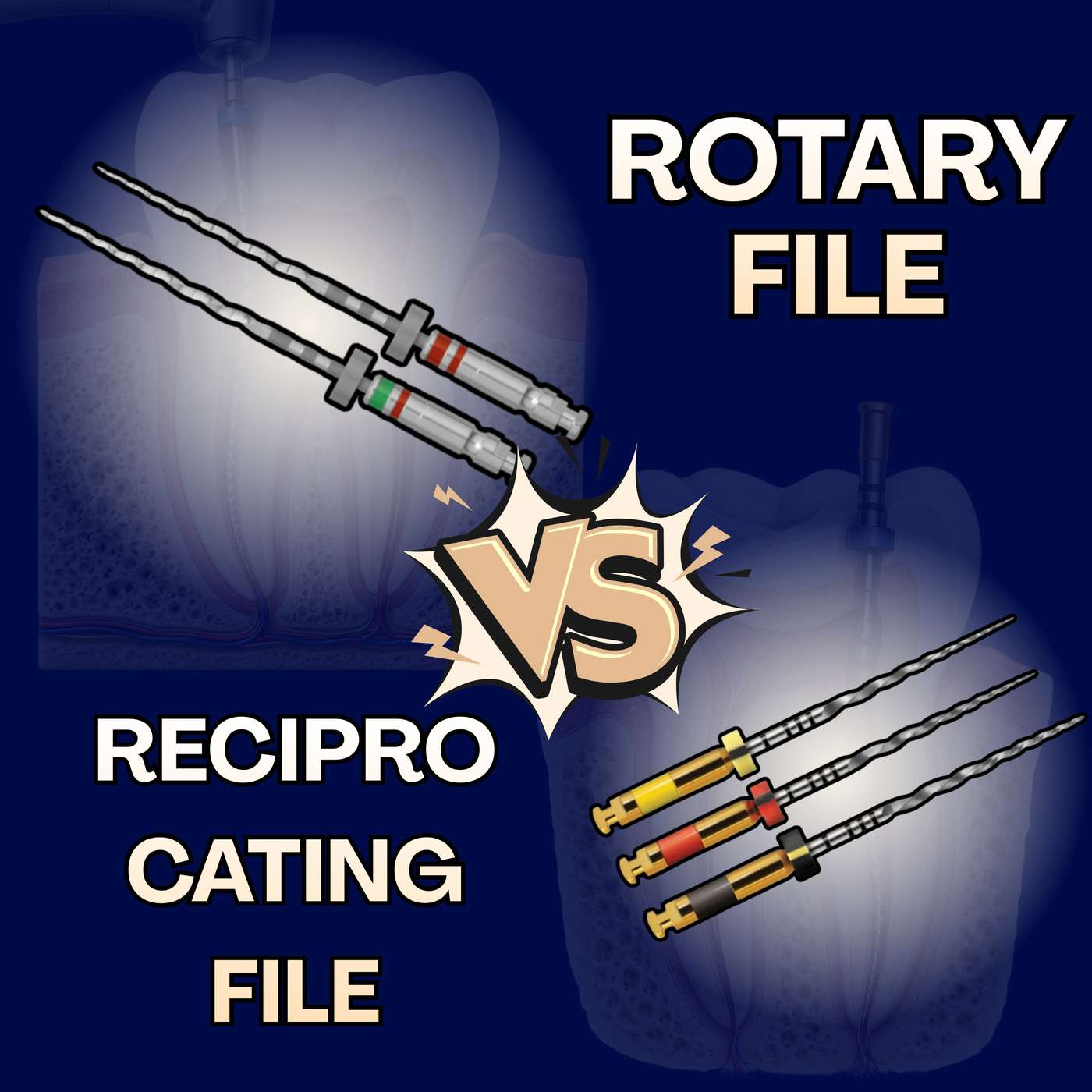
Rotary or reciprocating files — which should you actually be using?
Is one safer than the other? Does reciprocation really reduce file separation? Are you choosing your system because it suits the canal anatomy, or because it is simply the one you were taught?
Endodontic file systems can feel like a maze of brands, tapers, alloys, motions and marketing claims. But beneath all that noise, the real question is much more practical: what is your file doing inside the canal, and what compromise are you accepting?
In this episode, Dr Samuel Johnson returns to unpack the Endo Showdown: rotary versus reciprocating files. We cover file motion, glide paths, shaping philosophy, NiTi metallurgy, cyclic fatigue, torsional fatigue, and why no system is perfect.
https://youtu.be/HfWDBbNgjsA
Watch PDP270 on YouTube
Protrusive Dental Pearl
A palliative root canal can be useful for an unrestorable tooth if disinfecting the canal allows infection to heal and natural bone to recover before extraction and future implant planning.
⚠️ Do not dismiss root canal treatment purely because the tooth is not a long-term functional restoration.
✅ Where appropriate, consider whether endodontic disinfection could improve the future implant site by allowing natural bone healing.
Key Takeaways
• The purpose of shaping is not simply to scrape canal walls; it is to create space for irrigant flow.
• Irrigation is the most important part of root canal disinfection.
• Rotary files move in a continuous 360-degree rotation.
• Reciprocating files cut in one direction and reverse before excessive stress builds up.
• Modern reciprocation is designed to cut, release and gradually progress apically.
• File choice is not just about motion; metallurgy, taper, design and operator experience all matter.
• NiTi hand files with strong shape memory may be problematic in curved canals because they want to straighten.
• Martensitic heat-treated files are more flexible and can better follow canal curvature.
• Unwinding flutes are a warning sign that a file may be close to separation.
• Inspect files regularly during treatment, especially in curved, calcified or difficult canals.
• A glide path is essential before introducing larger rotary or reciprocating files.
• Without a glide path, a shaping file may create its own path, risking ledging, transportation or perforation.
• “Grabby” files pull themselves into the canal; this can be useful in experienced hands but risky if forced.
• Reciprocating systems can feel simpler and safer, but they are not foolproof.
• Cyclic fatigue happens when a file repeatedly bends around a…
Web sitesi: share.transistor.fm


