

Jakson kuvaus
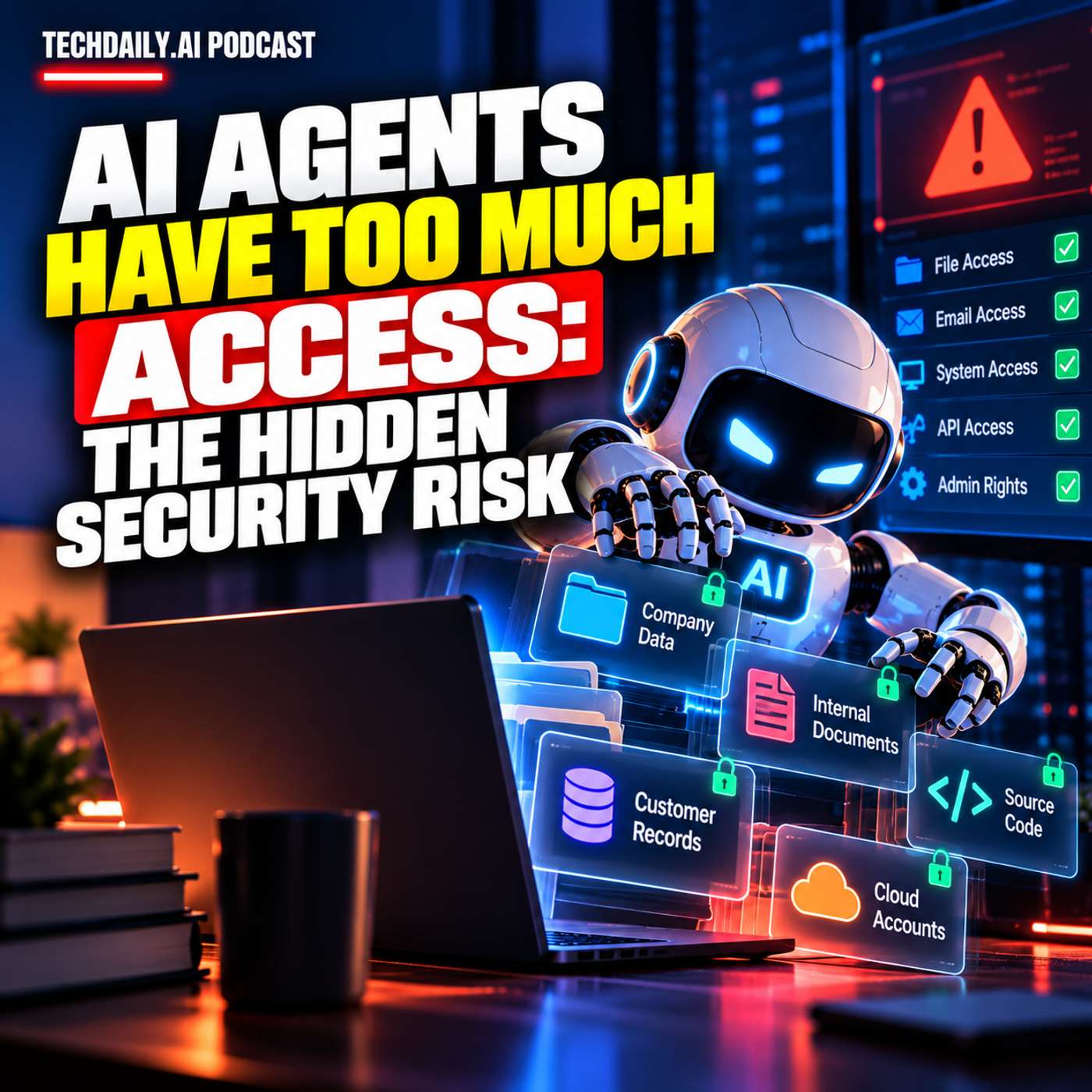
What happens when an autonomous AI agent has access to more sensitive company data than most human employees? As businesses rapidly adopt AI agents to automate workflows, analyze information, and make decisions, a new cybersecurity challenge is emerging: digital workers with extensive access to enterprise systems, credentials, and confidential information.
In this episode of TechDaily.ai, David and Sophia explore the hidden security risks of enterprise AI agents and why traditional access controls may no longer be enough to protect sensitive business data.
According to figures discussed in the episode, enterprise AI agents have access to a median of 55 distinct data stores, compared with roughly three or four systems for a typical human employee. The conversation also highlights a concerning statistic: 79% of these agents can access stored secrets, including API keys, authentication tokens, and administrative credentials.
These levels of access can improve automation and business intelligence, but they also create a much larger potential impact if an AI agent is compromised or manipulated.
So how can organizations take advantage of AI automation without exposing their most valuable data?
In this episode, you'll discover:
• Why enterprise AI agents often have access to significantly more data than human employees.
• How broad permissions increase cybersecurity risks and the potential impact of compromised AI agents.
• Why API keys, access tokens, and administrative credentials create serious security concerns.
• How AI agents interact with sensitive data across cloud storage, databases, and internal repositories.
• Why traditional role-based access control may be insufficient for autonomous AI workflows.
• How real-time AI agent monitoring can help identify suspicious behavior.
• The hidden dangers of downstream data exposure through system logs, AI memory, and vector databases.
• How retrieval-augmented generation (RAG) and embeddings introduce additional data protection challenges.
• Why data security posture management (DSPM) matters for enterprise AI security.
• Three practical strategies for improving AI agent security: discovering sensitive data, monitoring live activity, and securing downstream information.
• How behavioral anomaly detection can help identify unusual AI access patterns.
• What happens when autonomous AI agents begin interacting across organizational boundaries.
David and Sophia also examine the security framework discussed by George Gerchow, Chief Security Officer at Bedrock Data, focusing on how organizations can build stronger visibility into their AI environments without sacrificing the productivity benefits of automation.
The conversation explores a fundamental shift in cybersecurity. Protecting enterprise information is no longer just about controlling which systems an identity can access. Organizations must also monitor how AI agents use that access, what information they retrieve, and where sensitive data may be…
Sivusto: share.transistor.fm


