
Episodebeskrivelse
What happens when AI agents generate software faster than traditional development infrastructure can handle? As AI coding tools accelerate software production, systems originally designed for human developers are facing an entirely new challenge: keeping up with machine-speed engineering.
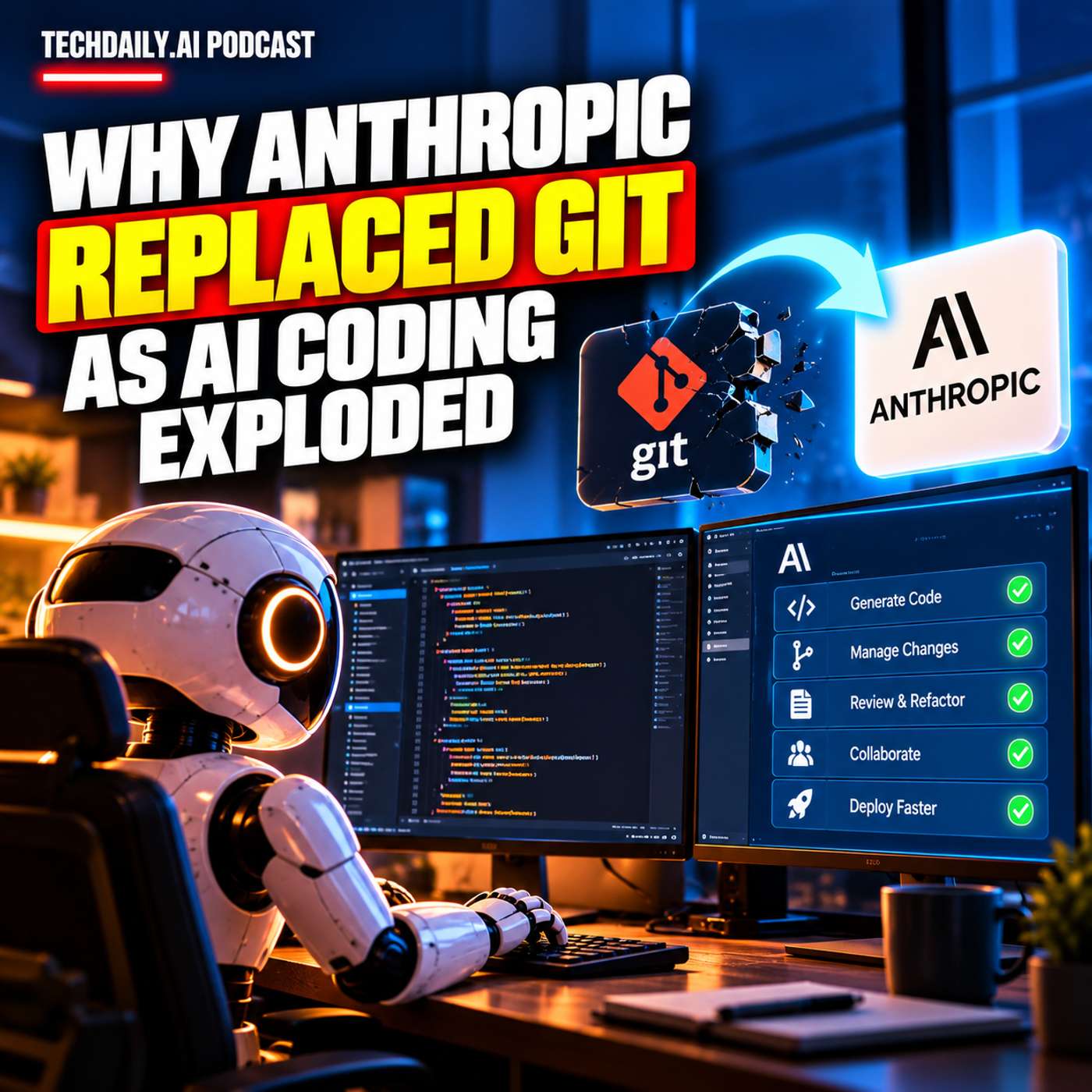
In this episode of TechDaily.ai, David and Sophia explore how Anthropic's rapid adoption of AI coding agents pushed its version control infrastructure beyond traditional limits, leading to the development of Scion, a custom-built alternative to Git.
The conversation examines a dramatic increase in software development activity, from approximately 2,500 daily code changes in May 2026 to more than 30,000 by September 2026, according to the figures discussed in the episode. With engineers managing multiple AI agents simultaneously, the demand for repository checkouts, code merges, and automated testing created infrastructure challenges that conventional scaling approaches struggled to address.
Why was Git no longer enough? And what happens when AI-generated code begins overwhelming the very systems responsible for managing it?
In this episode, you'll discover:
• How AI coding agents are changing the speed and scale of software development.
• Why Anthropic reportedly experienced a massive increase in daily code changes.
• How Git's distributed architecture can create inefficiencies for always-connected AI agents.
• Why traditional Git mirrors and horizontal scaling can encounter hardware limitations.
• How Anthropic's Scion architecture separates repository metadata from file storage.
• The roles of Rust, Google Spanner, and Google Cloud Storage in the system described.
• How content-addressed storage helps reduce duplication and improve efficiency.
• Why Anthropic developed Antique as a companion code review platform.
• How AI-assisted migration and automated error correction can change infrastructure management.
• How Scion compares with version control systems such as Google's Piper and Meta's Sapling.
• The open-source attribution controversy discussed in connection with Scion and the Bonsai data model.
• What AI-driven infrastructure challenges could mean for industries beyond software development.
David and Sophia also examine a broader shift in engineering: as AI agents take over more coding, testing, and maintenance work, human developers increasingly become orchestrators of automated systems rather than individual contributors writing every line of code themselves.
But this transformation introduces difficult questions about infrastructure reliability, technical complexity, and open-source collaboration.
If AI companies depend on community-developed technologies to build increasingly powerful proprietary systems, what responsibilities do they have to acknowledge and contribute to the projects that helped make those systems possible?
And as AI agents begin designing and maintaining more of the infrastructure they depend on, could software systems…
Website: share.transistor.fm
