
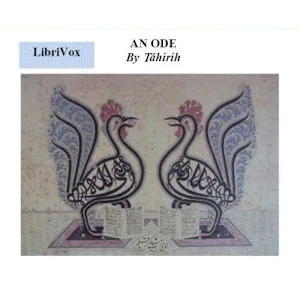
About this book
LibriVox volunteers bring you 13 recordings of An Ode by Táhirih (Fátimih Baraghání) (1814/1817 – 1852), Translated by Edward Granville Browne (1862 – 1926). This was the Fortnightly Poetry project for February 7th, 2010.
Fátimih Baraghání (1814/1817 – 1852), also known by the titles of Táhirih (Arabic for “The Pure One”) and Qurratu’l-‘Ayn (Arabic for “Consolation of the Eyes”) was an influential Iranian poet and Bábí heroine from the town of Qazvín. Her legacy is important to Bahá’ís, as well as supporters of women’s rights in Iran. In 1844, she became the seventeenth disciple or “Letter of the Living” of the Báb (1819-1850). As the only woman in this initial group of disciples, she is often compared to Mary Magdalene. From June-July 1848, she attended the Conference of Badasht where she appeared without a veil in public (a shocking statement of women’s rights) and declared that a new religious dispensation had been inaugurated. Coincidentally, shortly after this, the Seneca Falls Convention (an important women’s rights convention) was held in New York on the 19th-20th of July, 1848. She was executed in Tehran in 1852. Before her death, she said that although she would be killed, they could not stop the emancipation of women. Edward Granville Browne described her thus: “The appearance of such a woman as Qurratu’l-‘Ayn is in any country and any age a rare phenomenon, but in such a country as Persia it is a prodigy—nay, almost a miracle. Alike in virtue of her marvellous beauty, her rare intellectual gifts, her fervid eloquence her fearless devotion, and her glorious martyrdom, she stands forth incomparable and immortal amidst her countrywomen.” This poem is a ghazal composed in the Kámil metre. A ghazal may be understood as a poetic expression of both the pain of loss or separation and the beauty of love in spite of that pain. Browne notes that this poem appears to be addressed to the Báb. Browne made a versified translation of the poem, which first appeared in the J.R.A.S. in 1899. (Summary by Nicholas James Bridgewater)
Chapters
The next chapter starts by itself. Your place is remembered in this browser.
- 1Version 11:53 · read by Adib Masumian
- 2Version 21:56 · read by Corun
- 3Version 32:06 · read by Cori Samuel
- 4Version 41:55 · read by Algy Pug
- 5Version 51:56 · read by David Lawrence
- 6Version 62:14 · read by JimOCR
- 7Version 71:58 · read by L. Lambert Lawson
- 8Version 82:05 · read by Marc Rocher
- 9Version 92:23 · read by Nicholas James Bridgewater
- 10Version 103:00 · read by Naseem
- 11Version 112:17 · read by Ruth Golding
- 12Version 122:07 · read by Romane
- 13Version 132:22 · read by ravenotation
You may also like
 Year Amongst the PersiansEdward Granville Browne29 h 8 min
 Divine ComedyDante Alighieri12 h 23 min
 Beowulf (version 2)Unknown2 h 45 min
 BeowulfUnknown2 h 52 min
 Poems Every Child Should KnowMary E. Burt, Various8 h 7 min
 Christmas Poetry and Hymn CollectionVarious1 h 25 min
 RavenEdgar Allan Poe10 min
 Canterbury TalesGeoffrey Chaucer19 h 23 min

