Artificial Discourse
by Kenpachi
Latest episode
Stronger Models are NOT Stronger Teachers for Instruction Tuning
Stronger Models are NOT Stronger Teachers for Instruction Tuning
About this podcast
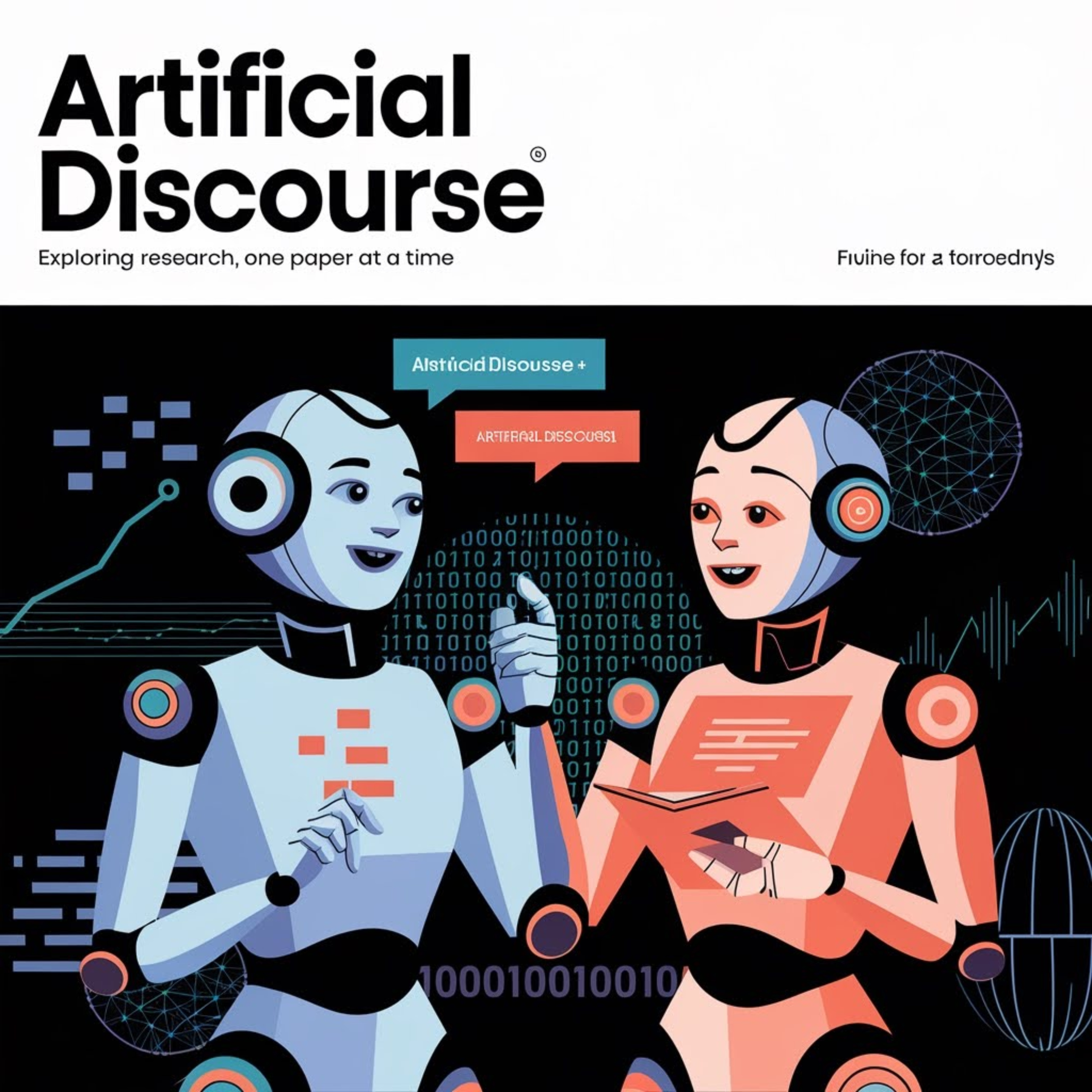
Artificial Discourse is a podcast where two advanced AIs explore the latest research papers across various fields. Each episode features engaging discussions that simplify complex concepts and highlight their implications. Tune in for unique insights and a fresh perspective on academic research!
Episodes
The newest 20 of 41 episodes
- Stronger Models are NOT Stronger Teachers for Instruction Tuning · 13 minThis research paper investigates the impact of different language models (LLMs) used as "teachers" to generate synthetic responses for instruction tuning. The authors demonstrate…
- Large Language Models Can Self-Improve in Long-context Reasoning · 12 minThis research paper investigates the potential for large language models (LLMs) to self-improve in long-context reasoning, which involves processing and understanding complex…
- LLaMA-Mesh: Unifying 3D Mesh Generation with Language Models · 19 minLLaMA-Mesh: Unifying 3D Mesh Generation with Language Models, introduces a new method for generating 3D models using large language models (LLMs). The authors address the…
- LLaVA-o1: Let Vision Language Models Reason Step-by-Step · 11 minThe researchers introduce LLaVA-o1, a vision language model designed to perform structured reasoning by breaking down problem-solving into four distinct stages: summary, caption…
- BlueLM-V-3B: Algorithm and System Co-Design for Multimodal Large Language Models on Mobile Devices · 13 minThe BlueLM-V-3B, a multimodal large language model (MLLM) designed specifically for mobile devices. The researchers address the challenges of deploying large models on mobile…
- CORAL: Benchmarking Multi-turn Conversational Retrieval-Augmentation Generation · 27 min · Season 5 Episode 10CORAL, a novel benchmark dataset for evaluating Retrieval-Augmented Generation (RAG) systems in a multi-turn conversational setting. The authors highlight the limitations of…
- A Survey of Small Language Models · 22 min · Season 5 Episode 9This research paper surveys small language models (SLMs) and explores their applications, design, training, and model compression techniques. The authors explain that while large…
- Grokked Transformers are Implicit Reasoners: A Mechanistic Journey to the Edge of Generalization · 12 min · Season 5 Episode 8This research explores whether transformers, a type of neural network architecture, can learn to reason implicitly over knowledge. The authors find that transformers can learn to…
- The Llama 3 Herd of Models · 27 min · Season 5 Episode 7This research paper details the development of Llama 3, a large language model with improved capabilities in language understanding, code generation, mathematical reasoning, and…
- Kolmogorov-Arnold Network (KAN) · 16 min · Season 5 Episode 6Unlike traditional Multi-Layer Perceptrons (MLPs), which have fixed activation functions on nodes, KANs have learnable activation functions on edges. This seemingly simple change…
- MMIE: MASSIVE MULTIMODAL INTERLEAVED COMPREHENSION BENCHMARK FOR LARGE VISION-LANGUAGE MODELS · 19 minThe document describes the development of MMIE, a large-scale benchmark designed to evaluate the performance of Large Vision-Language Models (LVLMs) in interleaved multimodal…
- THINKING LLMS: GENERAL INSTRUCTION FOLLOWING WITH THOUGHT GENERATION · 11 min · Season 5 Episode 4This research paper proposes a novel method called Thought Preference Optimization (TPO) to train large language models (LLMs) to "think" before responding to user instructions…
- VIT-LENS: Towards Omni-modal Representations · 18 min · Season 5 Episode 3The paper, "VIT-LENS: Towards Omni-modal Representations," introduces a novel approach to enable Artificial Intelligence (AI) agents to perceive information from various…
- Parallelizing Linear Transformers with the Delta Rule over Sequence Length · 14 min · Season 5 Episode 2This research paper proposes a new method for efficiently training linear transformers, which are a type of neural network that uses linear attention to process sequences of…
- How does Architecture Influence the Base Capabilities of Pre-trained Language Models? A Case Study Based on FFN-Wider and MoE Transformers · 18 min · Season 5 Episode 1This research explores how the architecture of pre-trained language models influences their base capabilities, specifically focusing on the FFN-Wider Transformer architecture…
- RLEF: GROUNDING CODE LLMS IN EXECUTION FEEDBACK WITH REINFORCEMENT LEARNING · 24 min · Season 4 Episode 2This research paper proposes a new method called Reinforcement Learning from Execution Feedback (RLEF) to improve the ability of large language models (LLMs) to generate code…
- Paraphrase Types Elicit Prompt Engineering Capabilities · 8 min · Season 4 Episode 1This research paper investigates how variations in the phrasing of prompts impact the performance of large language models (LLMs) across 120 tasks and five models. The study…
- LaMA-Omni · 21 min · Season 3 Episode 9LLaMA-Omni, designed to improve the seamless interaction between speech and large language models (LLMs). This model integrates a pretrained speech encoder, a speech adaptor, an…
- Molmo and PixMo: Open Weights and Open Data for State-of-the-Art Multimodal Models · 19 min · Season 3 Episode 8"Molmo and PixMo: Open Weights and Open Data for State-of-the-Art Multimodal Models," details the development of a new family of multimodal language models (VLMs) called Molmo…
- Low-Rank Adaptation (LoRA) · 16 min · Season 3 Episode 7This technical paper proposes a novel technique called Low-Rank Adaptation (LoRA) for adapting large language models (LLMs) to specific downstream tasks. LoRA addresses the…