

Note de episod
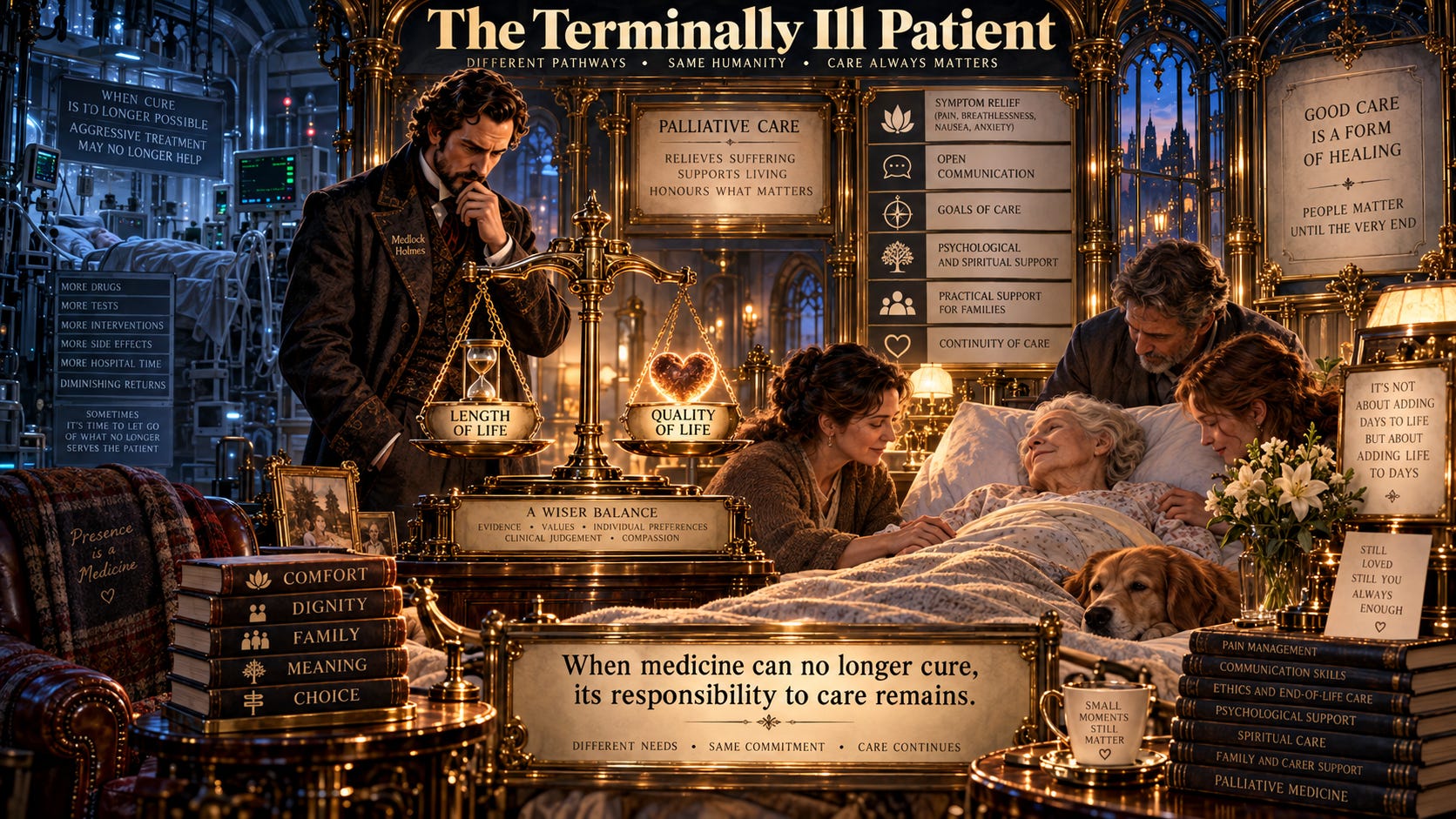
Medlock Holmes enters The Last Ward, a quiet wing of the hospital where medicine appears to be running out of doors.
Behind the patients lie operating theatres, chemotherapy suites, dialysis machines and intensive-care units. Ahead lies a doorway that medicine cannot ultimately prevent anyone from reaching.
But Holmes immediately notices something important.
The doctors have not disappeared.
Neither has psychiatry.
Because when cure becomes impossible, there remains an enormous amount to treat.
PAIN • FATIGUE • ANXIETY • DEPRESSION • DELIRIUM • FEAR • CONFLICT • LONELINESS • LOSS • MEANING
The central transition in terminal care is therefore not:
TREATMENT → NO TREATMENT
It is:
CURE-FOCUSED CARE → COMFORT-FOCUSED CARE
The goals change.
Instead of asking only, How can we prolong life?, clinicians increasingly ask:
How can this person live as well as possible within the life that remains?
This is where psychiatry becomes particularly important.
Dying is simultaneously biological, psychological, relational, cultural, spiritual and existential. The psychiatrist therefore works not simply with a diagnosis but with an entire human system:
PATIENT ↔ FAMILY ↔ MEDICAL TEAM
Holmes first encounters pain.
Pain is physical, but suffering is larger than pain. Anxiety can intensify pain. Depression can reduce tolerance of it. Fear may magnify bodily sensations. Family distress can increase the patient’s distress. Poor communication can leave symptoms undertreated.
The psychiatrist can therefore help the team understand that effective pain management requires attention to both physiology and meaning.
Beside pain lies fatigue, one of the most pervasive symptoms of advanced illness. It may contain physical, cognitive, emotional and motivational components. Disease, anaemia, medication, malnutrition, sleep disturbance and depression may all contribute.
The mistake is to force fatigue into a false choice:
PHYSICAL OR PSYCHOLOGICAL?
In terminal illness, it is frequently both.
Holmes then enters the room of anxiety.
Dying patients may experience fear of pain, breathlessness, dependency, separation, abandonment, loss of control or death itself. Anxiety may appear as restlessness, insomnia, nausea, tremor, tachycardia or shortness of breath rather than as the word anxiety.
Some fears can be treated.
Others must be understood.
A person frightened of dying does not necessarily have an anxiety disorder.
The psychiatrist’s task is not to pathologise mortality.
It is to identify when understandable fear has become overwhelming, when physical illness or medication is contributing, and what can realistically be relieved.
Then comes depression, one of the most difficult diagnostic problems in terminal illness.
Many ordinary depressive criteria overlap with advanced disease:
APPETITE ↓ • WEIGHT ↓ • ENERGY ↓ • SLEEP DISTURBED • CONCENTRATION ↓
Holmes therefore places greater weight on psychological evidence:
ANHEDONIA • HOPELESSNESS • WORTHLESSNESS • GUILT • PERSISTENT DESPAIR…
Site: drmanaankarray.substack.com


