

Show notes
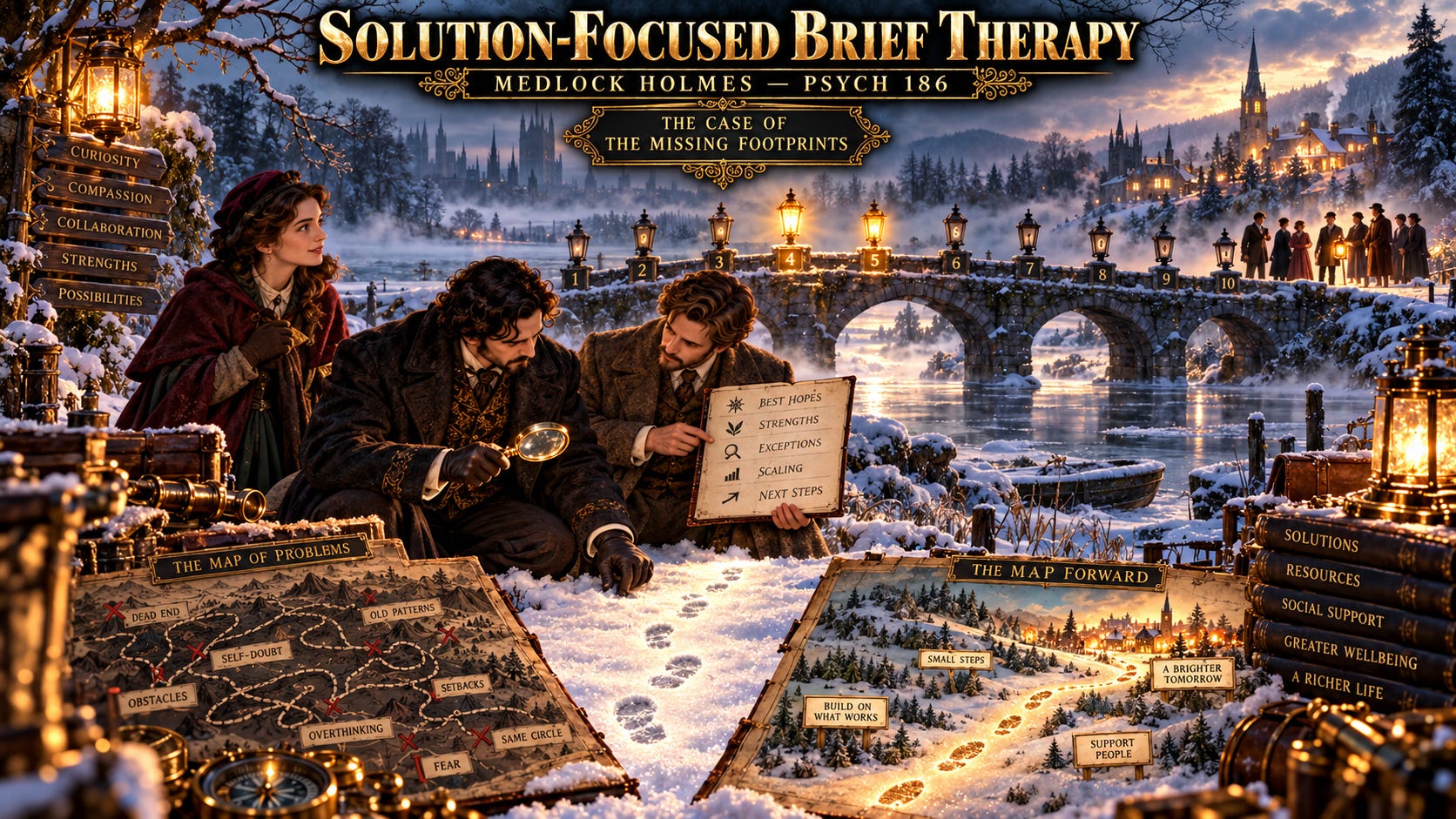
but to learn how to navigate through them.
The telegram arrived at Baker Street shortly before midnight.
Urgent assistance required. Repeated emergencies at Blackwater Lighthouse. Keeper in considerable distress. Conventional interventions unsuccessful.
Dr Watson folded the paper.
“Another crisis, Holmes. Shall we prepare for the worst?”
“Let us prepare to understand it,” replied Medlock Holmes.
They reached the lighthouse during a violent storm. Waves struck the rocks, lightning illuminated the cliffs, and from the lantern room came the sound of breaking glass.
Inside sat a young woman named Eleanor, her hands trembling.
“I have tried everything,” she whispered. “When people leave, I feel as though I am being torn apart. Sometimes I do things to stop the pain. Afterwards, I hate myself even more.”
Watson noticed a series of damaged instruments around the room.
“She must learn to control herself,” he said quietly.
Holmes raised a hand.
“That may be precisely what everyone has been telling her. And perhaps precisely why she has stopped believing anyone understands.”
Eleanor looked up.
“People always tell me I’m too sensitive. That I overreact. That I should simply calm down.”
Holmes approached the lighthouse window.
“Imagine, Miss Eleanor, that your nervous system is a lighthouse exposed to unusually violent storms. Its alarms sound earlier, its flames burn brighter, and the winds take longer to subside. Now imagine that, throughout your life, the people responsible for maintaining the lighthouse repeatedly told you there was no storm.”
Eleanor stared at him.
“Then how would I ever learn to trust the instruments?”
“Exactly.”
Holmes turned to Watson.
“Marsha Linehan called this the biosocial theory. Emotional vulnerability and an invalidating environment may interact over time, contributing to difficulties regulating emotions. It is a model for understanding suffering, not an accusation against the patient or her family.”
At that moment, a bell rang.
A message had arrived from Eleanor’s former partner.
She read it, her breathing quickened, and she moved towards the door.
“I cannot stand this feeling!”
Holmes did not argue with her emotion.
“Your pain is real,” he said. “And we must find a way to respond that does not create further suffering.”
Watson looked puzzled.
“You are accepting her feelings, Holmes, yet asking her to change her behaviour.”
“Both can be true, Watson. That is the dialectic.”
He drew two words on the dusty window:
ACCEPTANCE ↔ CHANGE
“To accept an emotion is not to approve every action it urges. And to change an action is not to deny the emotion that preceded it.”
Holmes then revealed four chambers within the lighthouse.
The first was the Observatory, where Eleanor would learn mindfulness: noticing thoughts, emotions and sensations without immediately obeying them.
The second was the Storm Shelter, where she would practise distress tolerance: surviving emotional crises without making them worse.
The third was the Engine Room…
Website: drmanaankarray.substack.com


