

Notes d’épisode
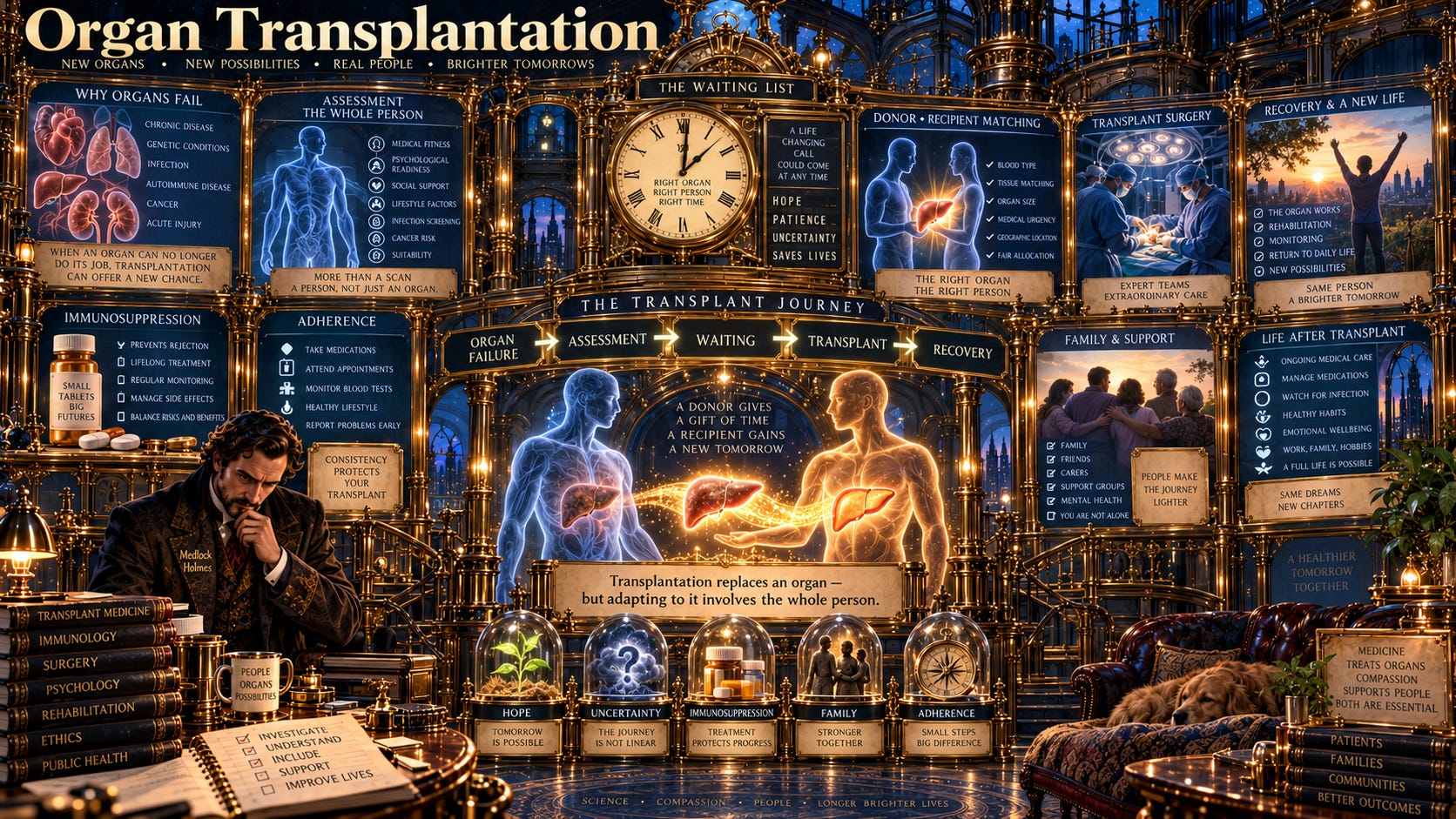
recovery and life with a transplanted organ.
Medlock Holmes enters The Hall of Second Lives.
At its centre stands an enormous clock. Around it wait patients with failing hearts, lungs, livers and kidneys. Above them hangs a second clock whose hands move unpredictably.
No one knows when an organ will become available.
For some, it will arrive in time.
For others, it will not.
Holmes immediately understands that transplantation is unlike most medical treatments. The patient is not simply preparing for an operation. They must live with severe illness while waiting for an unpredictable event upon which their survival may depend.
The psychological journey therefore begins long before surgery:
ORGAN FAILURE → ASSESSMENT → WAITING → TRANSPLANT → RECOVERY → LIFELONG ADAPTATION
Each stage creates different psychiatric challenges.
The first chamber is the Assessment Room.
Because donor organs are scarce, transplant teams must decide not simply whether transplantation is medically possible, but whether the patient is sufficiently prepared for everything that follows.
The psychiatrist is therefore asked unusual questions.
Does the patient understand transplantation?
Do they actually want it?
Can they adhere to complex treatment?
How have they managed previous medical care?
Is there active psychiatric illness?
Is substance use present?
What coping strategies do they possess?
Who will support them?
And can that support survive months or years of uncertainty?
Holmes writes on the assessment board:
UNDERSTANDING • MOTIVATION • ADHERENCE • MENTAL HEALTH • SUBSTANCE USE • COGNITION • COPING • SOCIAL SUPPORT
A psychiatric diagnosis alone does not answer the question of transplant suitability.
The clinically important issue is often:
How will this condition affect the patient’s ability to navigate transplantation - and can that risk be reduced?
Someone with depression may still be an excellent transplant candidate if their illness is recognised and treated.
A previous substance-use disorder does not automatically determine future behaviour.
A history of nonadherence requires understanding why the nonadherence occurred.
Psychiatric assessment therefore becomes both evaluation and intervention.
Then Holmes enters the Waiting Room.
It is perhaps the strangest room in medicine.
Patients are sick enough to need a new organ but must remain well enough to survive until one becomes available.
Every telephone call might be the call.
Every deterioration might mean they have become too ill for transplantation.
Patients can experience:
HOPE ↔ FEAR
ANTICIPATION ↔ DREAD
LIFE ↔ DEATH
Chronic illness may already have taken employment, independence, relationships and ordinary family roles.
The waiting period adds profound uncertainty.
Depression, anxiety, avoidance and grief can emerge.
Families wait too.
Then the telephone rings.
The doors to the operating theatre open.
After transplantation, Holmes expects relief.
Instead, he discovers another paradox.
TRANSPLANTATION DOES NOT…
Site web: drmanaankarray.substack.com

