

PSYCH 159: Borderline Intellectual Functioning and Academic or Educational Problems
· 51 min · Saison 13 Épisode 159
Notes d’épisode
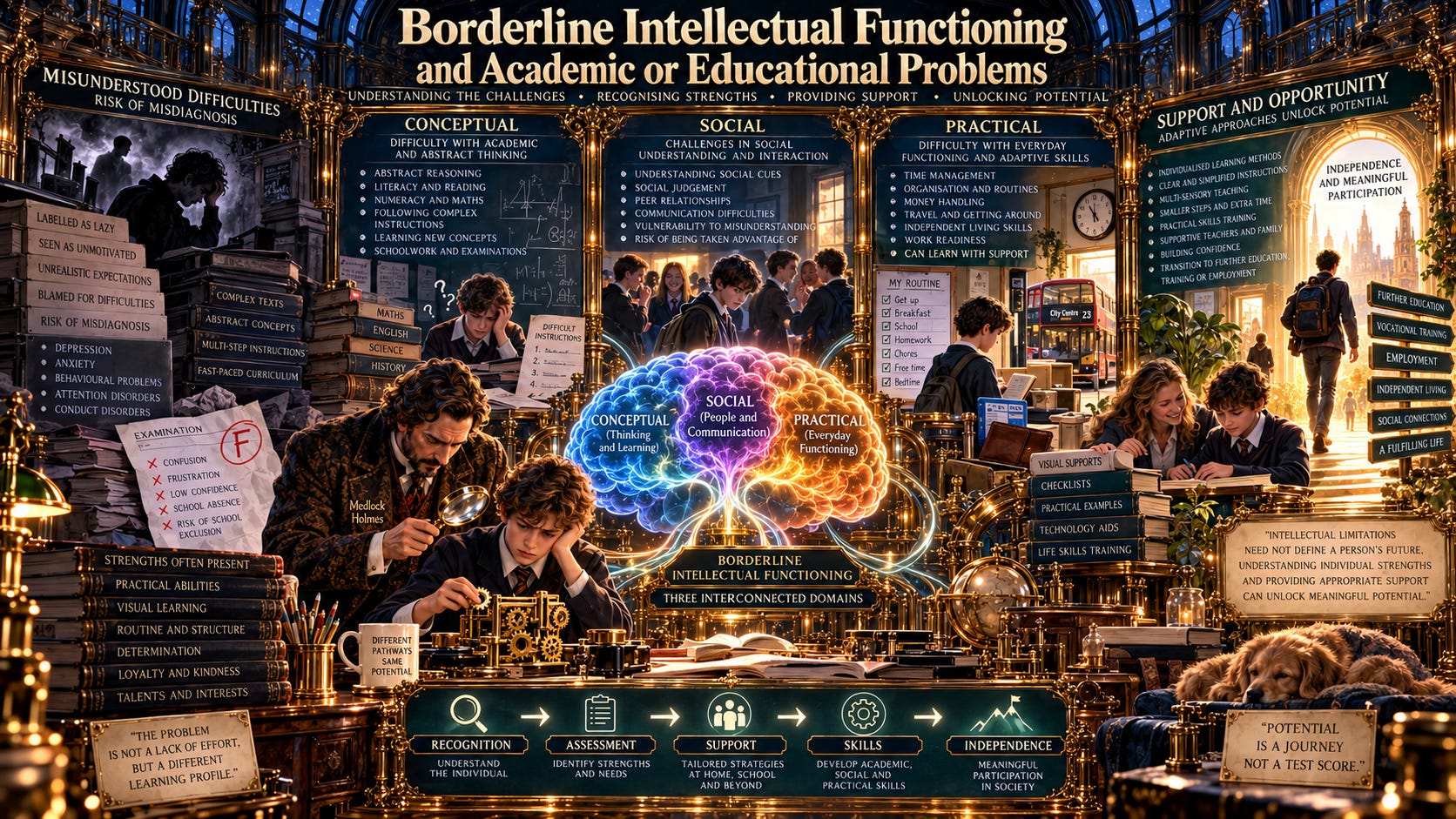
The Mystery of the Invisible Barrier
Medlock Holmes enters The Academy of Hidden Potential, where a puzzling pattern has emerged.
Some students struggle despite enormous effort. Others appear articulate yet cannot manage everyday responsibilities. A few have been labelled inattentive, oppositional or unmotivated, although repeated treatments have failed.
Holmes discovers that the difficulty may lie not in willingness, but in the interaction between intellectual capacity, adaptive functioning and environmental expectations.
His investigation reveals borderline intellectual functioning: a frequently overlooked condition associated with below-average cognitive abilities and, in some individuals, significant difficulties with practical and social adaptation.
Yet an intelligence quotient tells only part of the story.
Holmes examines three interconnected domains:
CONCEPTUAL SKILLS ↔ SOCIAL SKILLS ↔ PRACTICAL SKILLS
A student may struggle with abstract reasoning yet excel at practical tasks. Another may communicate fluently while finding planning, problem-solving and independent living unexpectedly difficult.
The Diagnostic Labyrinth
Holmes follows the clues through ADHD, specific learning disorders, autism, intellectual developmental disorder, trauma and emotional difficulties.
He discovers that similar outward behaviours can arise from very different underlying problems.
Poor performance is not necessarily poor motivation.
The investigation then moves beyond the individual to the classroom and home.
Bullying, family adversity, educational disadvantage, inaccessible teaching, substance use and psychiatric illness can all interfere with academic achievement.
The Pathway to Potential
In the final chamber, Holmes finds no miraculous treatment that transforms intellectual capacity overnight.
Instead, he discovers something more useful: carefully matched educational support, adapted communication, practical skills training, family involvement, emotional support and vocational preparation.
The goal is not to make everyone learn identically. It is to help each person develop their abilities and participate meaningfully in life.
Holmes closes his notebook:
“The measure of intelligence is not merely what a person knows, but what they can accomplish when the world provides the right opportunities and support.”
Key Takeaways
1. Understanding Borderline Intellectual Functioning
1. Borderline intellectual functioning (BIF) describes intellectual abilities substantially below the population average but generally above the range associated with intellectual developmental disorder.
2. Traditionally, BIF has been associated with IQ scores of approximately 70–85, although this range should not be treated as a rigid diagnostic boundary.
3. The chapter argues that the broader concept of borderline intellectual and adaptive functioning (BIAF) better captures the clinical difficulties experienced by affected individuals.
4. Intellectual ability and adaptive functioning…
Site web: drmanaankarray.substack.com


