

Shownotes
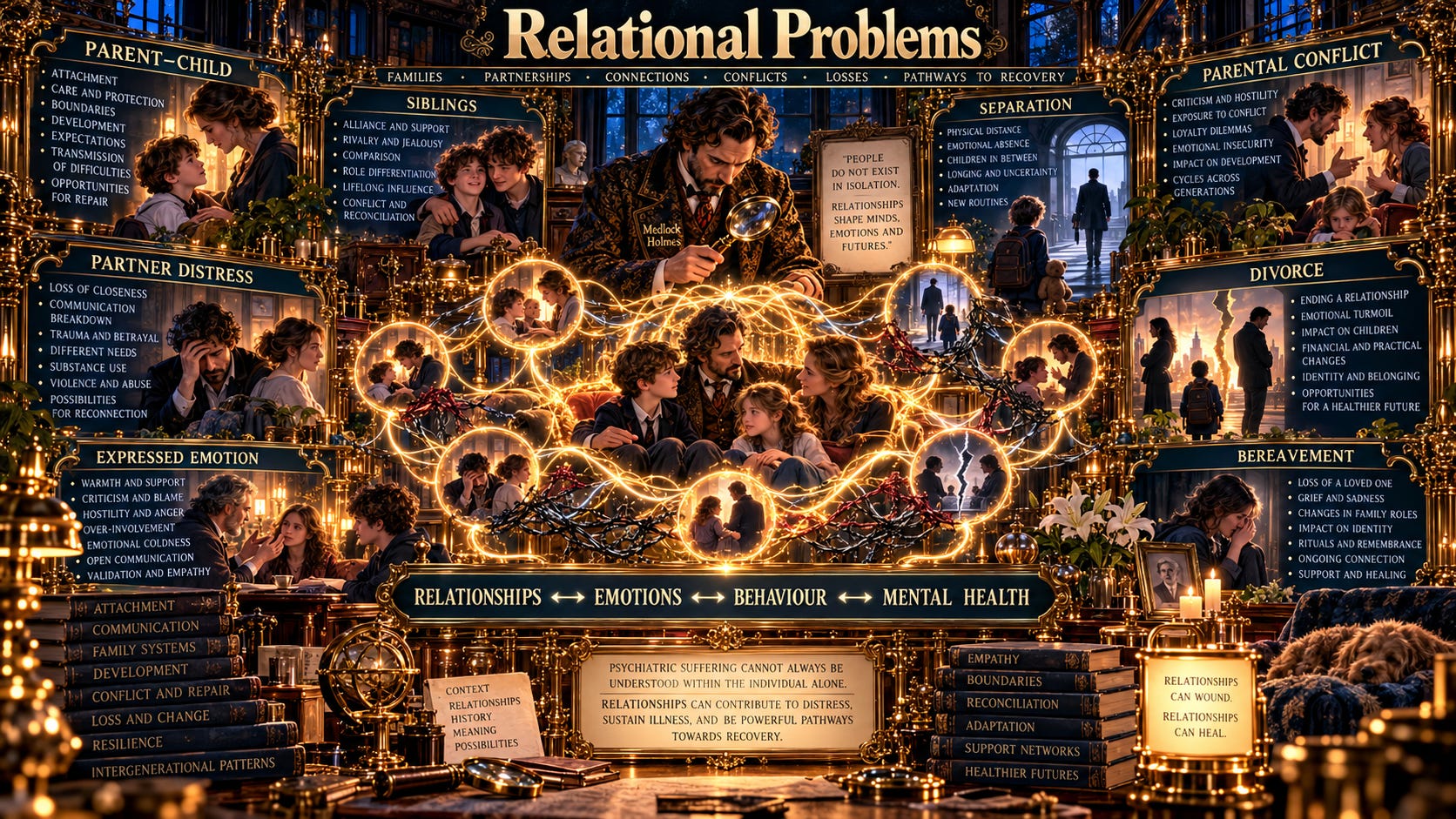
understanding how relationships shape psychological distress, psychiatric illness, recovery and resilience.
The House of Invisible Bonds
Medlock Holmes arrives at an imposing Neo-Victorian mansion known as The House of Invisible Bonds.
Unlike his previous investigations, there is no single patient waiting behind the consulting-room door. Instead, he encounters families, couples, siblings and grieving individuals, each carrying distress that cannot be fully understood in isolation.
A child presents with anxiety, but the parents are locked in relentless conflict. A young man experiences repeated psychiatric relapses while living in an atmosphere of criticism and hostility. A couple seeks treatment for depression, yet their relationship has become a cycle of accusation, defensiveness and withdrawal.
Holmes notices a remarkable pattern.
The symptoms may belong to an individual, but the processes maintaining them may exist between people.
The Eight Chambers of Relational Distress
Holmes opens eight interconnected chambers, each representing a distinct relational problem.
In the first, he encounters a parent and child trapped in escalating arguments. The parent’s attempts at control provoke resistance, and the child’s resistance generates even stricter control. Holmes examines attachment, parenting styles, behavioural difficulties and the influence of parental psychopathology.
In the second chamber, siblings compete for affection and recognition. Ordinary rivalry has transformed into persistent hostility, jealousy and, in some cases, violence.
The third chamber contains children growing up away from their parents. Some have found stability through foster care or kinship arrangements; others carry the psychological consequences of separation, disrupted attachments and repeated changes of home.
In the fourth, a child stands between two arguing parents, desperately attempting to preserve affection for both. Holmes discovers the emotional burden of parental relationship distress, loyalty conflicts and the complexities of parent–child contact refusal.
The fifth chamber contains an intimate couple whose communication has deteriorated into criticism, contempt, defensiveness and withdrawal. Holmes traces the vicious cycle through which relationship distress and depression reinforce one another.
The sixth chamber reveals the consequences of separation and divorce, including disrupted family routines, changing attachments and the challenge of protecting children from continuing parental conflict.
In the seventh, Holmes encounters a family whose conversations are saturated with criticism, hostility and emotional overinvolvement. He recognises the clinical significance of high expressed emotion, particularly in families supporting someone with serious mental illness.
The final chamber is quieter. A grieving individual sits beside an empty chair. Holmes distinguishes the natural pain of bereavement from major depression and more persistent, impairing grief.
The…
Website: drmanaankarray.substack.com


