
Σημειώσεις επεισοδίου
The Sanctuary of the Unseen
A peculiar case brought Medlock Holmes to an ancient sanctuary on the outskirts of London.
Its visitors had arrived seeking answers to questions that medicine could not always resolve. Some had experienced visions. Others had lost their faith. A few had found extraordinary comfort in prayer, meditation, music or acts of compassion.
The superintendent was perplexed.
“Holmes, how are we to distinguish spiritual experience from psychiatric illness?”
Holmes examined the sanctuary’s great stained-glass window.
“By remembering that an unusual belief is not necessarily a delusion, and that an experience of transcendence is not necessarily a symptom.”
The First Chamber: Religion and Spirituality
The first chamber contained two books.
One described religion through shared traditions, sacred narratives, communal rituals and organised systems of belief.
The other described spirituality through meaning, connectedness, compassion, transcendence and the search for something beyond the ordinary self.
“They overlap,” Holmes observed, “but they are not identical.”
He explained that an individual might be deeply religious without reporting mystical experiences, or profoundly spiritual without belonging to any religion.
The clinical task was to understand what these ideas meant to the individual rather than impose the clinician’s own definition.
The Second Chamber: The Brain and the Sacred
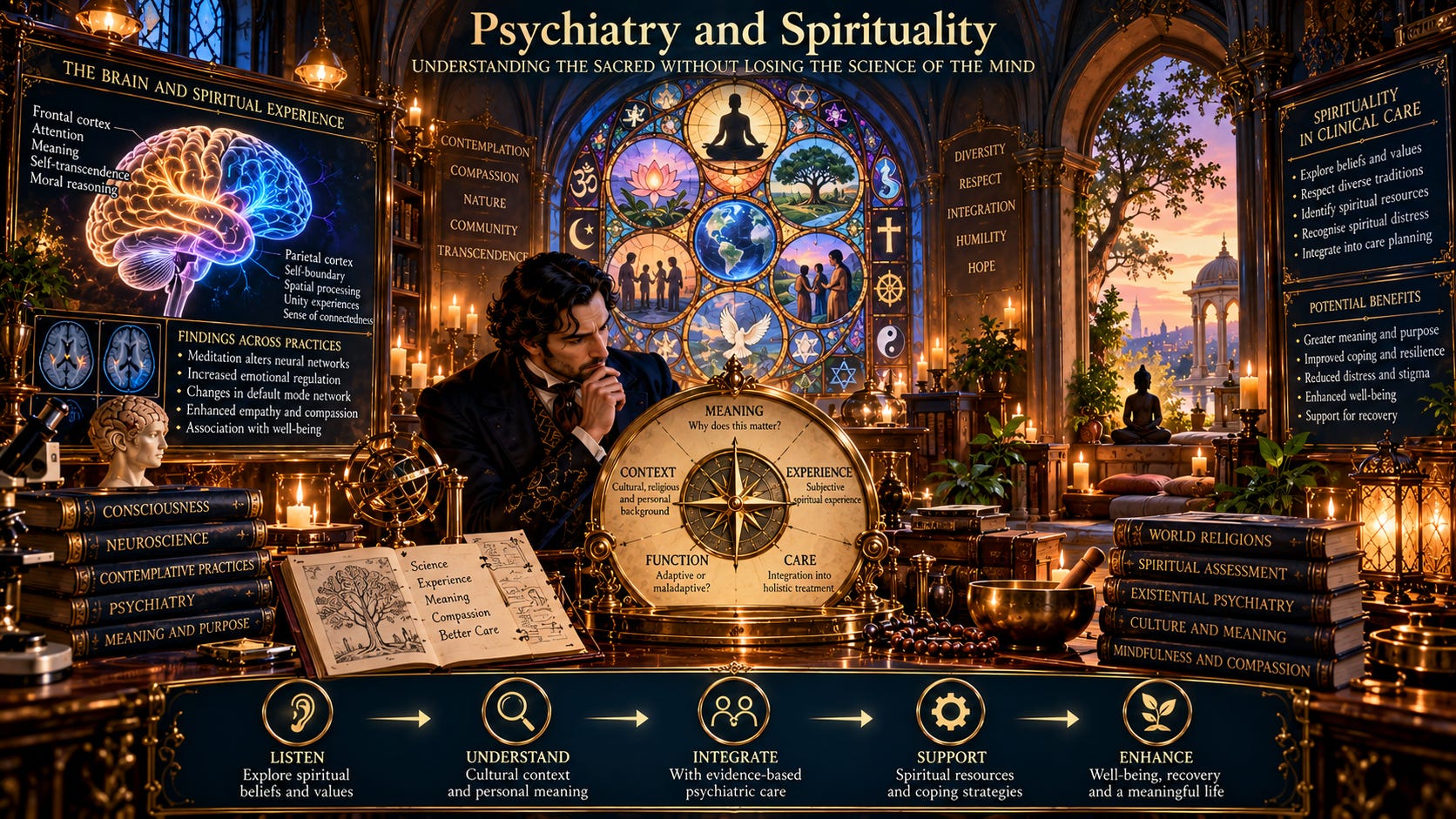
In the next chamber, a neurological map illuminated the frontal and parietal lobes.
Holmes described research associating changes in self-referential processing, particularly involving the right parietal region, with experiences of self-transcendence.
Prayer and meditation could alter attention, awareness and the subjective boundaries of the self.
But the superintendent was eager to announce that science had discovered the location of God.
“Not so quickly,” Holmes replied.
“A neural correlate tells us something about how an experience occurs. It does not establish whether its spiritual interpretation is true or false.”
The Third Chamber: The Hall of Altered Consciousness
Here were accounts of meditation, contemplative prayer, ecstatic dancing, fasting, shamanic rituals and psychedelic experiences.
Some described peace and unity. Others described frightening visions or a dissolution of personal identity.
Holmes warned that the same outwardly unusual experience could have very different meanings depending on culture, context, duration, distress and functioning.
A brief, culturally recognised trance was not equivalent to a persistent psychotic disorder.
Nor was every apparently spiritual experience benign.
“Ask what happened, what it meant, whether the person remained in control, and what followed.”
The Fourth Chamber: The Clinic of Meaning
The next room was a psychiatric consulting chamber.
A bereaved woman found comfort in prayer. A depressed man believed his suffering was divine punishment. Another patient feared that intrusive blasphemous thoughts…
Ιστότοπος: drmanaankarray.substack.com

