

PSYCH 172: Suicide - Epidemiology, Risk and Protective Factors, Treatment, and Prevention
· 57 dk · Sezon 13 Bölüm 172
Bölüm notları
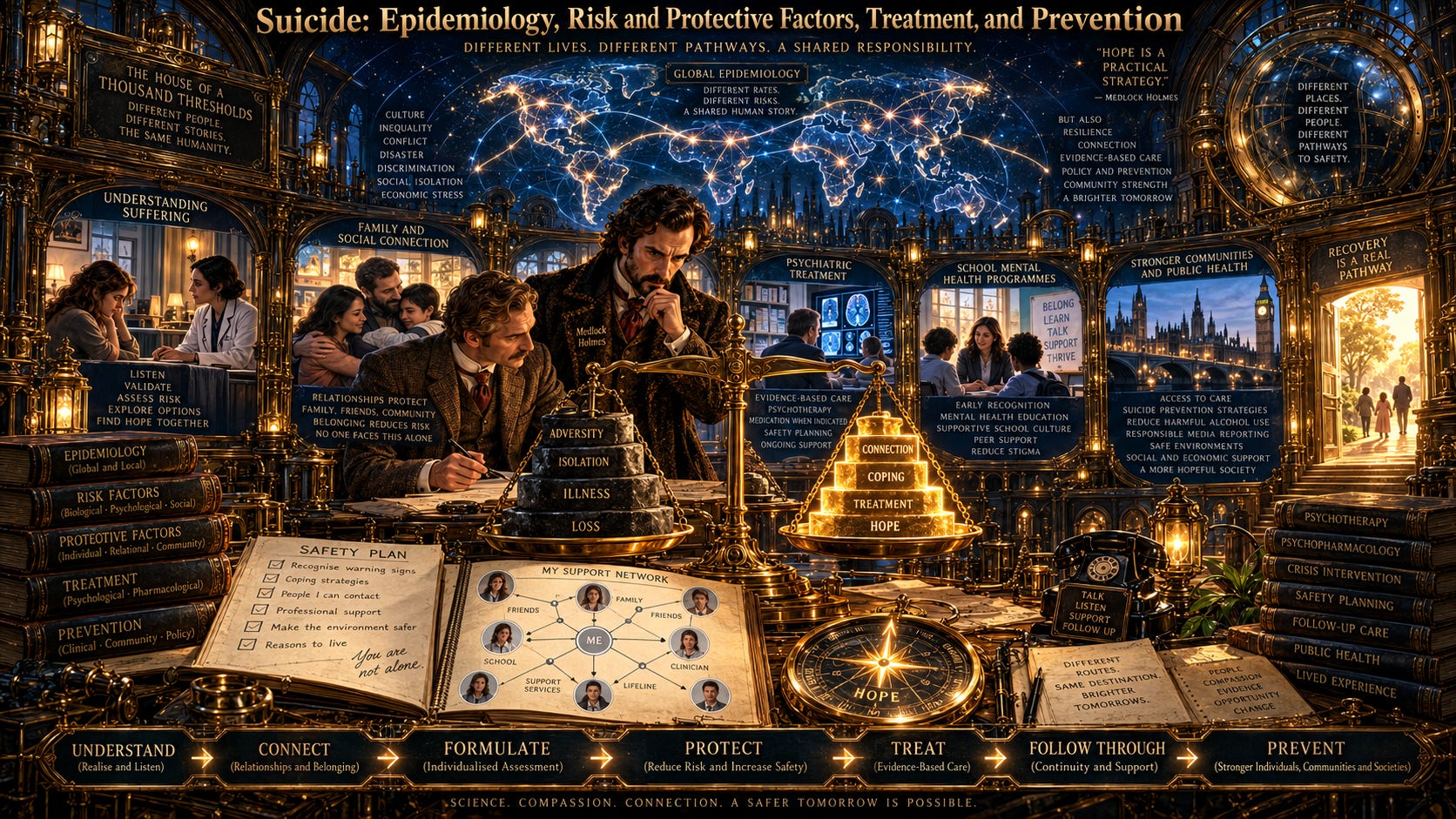
London, 1895.
A strange series of events had unsettled the city. A young student, overwhelmed by humiliation and loneliness, had survived a suicidal crisis. An elderly widower had withdrawn from his neighbours and stopped attending his medical appointments. A successful businessman, outwardly composed, had concealed a growing sense of hopelessness.
Their circumstances appeared entirely different. Yet each had approached a moment when life seemed unbearable.
The Commissioner summoned Medlock Holmes.
“Three people, Holmes. Three very different lives. Is there one explanation?”
Holmes studied the case files.
“No single explanation, Commissioner. That is precisely what makes this mystery so important.”
He led Watson into an extraordinary building known as the House of a Thousand Thresholds.
In the first chamber stood a great balance. On one side were genetic vulnerability, childhood adversity, psychiatric illness and painful life experiences. On the other were belonging, coping, treatment, personal values and hope.
“This,” Holmes explained, “is the stress–vulnerability model. Risk is not fixed. It changes as vulnerabilities, stressors and protective factors interact.”
The next chamber contained maps of the world. Suicide rates differed across countries, ages and sexes. Holmes pointed out that statistics could identify populations requiring attention, but could never explain an individual life on their own.
In the third chamber, Watson encountered patients with depression, bipolar disorder, psychosis, substance use disorders, anxiety and personality difficulties. Each described a different pathway towards suicidal distress.
“The diagnosis matters,” Holmes observed, “but the person matters more. We must understand what has made death appear preferable to living, and what might help restore another possibility.”
The fourth chamber was a consultation room.
A clinician asked about suicidal thoughts, plans, previous attempts, agitation, access to dangerous means and reasons for living. She also asked about family, financial pressures, relationships and what might happen tomorrow.
Watson noticed that she did not simply assign a risk label.
“She is constructing a formulation,” Holmes replied. “Not merely asking whether danger exists, but discovering what drives it, what protects against it and what could change.”
Beyond the consultation room lay a treatment ward. Its doors were neither permanently locked nor carelessly opened. Safety measures were combined with compassionate engagement, psychological treatment, appropriate medication and carefully planned transitions back into the community.
Holmes showed Watson evidence for lithium in bipolar disorder, clozapine in schizophrenia, electroconvulsive therapy in severe depression, and psychotherapies including cognitive behavioural therapy, dialectical behaviour therapy and collaborative approaches to suicidality.
Yet he lingered longest beside a simple safety plan.
“A life may be protected,” he said, “not…
Web sitesi: drmanaankarray.substack.com


