
PSYCH 174: Other Psychiatric Emergencies
· 1 h 3 min · Temporada 13 Episodio 174
Notas del episodio
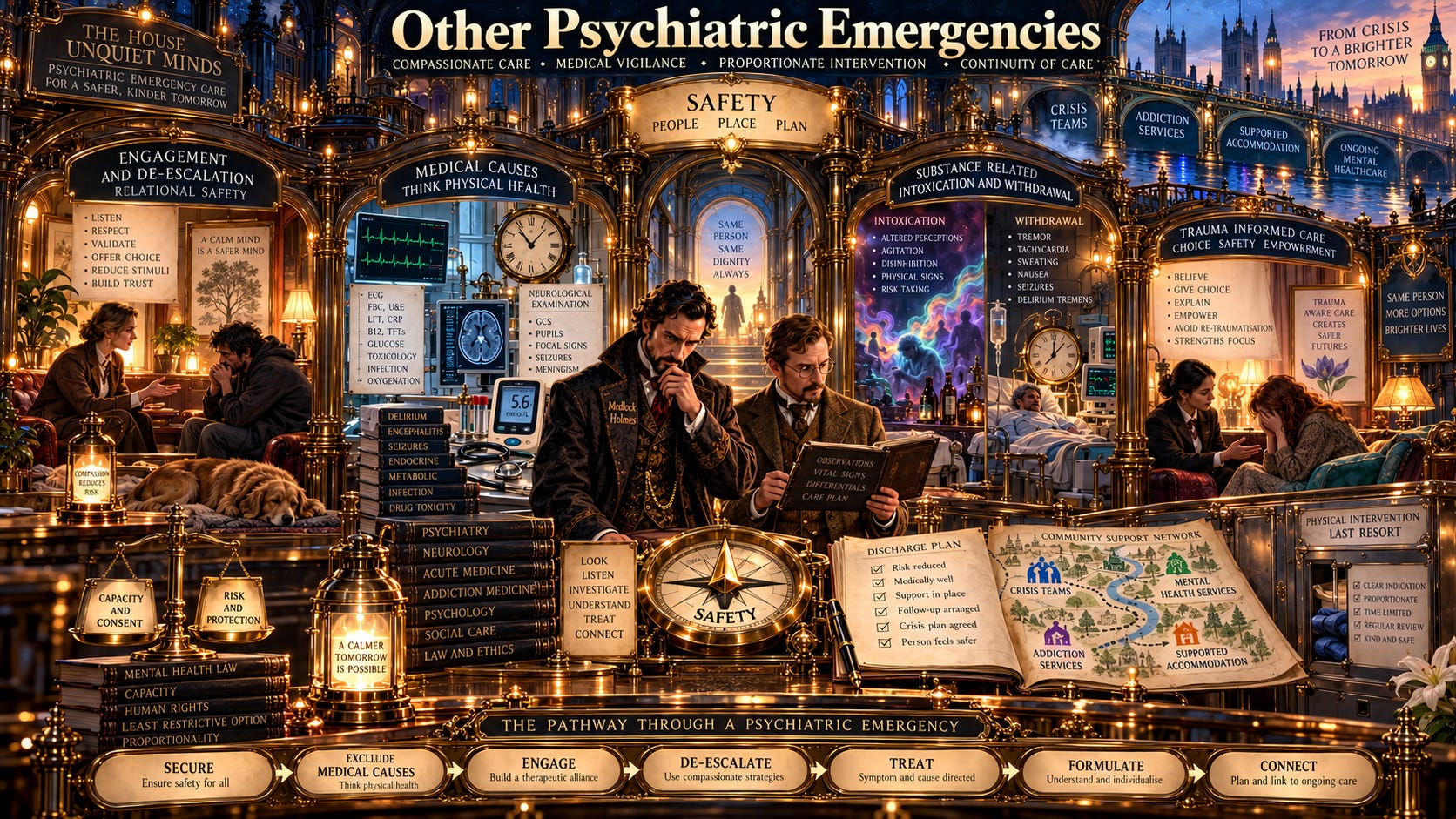
London, 1895.
At three o’clock in the morning, an urgent summons brought Medlock Holmes and Dr Watson to a mysterious institution on the banks of the Thames.
Its name was the House of Unquiet Minds.
Within its walls, the city’s most bewildering psychiatric emergencies arrived without warning. Some patients were frightened, others confused, and a few were so agitated that the staff feared for everyone’s safety.
The superintendent greeted Holmes with an alarming declaration.
“We must determine which of these people are mad, which are dangerous, and which must be locked away.”
Holmes surveyed the crowded receiving hall.
“You have already made your first error,” he replied. “You have confused diagnosis with danger, and danger with the need for confinement.”
He pointed towards three enormous brass doors.
The first was engraved SAFETY.
The second bore the words MEDICAL CAUSES.
The third read UNDERSTANDING AND DISPOSITION.
“These are the three priorities of emergency psychiatry,” Holmes explained. “And they must be approached in the correct order.”
In the first chamber, a distressed man paced beneath flickering gas lamps. Two attendants approached him forcefully, demanding that he sit down.
His agitation intensified.
Holmes quietly dismissed the attendants, reduced the noise, offered the man water and spoke without confrontation.
Within minutes, the patient began to describe his terror.
“Before we attempt to control behaviour,” Holmes told Watson, “we must understand what the behaviour is communicating.”
The second chamber contained a woman who appeared to be experiencing a sudden psychotic episode.
A junior physician proposed immediate psychiatric admission.
But Holmes noticed her fluctuating attention, disorientation and fever.
“Delirium,” he declared. “Until we investigate otherwise, this is a medical emergency wearing a psychiatric disguise.”
Beyond her lay the Hall of Altered States. Its rooms represented stimulant intoxication, alcohol withdrawal, sedative dependence, opioid withdrawal and hallucinogen-related crises.
Watson watched one patient tremble as alcohol withdrawal progressed, while another struggled with the overwhelming discomfort of opioid withdrawal.
“Similar distress,” Watson observed, “but profoundly different dangers.”
“Precisely. Alcohol and sedative withdrawal may be fatal. Opioid withdrawal is usually not, although complications and overdose risk demand attention. The correct treatment depends upon knowing the difference.”
In the next room, a young woman disclosed a recent sexual assault. Holmes instructed the staff to protect her privacy, restore her choices and ensure that appropriate medical and forensic services were available.
“No investigation,” he said, “should strip a person of the control that compassionate care can begin to restore.”
At the rear of the building, the superintendent presented Holmes with a final dilemma.
A man experiencing severe mental illness refused admission.
“Surely illness alone permits us to…
Web: drmanaankarray.substack.com


