

PSYCH 197: Other Methods of Psychotherapy
· 1 u 3 min · Seizoen 13 Aflevering 197
Beschrijving
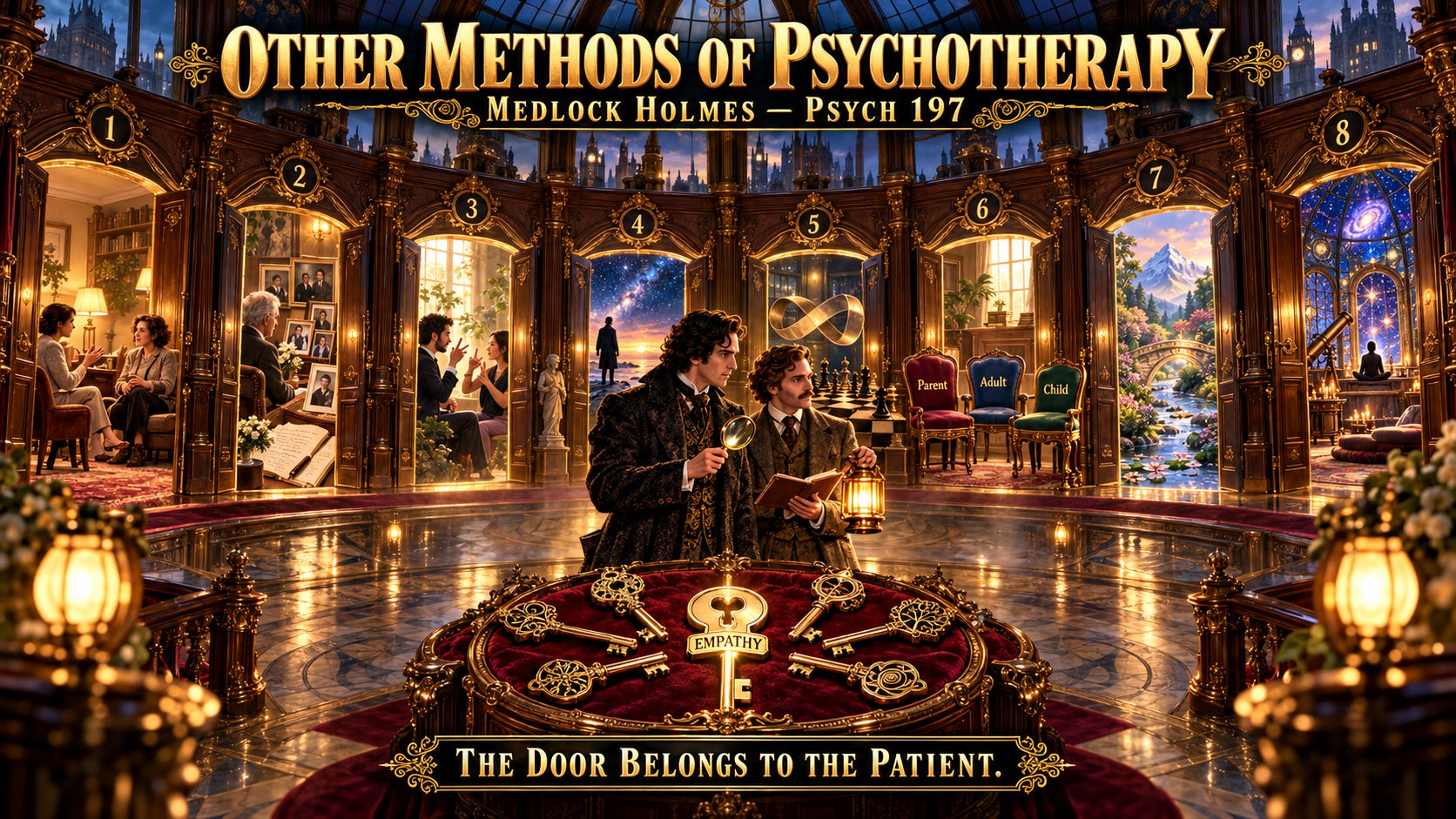
Medlock Holmes and the Case of the Eight Doors
It began with a peculiar invitation delivered to 221B Baker Street.
Mr Holmes, I have built a house containing eight consulting rooms. Each room offers a different method of relieving human suffering. Yet the patients insist that no single room holds the answer to every problem.
The letter was signed by Dr Nathaniel Ashcroft, physician and founder of the Institute of Human Understanding.
Watson turned the envelope over.
“Eight different treatments, Holmes? Surely one must be the best.”
“That depends, Watson, upon what we mean by best-and for whom.”
The institute stood at the end of a quiet London street. Its entrance hall was illuminated by eight lamps, each hanging above a different door.
Dr Ashcroft welcomed them.
“Every room contains a different philosophy of suffering. I should like you to investigate them.”
Holmes approached the first door.
Its inscription read: THE ROOM OF ACCEPTANCE.
Inside sat a young woman named Clara, who had spent years believing that her feelings made her weak.
Her therapist did not challenge her thoughts or offer explanations. Instead, she listened carefully.
“I feel ashamed whenever I disappoint someone,” Clara said.
“You feel that disappointing another person means there is something wrong with you.”
Clara looked up.
“Yes. Nobody has ever put it quite like that.”
Holmes whispered to Watson, “Carl Rogers would recognise this room. Empathy, genuineness and unconditional positive regard create conditions in which a person may begin to understand themselves.”
They entered the second room.
An elderly gentleman sat beside a small desk covered with photographs and handwritten letters.
“My illness has taken so much,” he told the therapist. “I fear my grandchildren will remember only a frail old man.”
“What would you most want them to know about your life?”
The gentleman began speaking of the people he had loved, the mistakes he had made and the values he hoped to pass on.
His words were being assembled into a document for his family.
“Dignity therapy,” Holmes observed. “It does not promise to abolish mortality. It helps preserve a person’s voice and sense of meaning.”
The third room was almost silent.
Two people sat opposite one another, communicating through sign language. The therapist’s hands moved with fluent precision.
Watson reached instinctively for his notebook.
“Is this a new form of psychotherapy?”
“No, Watson. The essential treatment may be familiar, but its delivery must be linguistically and culturally accessible. Deafness does not require a different humanity. It requires communication that truly reaches the person.”
Beyond the fourth door stood a man gazing at a painting of an empty horizon.
“What troubles you most?” asked his therapist.
“That I may live my entire life without knowing what it means.”
The therapist did not reassure him that life possessed a predetermined purpose.
Instead, they explored freedom, responsibility, isolation and…
Website: drmanaankarray.substack.com

