

Course 45 - IE Data Center Network Design | Episode 1: Layer 2 Data Center Design
· 26 min
Note dell’episodio
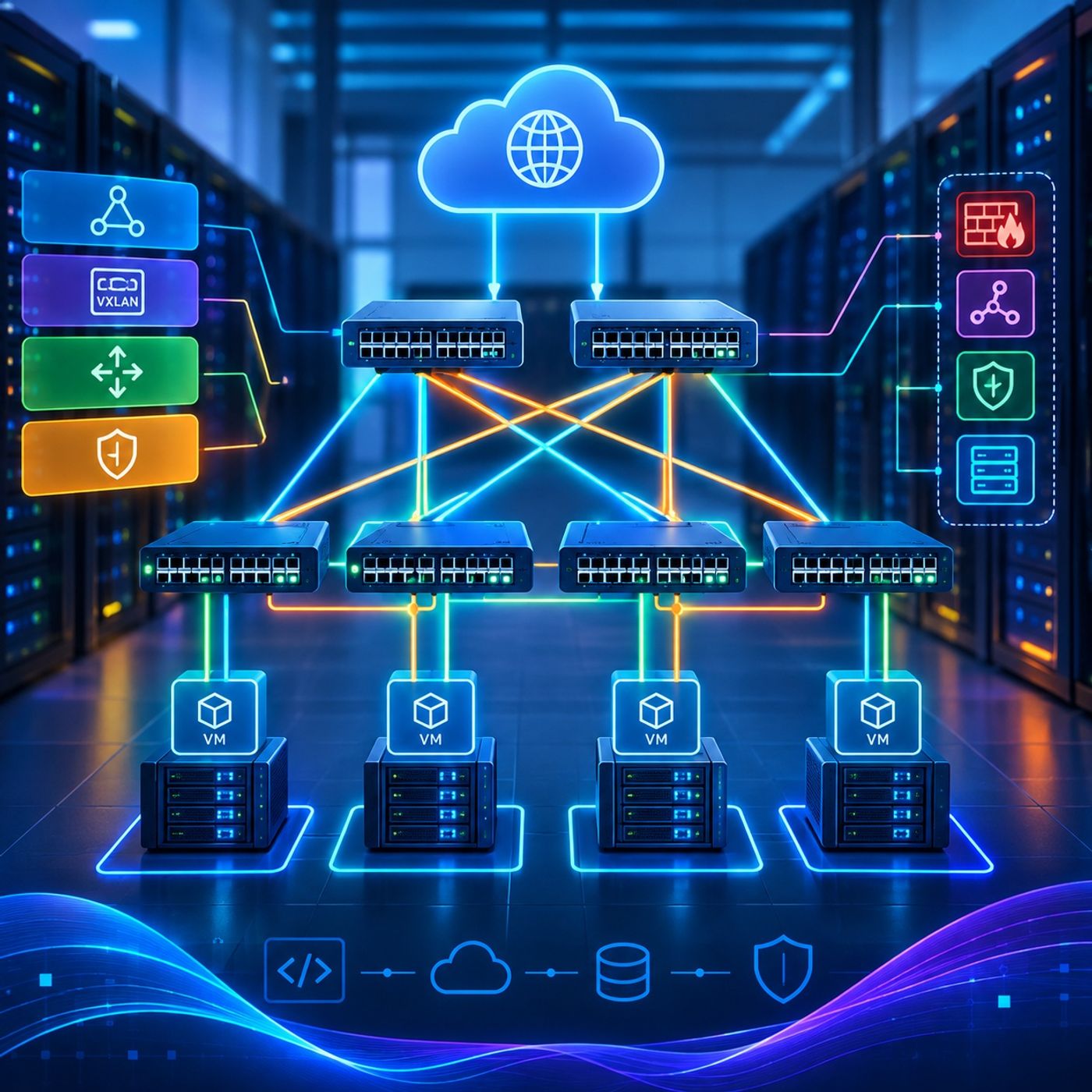
Layer 2 Data Center Design & Endpoint MobilityEpisode OverviewModern data center networks must do more than simply connect servers. They must support workload mobility, continuous availability, scalable architectures, and intelligent integration of network services.In this episode, we explore the architectural principles behind high-performance Layer 2 and data center fabrics, beginning with the limitations of traditional Spanning Tree Protocol and progressing toward Virtual Port Channels, leaf-spine architectures, VXLAN, ECMP, and Layer 4–7 service integration.The goal is to understand how modern data center designs preserve the benefits of Layer 2 connectivity while introducing the scalability, redundancy, and fast convergence associated with Layer 3 architectures.1. Defining the Data Center Network Design GoalsA modern data center architecture should address three fundamental requirements.Endpoint and Workload MobilityVirtual machines and other workloads may need to move between physical hosts or network locations without requiring major changes to their network identity.The underlying network therefore needs to maintain connectivity while workloads move across the infrastructure.High AvailabilityCritical network paths should avoid single points of failure.Ideally, redundant links should not sit idle waiting for a failure. An active-active architecture allows available bandwidth to be used while maintaining redundancy.Services AwarenessApplications frequently depend on network services such as:
- Firewalls.
- Load balancers.
- Proxy servers.
- Other Layer 4–7 services.
The network architecture must provide a clean mechanism for integrating these services into traffic flows.2. Understanding the Limitations of Spanning TreeTraditional Spanning Tree Protocol (STP) was designed to prevent Layer 2 switching loops by placing redundant paths into a blocked state.While this provides loop prevention, it introduces several challenges in modern data centers.Redundant links may remain unused during normal operation, resulting in inefficient bandwidth utilization.STP convergence can also introduce disruption during topology changes. Changes may trigger Topology Change Notifications (TCNs) and associated MAC-table behavior, potentially causing temporary flooding while the network relearns forwarding information.Another concern is that traditional Layer 2 designs can become increasingly difficult to scale as the number of endpoints and redundant paths grows.These limitations motivate architectures that can use multiple physical paths simultaneously.3. Virtual Port ChannelsVirtual Port Channels (vPC) provide a mechanism for presenting multiple physical switches as a logical port-channel endpoint from the perspective of connected devices.This allows a downstream device to establish links toward two switches while treating them as a single logical connection.The result can be represented conceptually as:Traditional Redundancy:
Active Link + Standby…
Sito web: spreaker.com
