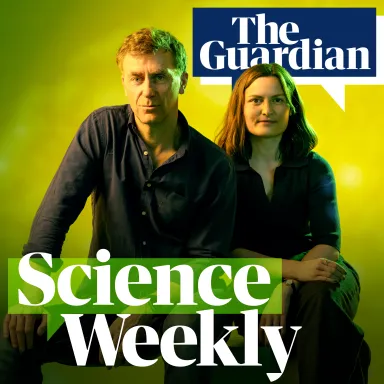
Science Weekly
by The Guardian
Latest episode
Is BMI working? Cop31 latest, the science of great conversation
Is BMI working? Cop31 latest, the science of great conversation
About this podcast
Twice a week, the Guardian brings you the latest science and environment news
Episodes
The newest 50 of 296 episodes
- Is BMI working? Cop31 latest, the science of great conversation · 23 minMadeleine Finlay and co-host Ian Sample discuss the three science stories you need to know about this week, including an alternative to BMI for diagnosing obesity which could…
- Winter depression is real. Here’s what can help · 17 minAs the nights draw in, many of us can experience low mood. But for a small proportion of people a more intense depression develops through the winter months. It’s a phenomenon…
- ‘Ferritin face’: what you need to know about low iron · 20 minSocial media is awash with claims iron deficiency can be identified in the mirror by dark circles, breaking hair and dry skin. But is ‘ferritin face’ real? Madeleine Finlay tells…
- How a scientist went from hero to traitor in a US water crisis · 19 minWhen the water in Flint, Michigan, became contaminated with dangerous levels of lead, Dr Siddhartha Roy, then a third year PhD student, was part of the team of scientists who…
- ‘Assad had one of my books by his bed’: life as a forensic scientist · 18 minAs one of the world’s leading forensic anthropologists, Dame Sue Black has acted as an expert witness in a myriad of high-profile criminal cases. Her work has taken her from the…
- Perimenopause is everywhere. How do you know if you’re in it? · 15 minPerimenopause has become a hot topic, with celebrities sharing their experiences and doctors offering tips and advice online. But despite the benefits of growing awareness, a…
- Elizabeth Holmes is back in the spotlight: why can’t we look away? · 17 minYou Can See Everything, a documentary about the disgraced health tech company founder Elizabeth Holmes, has enjoyed a record-breaking opening in the US. It is a testament to how…
- ‘These risks are real’: the threat of AI bioweapons · 16 minIn his annual speech on threats to the nation, Sir Ken McCallum, the head of the UK’s intelligence service, MI5, warned that AI had the potential to ‘change the stakes’ on…
- Is your boss watching you? The rise of AI surveillance at work · 18 minWorkers have always been monitored by their bosses, first through output targets, and then via computer software labelled ‘bossware’. But AI is transforming the capabilities of…
- The surprising psychology of morbid curiosity · 17 minUS defence secretary Pete Hegseth’s plan to livestream the execution of Nidal Malik Hasan has incurred condemnation from human rights groups and politicians on all sides. But…
- All the news and science from the 2026 Nobel prizes · 23 minThis year’s Nobel prizes in chemistry, physics and physiology or medicine have celebrated work that has been used to develop countless drugs and transform modern medicine…
- Today in Focus: Should we be worried about a plague outbreak? · 14 minSeveral hospitals in eastern Russia are under quarantine after a lab worker fell ill at a plague research centre following a reported accident and died. Russia’s health watchdog…
- Narcolepsy: why you’ve been thinking about it all wrong · 17 minThe sleep disorder has been the butt of jokes and a comedic plot point, but the reality of living with narcolepsy is anything but funny. Things could be about to change for…
- The incredible science of memory manipulation · 21 minMadeleine Finlay hears from Steve Ramirez, an associate professor of psychological and brain sciences at Boston University, whose book How to Change a Memory was shortlisted for…
- Are household cleaning products damaging our health? · 18 minOur use of cleaning products has increased since the pandemic, but do we understand what they could be doing to our health? The journalist Rebecca Seal recently wrote for the…
- Are baby girls more sociable? Super El Niño, meningitis outbreak explained · 22 minMadeleine Finlay sits down with her co-host and Guardian science editor, Ian Sample, to discuss three science stories from the week, including a study that offers a clue in the…
- From paleo to intermittent fasting: are any diets actually good for us? · 17 minAs diet trends proliferate on social media, it can be hard to work out which are backed by science and which should be ignored. From paleo to keto, raw food to intermittent…
- The week that changed maths for ever · 16 minIn early September, OpenAI announced it had solved a major mathematics problem that has stumped humans for nearly a century. The news left mathematicians reeling, and many…
- Is collagen all hype? · 19 minCollagen powders, gummies and pills have boomed in popularity in recent years boosted by claims that they smooth wrinkles, promote glossy hair and help with joint pain. Amid the…
- Live episode: how AI is reshaping our minds · 1 h 22 minIn this episode of Science Weekly, recorded in front of an audience at the London podcast festival on 3 September, Ian Sample hears from Michael Safi, the host of the Guardian’s…
- ‘One of the biggest discoveries in science’: have scientists found dark matter? · 17 minFor decades physicists have been puzzling over the enigma of dark matter. We think it makes up 85% of the matter in the universe, but the mysterious substance cannot be seen or…
- Are rich people really worse behaved? Here’s the science · 18 minWho’s more likely to steal sweets from a child? According to science, it’s the rich. A study seemingly confirming our suspicions about the moral behaviour of the wealthy was one…
- Introducing Black Box: The Chatbots · 40 minFrom the Guardian Investigates team: Across the world, hundreds of people have come to believe they have made extraordinary scientific discoveries with AI chatbots such as…
- There’s a quick way to slow climate change. Why isn’t everyone doing it? · 14 minMethane is a potent greenhouse gas that traps more than 80 times as much heat than carbon dioxide over a 20-year period and causes 25% of global heating today. We definitely…
- Could humans ever communicate with whales? · 17 minEver since the earliest known recording of whale song was made in 1949, researchers have been captivated by the wails, rumbles, clicks, grunts and squeals of their communication…
- Everyone hates datacentres. Do we really need them? · 17 minAI companies have promised us world-shifting technology. But there’s a cost: loud, unsightly datacentres that drain environmental resources. As the government pushes their rapid…
- Creatine: is there truth behind the hype? · 16 minCreatine has become the go-to supplement for anyone wanting to give their fitness a boost and build muscle. It’s even made it out of the gym, with influencers touting its…
- It’s finally raining. Will it be enough to end the drought? · 16 minAfter a summer that has seen England and Wales experience the driest July since records began, rain is finally on the horizon. But with reservoirs at ‘exceptionally low’ levels…
- The ultra rich are collecting fossils, and that’s bad for science · 15 minOne of the UK’s best fossil collections has been sold overseas in what experts have called a loss to the nation. The collection, which is now on display at the Natural History…
- The immortal jellyfish and other mindblowing invertebrates · 15 minEach year the Guardian runs a competition to find the invertebrate of the year. To find out more about the 2026 nominees science editor Ian Sample hears from climate reporter…
- We’re reading less. And it’s making us stupid · 20 minBooks have never been trendier, but studies show that as more and more things compete for our frazzled attention spans, we’re reading less and less. This is a problem because…
- Four types of thinker, the cyclosporiasis outbreak, and the UK’s biggest telescope threatened · 22 minMadeleine Finlay is joined by Ian Sample, Guardian science editor, to discuss three eye-catching science stories including an investigation that has identified four distinct…
- The fight to save a historic English landscape · 17 minMadeleine Finlay travels to the Rothbury estate in Northumberland, in north-east England. It’s a piece of land that has been in the same family for 700 years, but now it has been…
- Revisited: Saunas and cold plunges, where does the evidence stand? · 16 minSaunas and cold plunge pools are popping up everywhere in the UK, bringing fiery heat and icy cold to a beach, city farm or park near you. Their users will be ready with all the…
- Revisited: The surprising science of dreams and nightmares · 22 minIn this episode from January 2026, Ian Sample puts listeners’ questions about dreams and nightmares to Dr Michelle Carr, the director of the Dream Engineering Laboratory in…
- Revisited: A Scottish tea mystery, episode three – a bag for life · 20 minScience correspondent Nicola Davis investigates the strange story of Tam O’Braan and his attempts to grow tea in Scotland. In episode three of this mini-series first broadcast in…
- Revisited: A Scottish tea mystery, episode two – the list · 23 minScience correspondent Nicola Davis investigates the strange story of Tam O’Braan and his attempts to grow tea in Scotland. In episode two of this mini-series first broadcast in…
- Revisited: A Scottish tea mystery, episode one – green shoots · 22 minScience correspondent Nicola Davis investigates the strange story of Tam O’Braan and his attempts to grow tea in Scotland. In episode one of this mini-series first broadcast in…
- Can a world-first gene therapy reverse ageing? · 18 minThe first person has been treated with a highly anticipated new gene therapy that aims to turn back the clock on ageing cells. The trial is aimed at retinal cells, with the hope…
- Fungi: the invisible force protecting our planet · 16 minScientists often talk about the importance of flora and fauna to the health of our planet, but Dr Toby Kiers, an evolutionary biologist and founder of the Society for the…
- Is male testosterone in freefall? · 14 minMen’s average testosterone levels have halved over the past 50 years, according to scientists who say society is facing a male fertility crisis. Rising levels of obesity and…
- ‘A break from scrolling’: how Gen Z fell in love with birding · 17 minIn the last 50 years, Britain has lost an astonishing 73 million wild birds from its landscape, according to the British Trust for Ornithology. Habitat loss, pesticides, disease…
- ‘Beautiful blobs’: can scientists build life from scratch? · 17 minResearchers claim they are closer to creating life from nothing after building tiny, quivering blobs that use lab-made DNA to feed, grow and multiply in a dish. To find out how…
- Reflecting pool algae: the science Trump needs to know · 16 minThe Lincoln Memorial reflecting pool in Washington DC has hardly been out of the news since April when President Trump vowed to have it renovated, and painted ‘American flag…
- Nature or nurture: can genes make us behave ‘badly’? · 20 minHow much do our genes determine about our lives, and could they influence traits like risk-taking, antisocial behaviour or even violence? Ian Sample talks to Kathryn Paige…
- Extreme heat: is the UK becoming a 40C country? · 15 minMet Office forecasters have issued a rare red weather warning for England, with temperatures potentially reaching 40C (104F) in some places. Europe is also dealing with a…
- The audacious plan to refreeze the Arctic · 16 minSea ice is melting fast and worsening the climate crisis. But what if there were a way to thicken it again? Madeleine Finlay is joined by environment editor Damian Carrington to…
- Should we ban social media for under-16s? · 20 minThe UK prime minister, Keir Starmer, has announced a social media ban for under-16s, as part of an online safety drive that aims to go even further than the world’s first ban…
- ‘The undruggable became druggable’: a gamechanging treatment for the world’s deadliest cancer · 15 minA daily pill can double survival time in patients with the world’s deadliest cancer, according to the results of a clinical trial that experts are saying is a gamechanger and one…
- The dinosaurs who survived the asteroid · 17 minWhile many dinosaurs were wiped out when a colossal asteroid struck Earth 66m years ago, one group survived: birds. Prof Steve Brusatte, a palaeontologist at the University of…