

Episodebeskrivelse
The Trillion-Dollar Bet That the Cycle Is Dead
The market just handed a memory company a trillion-dollar valuation at roughly a hundred times trailing free cash flow, on a yield under one percent.¹² Strip the letters AI off that sentence and it is a bet that the most violently cyclical business in technology has quietly stopped being cyclical.
On Wednesday’s main show, Hunt, Jason, and Mike spent an hour on the opposite problem — how you get to a two-trillion-dollar valuation on a company with almost no free cash flow at all. That was the SpaceX S-1.³ This week the market answered the mirror image for Micron. It looked at the cash that actually exists, and it priced that cash as if it can never fall again.
Here is the part the screens are not showing you. As recently as fiscal 2023, Micron lost almost six billion dollars in a single year — and its gross margin went negative, which is the polite way of saying it sold memory for less than it cost to make.⁴ That was not 1998. That was two years ago. The cycle before it: fourteen billion in net income in 2018, gone to a fraction of that by 2020.⁵ Boom, glut, collapse, repeat. The most reliable pattern in semiconductors, and Micron has run it twice in the last eight years.
The mechanism is not mysterious. High memory prices pull in capacity. Capacity becomes supply. Supply kills the price. A hundred times trailing free cash flow is the market betting that mechanism has been switched off — that high-bandwidth memory, the stuff that feeds the AI accelerators, is different enough to outrun the cycle for years instead of quarters. The bull case is real, and worth stating fairly: Micron’s entire 2026 HBM output is already sold out,⁶ management says it can fill only half to two-thirds of what its largest customers are asking for,⁷ and trailing free cash flow has grown more than fivefold off the 2023 trough.⁸ The stock rose nineteen percent the day it crossed a trillion, and nearly ninety percent in a month.⁹¹⁰ None of that is fake. The only question is whether it is permanent.
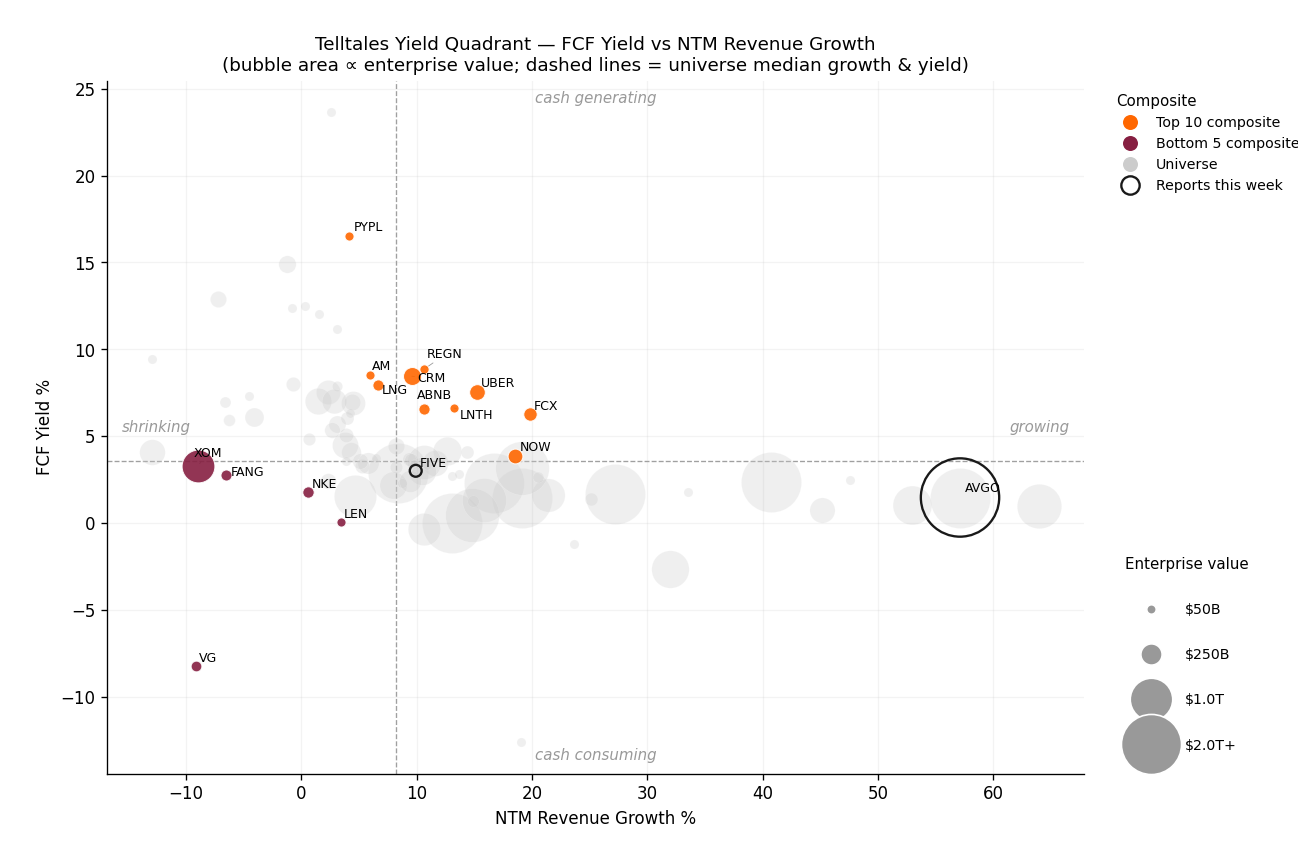
Now put Broadcom next to it, because it reports Wednesday and the contrast is the whole point.¹¹ Broadcom is guiding AI-chip revenue up a hundred and forty percent, to roughly eleven billion dollars in a single quarter¹² — and it goes into that print at about seventy times trailing free cash flow, on more than thirty billion dollars of cash it has already banked.¹³¹⁴ The cashflow read is in Marcus’s column below; short version, one of these names is a bet on a shortage and the other is a bet on a standard. Micron needs the cycle to stay broken. Broadcom gets paid whether the buyer is Google, Meta, or Anthropic, and it needs nothing about memory pricing to be true. Page one of the Cash Flow Memo has both names. The market is paying the fatter multiple for the one carrying all the cycle risk.
What changes the read is not a hiring chart or a single beat. It is the first crack in sold out. Broadcom’s print on Wednesday, June third, is…
Nettsted: telltales.substack.com


