

Episodebeskrivelse
▶ Explore this week’s Tape — live, sortable, drill-down →
Three Bottlenecks, One Multiple, and Only One Monopoly
The AI argument flipped sides this week. For two years the only question that mattered was whether anyone would actually buy all this compute, and Wednesday’s show put that one to bed. The question left standing is whether the supply chain can physically build it — the lithography, the power, the memory. And in the rush to own the chokepoints, the market did something lazy. It paid all three the same monopoly multiple. Only one of them is a monopoly.
Start with the one that is. ASML makes the machine that etches the most advanced chips on earth, and it makes it alone — no second source, no roadmap to one, no credible challenger inside a decade. The Cash Flow Memo has it trading around sixty times free cash flow, on roughly eleven billion dollars of trailing free cash flow translated from euros.¹² That is a monopoly multiple, and for once it is bolted to an actual monopoly. The thing that can dent it is not a competitor — it is a government. Commerce Secretary Howard Lutnick told ASML, per Bloomberg, that he is concerned a top-tier extreme-ultraviolet machine may have reached China in violation of export controls; the company denied it has ever shipped one there.³ Notice what the risk actually is. Not the machine. The map of who is allowed to buy it. ASML’s customer list is the only variable that has ever moved this stock, and it is the one variable ASML does not control.
Now the two the market is paying as if they were ASML. GE Vernova booked more data-center power orders last quarter than it did in all of the prior year, and its turbine backlog now stretches past a hundred-ten gigawatts into 2029.⁴⁵ Free cash flow grew almost four hundred percent.⁶ Real demand, real scarcity — for now. But a gas turbine is not an EUV machine. Siemens Energy and Mitsubishi build them too, and slot scarcity is the kind of bottleneck competition fills in three or four years, not three or four decades. GE Vernova is renting its scarcity. The order book is genuine; the durability is the open question, and a thirty-times multiple is pricing the scarcity as if it were permanent.
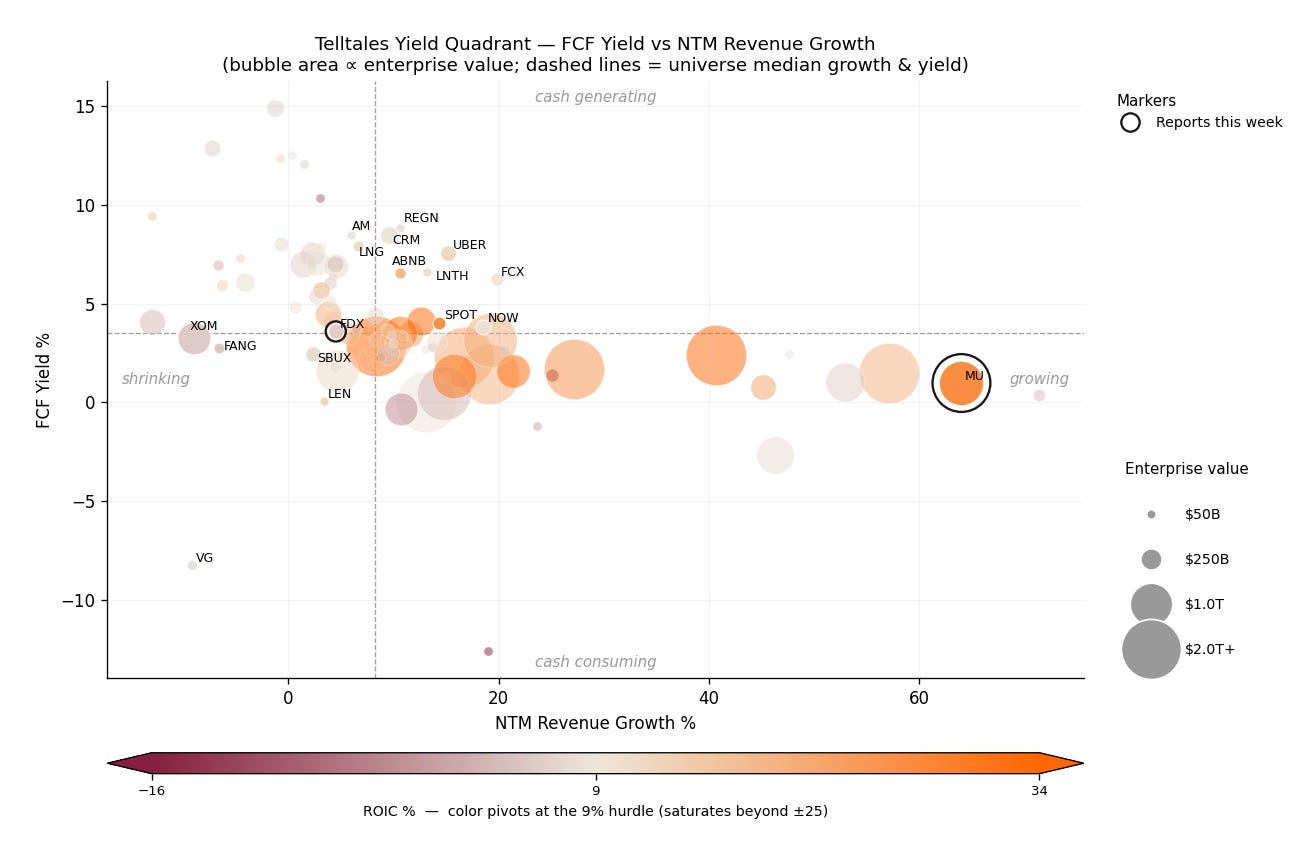
Then memory — the bottleneck with the longest rap sheet. Micron reports Wednesday with its entire 2026 high-bandwidth-memory output already sold under contract and DRAM pricing set to jump fifty percent this quarter.⁷⁸ The cashflow read is in Marcus’s column below — short version, the trailing multiple is the cheap number, not the scary one. But here is the part the show had no room for: memory is the one bottleneck on this list that has detonated itself before. Every prior cycle ended the same way. All three makers see the shortage, all three turn the capex spigot at once, supply overshoots demand, and the pricing that looked structural turns out to have been a moment. Micron is committing roughly two hundred billion dollars to new capacity, and its two competitors are spending…
Website: telltales.substack.com


