

Show notes
▶ Explore this week’s Tape — live, sortable, drill-down →
Twelve Times Free Cash Flow Bought One Company and Trapped Another
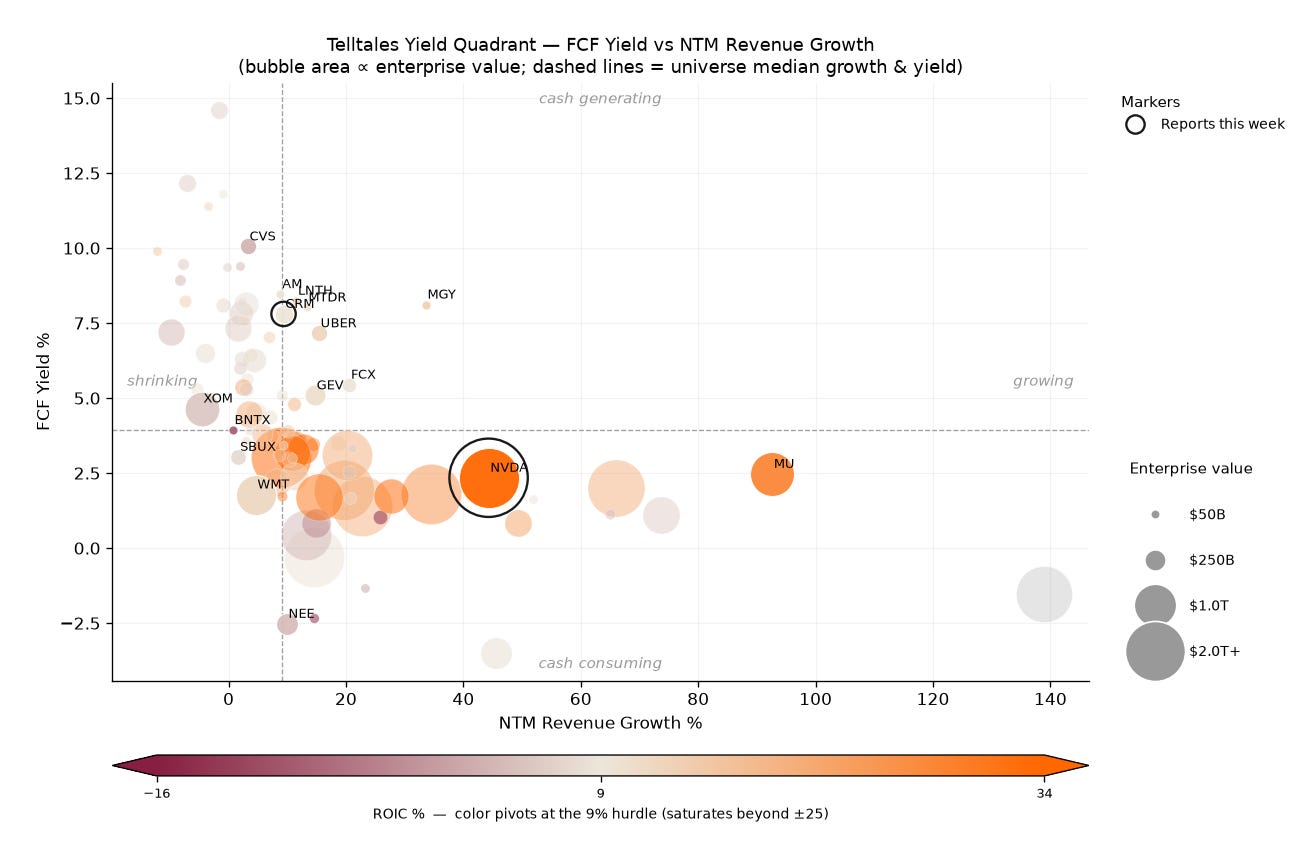
Two of our companies signed deals this week, and the Cash Flow Memo prices them almost identically: about twelve times trailing free cash flow, roughly an eight percent free cash flow yield, page fifteen and page six¹²³⁴. One of them got bought at a premium. The other one had to be its own buyer. The multiple decided none of that. Leverage did, and the leaderboard the memo ranks on does not measure leverage at all.
Start with what an acquirer is actually buying. Curium agreed to take Lantheus out whole — a hundred and two fifty a share in cash plus contingent value rights worth up to twelve dollars more, call it eight billion dollars, per the merger 8-K, with a close pushed out to the first half of 2027⁵. The agreement landed five days after the FDA approved Tauklarify, the company’s tau imaging agent for Alzheimer’s evaluation⁶. What Curium is buying is a business carrying about one turn of debt against its cash flow⁷. Not a multiple. Cash flow with nobody else’s name on it, which turned out to be the scarce thing this week.
Charter ran the same arithmetic from the other side of the table. It closed a thirty-four and a half billion dollar acquisition of Cox and Liberty Broadband, took the largest internet and cable footprint in the country, and then took the acquired company’s name⁸. Same twelve times trailing free cash flow. Ten turns of debt against it⁹, on fifty-four billion dollars of revenue that is going backwards¹⁰. The market prices that equity under four times next year’s earnings¹¹, which is less a verdict on the business than an estimate of who ends up owning the cash it throws off.
Ten turns.
Charter has been at this altitude before. It filed Chapter 11 in March 2009 and came out that November having shed about eight billion dollars of debt, roughly forty percent of the stack, and some eight hundred and thirty million dollars a year of interest expense, per the company’s own release¹². That trade worked because broadband was still a growth business. Cut the debt, keep the subscribers, let the growth re-lever you back into solvency. The same trade is not available on revenue that shrinks, and the fix on offer this time is a bigger footprint bought with more paper.
The California Public Utilities Commission approved the merger on August thirteenth and attached affordable-broadband and network-upgrade conditions to the sign-off¹³. A regulator collecting spending promises from a company whose free cash flow is committed a decade out. Everyone signed.
The cashflow read is in Marcus’s column below; short version, the composite ranks cash yield and growth and stops there. Scroll down to the debt-to-free-cash-flow table in The Tape and read it as something other than a risk screen. It is a list of the companies in this memo that will be approached rather than approaching. The ones that fund the next move with equity…
Website: telltales.substack.com


