

Show notes
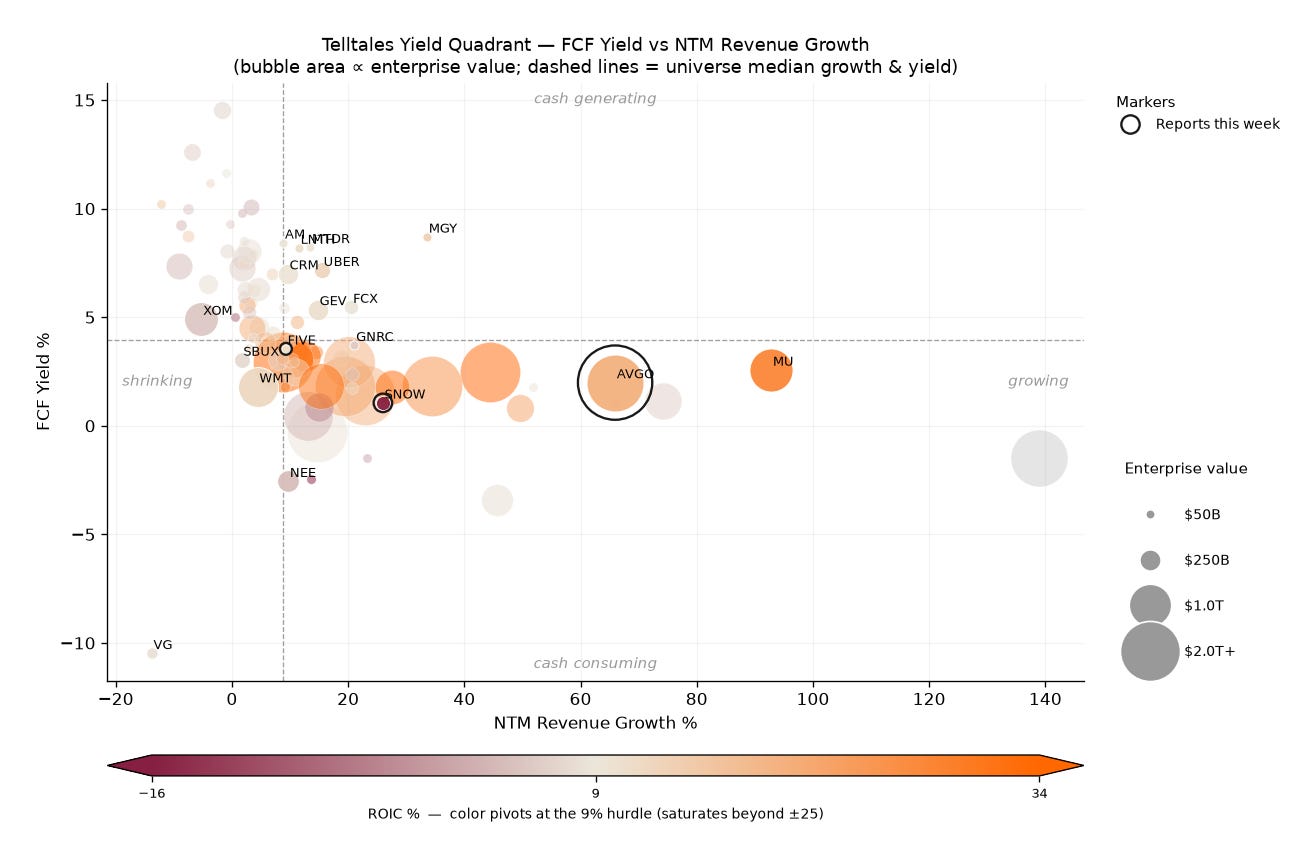
▶ Explore this week’s Tape — live, sortable, drill-down →
The Bid Was the Business
PayPal spent the summer being priced by a buyer rather than by a business, and on Friday it found out which of the two it actually had. Advent and Stripe abandoned an approach that had run to roughly fifty-three billion dollars, a deal that would have ranked among the largest leveraged buyouts ever attempted¹. The stock gave back thirteen percent². Nothing about the company changed on Thursday night. What changed was the number of people willing to pay for it.
Price what walked away. The Cash Flow Memo has PayPal at about six and a half times trailing free cash flow, near a fifteen percent free-cash-flow yield, on close to seven billion dollars of trailing cash generation³. Then the memo does something to PayPal it does not do to anyone on the leaderboard: it takes the name off the ranked list entirely, because an operating-cash-flow method overstates cash for a business that holds customer funds⁴. So take the haircut. Take a generous one. You are still looking at a company the public market prices in single digits, that a buyout firm and a strategic spent a summer trying to take private, and that as of Friday has no bid above the tape.
Six and a half times is only a price if somebody can fund it. A fifty-three-billion-dollar take-private does not get funded out of equity. It gets funded out of the leveraged-loan and private-credit market, which spent this same week being asked for something else. CNBC reported Broadcom in talks over a chip financing package running to seventy or eighty billion dollars, forty-five senior and thirty-five junior, with Blackstone and Apollo among the firms discussed as putting up the money⁵. One deal, one week, aimed at chips that have not shipped.
Larger than the entire PayPal buyout.
Those are not literally the same firms, and the comparison is an argument rather than a report. They are the same appetite. Private credit is a finite bid, and for most of the last decade its natural habitat was the PayPal trade: mature, cash-generative, unloved, with enough coverage to carry debt. That capital now has a shorter, better-paying alternative underwriting infrastructure. When the marginal lender has somewhere better to be, the marginal buyer of cheap cash flow stops turning up, and a multiple that looked like a mispricing turns out to be the clearing price.
Salesforce is the control. It gained twenty-three percent on Thursday, its best day since 2020, for producing evidence that its cash flow survives the technology everyone assumed was coming to kill it⁶. Nobody had to finance that. The equity market re-rated it in a single session, at no cost to anybody. PayPal’s re-rating needed a sponsor, a lender and six weeks, and it did not survive the stock rising into the offer. A leveraged bid with no premium left in it is an expensive way to own what you were already looking at.
Marcus’s column below is on Micron, which has the opposite…
Website: telltales.substack.com


