

Catatan episode
What Europe’s First Pressurized Water Reactor Taught About
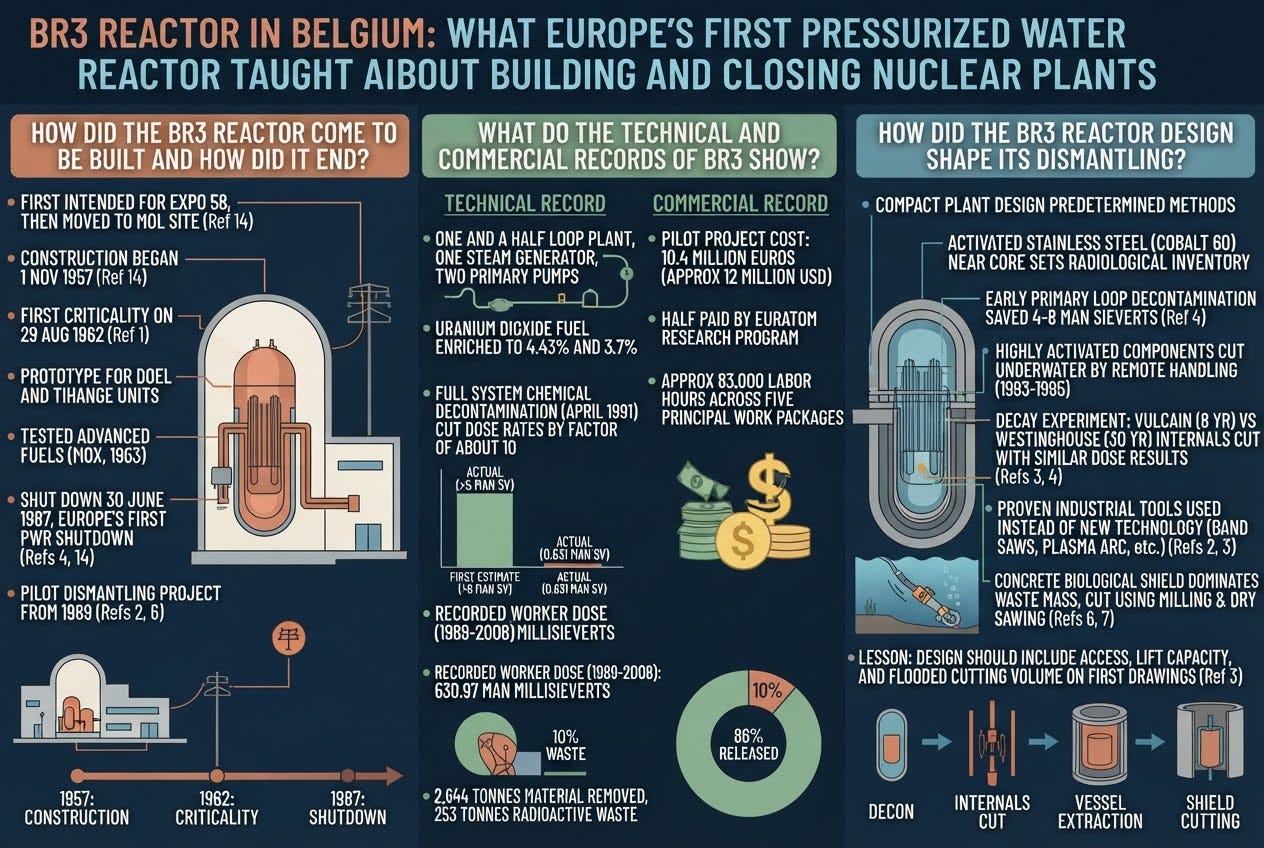
The BR3 reactor at Mol, Belgium, a 40.9 megawatt thermal pressurized water reactor that first reached criticality on 29 August 1962, became the European Commission’s pilot dismantling project in 1989.
BR3 operated until 30 June 1987, tested advanced fuel for the Belgian program, and served as the prototype for the Doel and Tihange units. Its dismantling has run for about 35 years and produced the dose, waste and labor data that Belgian owners now use to plan the closure of their commercial plants. The reactor is forgotten because of its size: at about 10.5 megawatts electric it never competed for a market, and its largest product is a decommissioning record.
Classification: BR3 is classified as a power and demonstration reactor, because it was built and connected to the grid as the first Belgian nuclear power station and served as the prototype for the commercial pressurized water fleet, even though it also carried a fuel test mission.
The technical record shows a one and a half loop plant with one steam generator and two primary pumps, uranium dioxide fuel enriched to 4.43 percent and 3.7 percent, and a full system chemical decontamination in April 1991 that cut dose rates near the primary loop by a factor of about 10. Recorded worker dose from 1989 through 2008 totaled 630.97 man millisieverts against a first estimate above 5 man sieverts. Of 2,644 tonnes of material removed, 253 tonnes remain radioactive waste.
The commercial record shows a pilot project that cost 10.4 million euros, about 12 million US Dollars, with half paid by the Euratom research program, and about 83,000 labor hours across the five principal work packages. The record consulted does not state the original construction cost or the total cost of the full dismantling.
How Did the BR3 Reactor Come to Be Built and How Did It End?
The BR3 reactor came to Mol, Belgium because a Westinghouse pressurized water reactor design, imported from the United States, was first intended to power Expo 58 in Brussels, and safety concerns and administrative problems moved it to the research site at Mol (Ref 14). Construction began on 1 November 1957 (Ref 14). The nuclear research center at Mol had been established in 1952, the BR1 reactor reached criticality there in 1956, and construction of BR2 began in 1957, so BR3 joined a site that already employed the country’s reactor engineers (Ref 14).
BR3 first reached criticality on 29 August 1962, according to the December 1963 operating report, and Belgian sources list commercial operation from 10 October 1962 (Refs 1, 14). The plant sat at Mol Donk, about 90 miles from Brussels. The research center owned it and an industrial group operated it, with operators drawn from conventional power plants and trained in nuclear and conventional work (Ref 1).
The first months produced the data that a prototype exists to produce. Engineers measured control rod and boron worth, temperature and…
Situs: theinnovationattorney.substack.com

