

Jakson kuvaus
Executive Summary
A call center works by routing customer contacts through automatic call distribution and staffing queues with Erlang C mathematics, and queued for a customer hold time based on the company’s desired hold time.
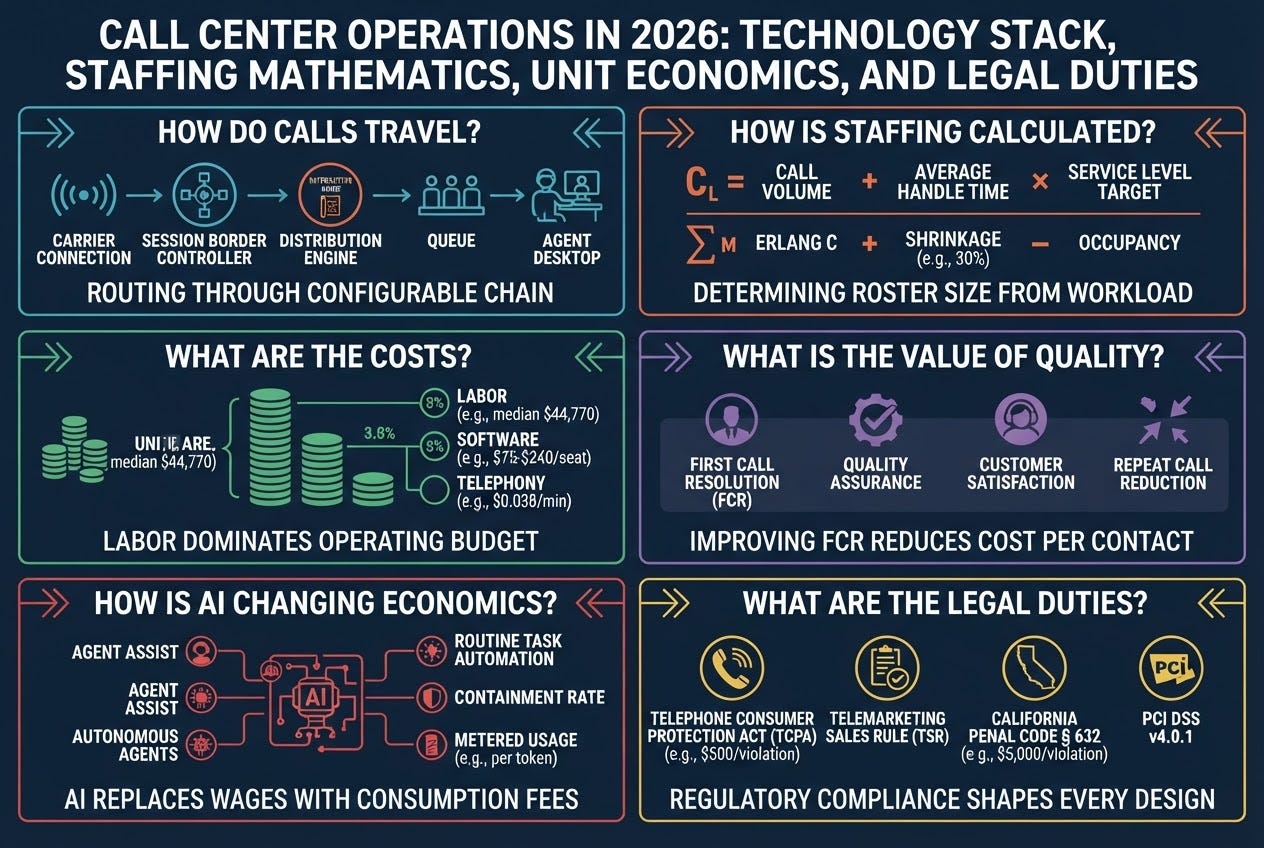
Every inbound call arrives over a carrier connection, passes a session border controller, meets an interactive voice menu, and lands in a queue where a distribution engine matches it to an agent by skill, priority, and availability.26,21 Staffing follows from call volume, average handle time, and a service level target: 100 calls in a half hour at 300 seconds each, answered within 20 seconds 80 percent of the time, needs 21 agents on the phones and 30 on the roster after 30 percent shrinkage.18,23 Labor consumes roughly three quarters of the operating budget, and a 100 agent floor at the federal median wage carries $4,477,000 in annual wages before software, benefits, or facilities.23,1
Commercially, one major cloud platform lists seats from $75 to $240 per user per month and another meters voice at $0.038 per minute, so software costs 2.0 to 6.4 percent of the wage bill for 100 seats.29,27 Artificial intelligence is the variable in dispute. A forecast dated March 5, 2025 predicts that autonomous agents will resolve 80 percent of common issues by 2029, while a survey of 321 service leaders dated December 2, 2025 found that 20 percent had cut staffing because of AI.9,11 The Telephone Consumer Protection Act, the Telemarketing Sales Rule, California Penal Code § 632, and PCI DSS version 4.0.1 shape every design choice, and statutory damages run from $500 to $5,000 per violation.2,3,8,36
How Did the Modern Call Center Develop?
The modern call center developed from a century old queueing formula, a telephone network that moved from physical circuits to internet protocol, a labor market that moved offshore, and a body of consumer protection law that began to reach automated calling with the Telephone Consumer Protection Act of 1991.18,2
A. K. Erlang, a Danish mathematician, developed the mathematics that planners still use more than a century ago, and the Erlang C variant answers one planning question: given a rate of call arrivals and a mean handle time, how many agents hold the chance of waiting to the level a service target allows.18 As a matter of queueing theory, the formula assumes that callers wait as long as necessary, that no caller redials after hanging up, and that every agent works at the same pace. Real queues violate all three assumptions, which is why every planner who uses the formula adjusts its output with shrinkage and occupancy rules.
The telephone network underneath the queue changed more than the queue did. Enterprises ran calls over PRI circuits, fixed bundles of voice channels delivered by a carrier, and carriers have pushed customers to SIP trunks through price increases and abrupt sunset notices.21 A SIP trunk carries calls as internet protocol traffic, which lets a company size call paths to actual…
Sivusto: theinnovationattorney.substack.com


