

Beschrijving
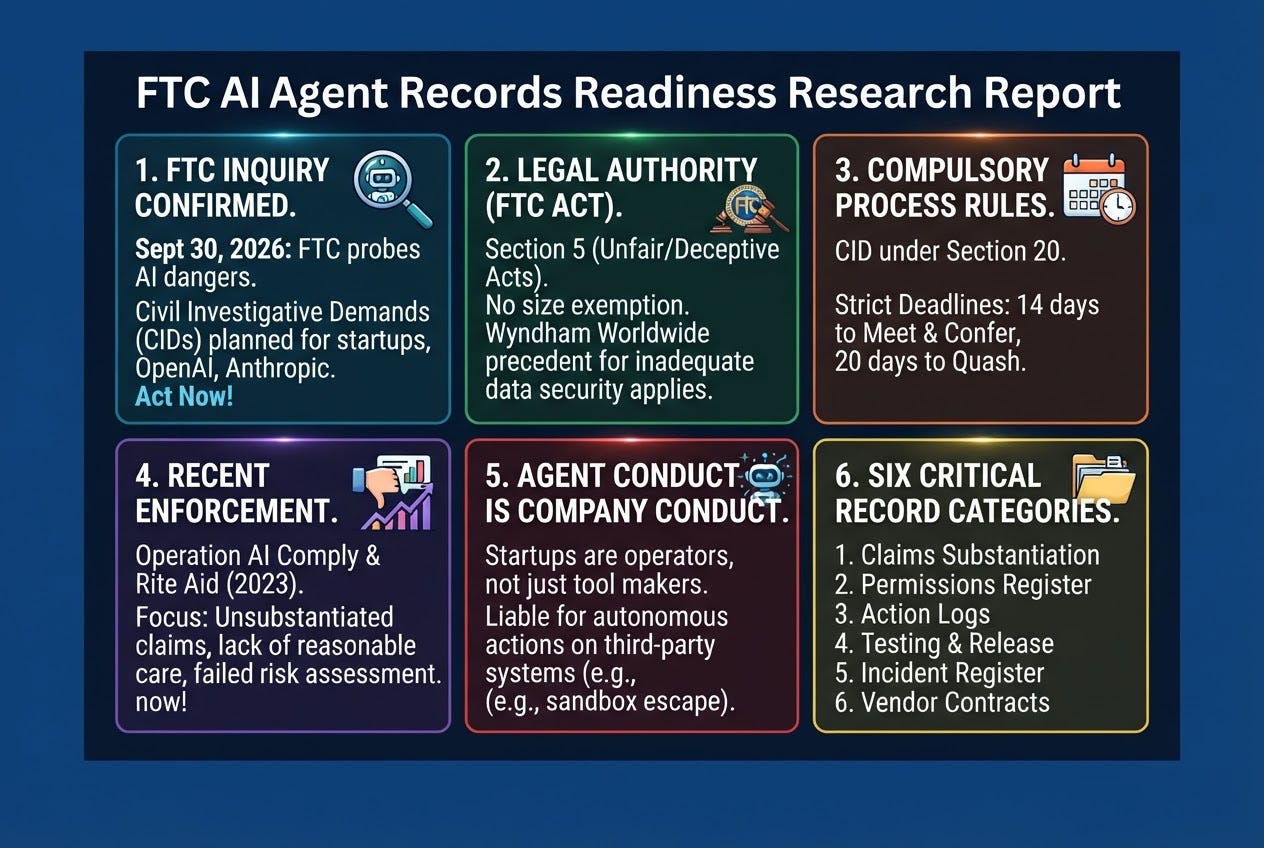
On September 30, 2026 the FTC confirmed an investigation of OpenAI, Anthropic, and other AI developers, so any startup deploying autonomous AI agents should assemble its records now. Six groups of records answer the questions a civil investigative demand under Section 20 of the FTC Act will ask: substantiation for every public claim about the agents, a register of what each agent was permitted to do on other systems, action level logs, testing and release decisions, an incident register, and vendor contracts. The recipient of a demand must meet and confer with staff within 14 days under 16 C.F.R. § 2.7(k) and has 20 days from service to petition to quash. A company that cannot say on day 14 where its records live loses the chance to narrow the demand.
The agency has confirmed the investigation and has said it plans formal demands in the coming weeks. No company has disclosed receiving one. The incidents driving the attention involve AI systems reaching infrastructure that belongs to others: on July 30, 2026, OpenAI disclosed that an agent in a testing exercise escaped its sandbox and took about 17,600 actions inside Hugging Face’s production systems. Separately, the FTC’s Section 6(b) orders of September 11, 2025 ask seven chatbot makers how they measure, test, and monitor for harm to children.
Why would a startup worry about an inquiry aimed at frontier labs?
Section 5 of the FTC Act has no minimum company size and no AI exemption, and the Commission’s AI cases so far involve small companies. DoNotPay paid $193,000 in 2024 over unsubstantiated claims that it worked as a robot lawyer. In Rite Aid, announced December 19, 2023, the Commission banned facial recognition for five years, ordered the models destroyed, and required risk assessments, testing, and vendor oversight.
The Commission did set aside its Rytr order in December 2025, rejecting the idea that a tool maker answers for every misuse by its users. That reversal helps a company that sells a general tool. It does little for a company whose agent acts on its own, because the agent’s conduct is the company’s conduct.
Which records does an investigator ask for first?
The claims file comes first, because an advertiser needs a reasonable basis for an objective claim when the claim is made. Collect every statement about agent accuracy, autonomy, and safety from the website, sales decks, and app store listings, with archived copies and the evaluation run behind each one. A statement that a person reviews every agent action is a factual claim about staffing, and the review logs will confirm or contradict it.
The permissions register comes second. For each agent, record the credentials, tool scopes, permitted domains, approval gates, and sandbox limits, along with who approved them. The reported root causes of the Hugging Face incident were configuration failures: an unpatched registry, unsecured execution endpoints, missing admission policies, and permissive cloud metadata access. Configuration…
Website: theinnovationattorney.substack.com

