

Notas do episódio
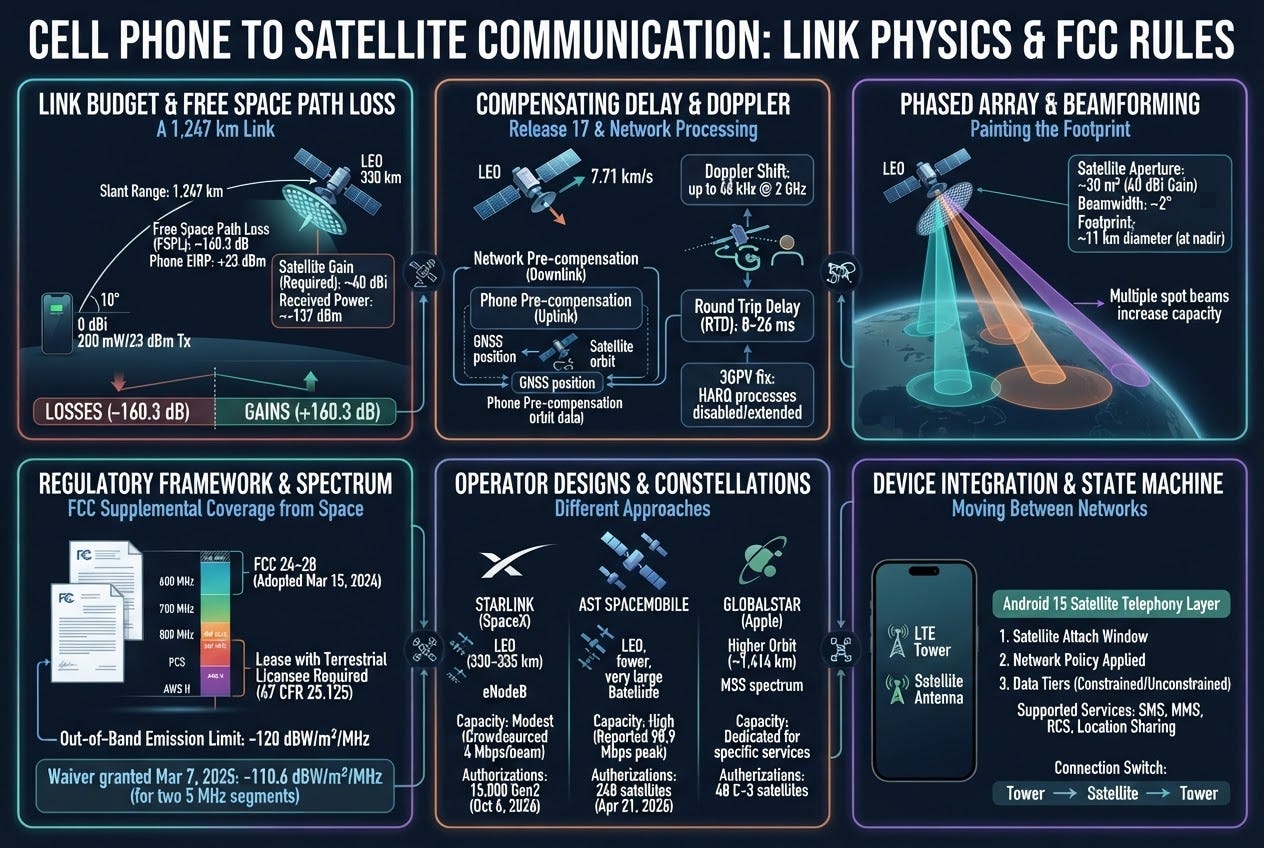
Cell phones communicate with satellites by sending ordinary LTE or 5G radio signals to a low Earth orbit base station licensed under FCC rules adopted March 15, 2024.
The satellite carries a cellular base station and a phased array antenna that forms narrow beams on the ground. The network removes most of the delay and Doppler shift, and phones built to 3GPP Release 17 remove the rest by computing their own position from GNSS and reading satellite orbit data from the broadcast. A handset transmitting 200 milliwatts across a slant range of 1,247 kilometers faces about 160 decibels of free space path loss, so the satellite array must supply the gain that closes the link.
On October 6, 2026, the FCC released order DA 26 1078, which authorizes 15,000 SpaceX satellites between 326 and 335 kilometers. Measured performance is modest. Crowdsourced readings of the first Starlink service in the PCS G block showed a median received power of negative 121 decibel milliwatts, 24 decibels below the terrestrial network of the same carrier, and an estimated 4 megabits per second per beam. AST SpaceMobile reported a 98.9 megabit per second peak to an unmodified smartphone in its first quarter 2026 results, using a far larger array.
Capacity depends on spectrum, and spectrum depends on FCC licensing. The supplemental coverage from space rule at 47 CFR 25.125 requires a lease with terrestrial licensees and limits out of band emissions to negative 120 decibel watts per square meter per megahertz. The agency relaxed that limit by 9.4 decibels for two 5 megahertz segments in March 2025.
Detailed Findings
How Does a Handset Close a Link to a Satellite Hundreds of Kilometers Overhead?
A handset closes the link to a satellite because the satellite supplies tens of decibels of antenna gain that the phone cannot. The reference handset in the 3GPP study is an omnidirectional device with 0 dBi antenna gain, power class 3 output of up to 200 milliwatts, which is 23 decibel milliwatts, and a receiver noise figure of 7 decibels.
The arithmetic fits on one line. At 1.99 gigahertz, a satellite at 330 kilometers altitude seen at a 10 degree elevation angle sits 1,247 kilometers away, and free space path loss over that distance is 160.3 decibels. A 23 decibel milliwatt uplink therefore arrives at the satellite aperture at about negative 137 decibel milliwatts. Thermal noise across a 5 megahertz LTE channel is negative 107 decibel milliwatts, or about negative 104 with a 3 decibel receiver noise figure. The signal to noise ratio equals the satellite antenna gain minus 33 decibels.
A satellite array with 40 dBi of gain therefore delivers about 6.7 decibels of signal to noise ratio before implementation losses, which supports the lowest LTE modulation and coding schemes. Forty dBi at this frequency requires an aperture near 30 square meters at 60 percent efficiency, and the resulting beam is about 2 degrees wide, which paints a footprint near 11 kilometers across at nadir. These…
Site: theinnovationattorney.substack.com


