

Notas del episodio
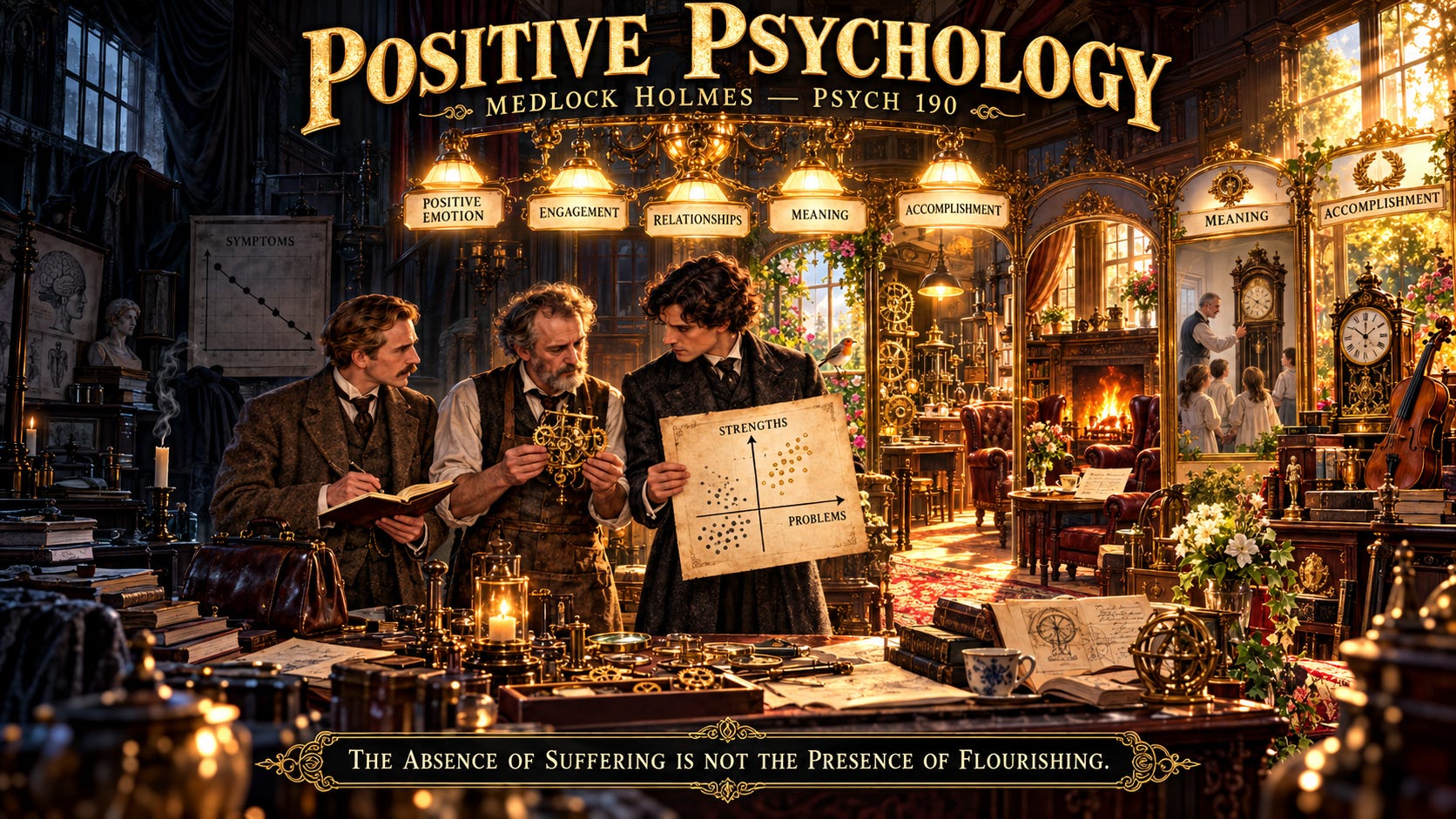
It was a bitter November morning when Dr Watson discovered an unusual letter upon the breakfast table at 221B Baker Street.
The envelope bore the seal of a distinguished physician, Sir Edmund Ashcroft.
Dear Mr Holmes,
My patient has recovered from his illness, yet he insists he is not well. Every investigation suggests improvement, every symptom scale confirms remission, and still he describes his life as empty.
I fear I have cured the disease but failed the man.
Holmes read the letter twice.
“A fascinating paradox, Watson. We have been summoned to investigate a house in which the fire has been extinguished, but no one has thought to open the windows.”
“Surely, Holmes, extinguishing a fire is a considerable achievement.”
“Indeed. But it does not necessarily make the house worth living in.”
That afternoon, they arrived at the home of Mr Arthur Bellamy, a forty-two-year-old watchmaker who had recently completed treatment for a severe depressive episode.
Bellamy welcomed them politely.
“My sleep has improved. My appetite has returned. I no longer feel the despair that once consumed me. Sir Edmund says I am recovered.”
“And do you agree?” asked Watson.
Bellamy looked towards the window.
“I suppose I am no longer miserable. But I am not happy either. I wake, work, eat and sleep. Nothing seems particularly wrong. Nothing seems particularly right.”
Holmes glanced around the room.
There were no paintings, no music, no visitors and no evidence of hobbies.
Yet the workshop beyond the door contained magnificent clocks, their mechanisms intricate and exquisitely assembled.
“Tell me, Mr Bellamy, what was your life like before your illness?”
“I had friends. I played the violin. I repaired clocks for the children’s hospital. I loved teaching my apprentice. But I stopped everything when I became ill.”
“And since recovering?”
“I have not begun again.”
Holmes approached the workshop.
“Then, Watson, we must examine five curious chambers.”
The first chamber contained a magnificent window overlooking a garden.
Above it was written:
POSITIVE EMOTION
Holmes asked Bellamy to describe one pleasant moment from the previous week.
“There was a robin on the windowsill. I watched it for several minutes.”
“And what did you feel?”
“A little warmth, perhaps.”
“Then our first discovery is that pleasure has not entirely disappeared. We may help you notice and savour it without pretending that every moment must be cheerful.”
The second chamber contained an unfinished clock.
Its inscription read:
ENGAGEMENT
Holmes handed Bellamy a tiny brass gear.
“Would you repair this?”
Bellamy sat at the workbench.
Minutes passed. Then an hour.
When he finally looked up, he seemed astonished.
“Good heavens. I had forgotten the time.”
Watson smiled.
“An unusual observation for a watchmaker.”
“Quite,” Holmes replied. “He has experienced what Professor Csikszentmihalyi calls flow: absorption in a challenging activity that matches one’s abilities.”
The third chamber contained two chairs beside a…
Web: drmanaankarray.substack.com


