

Notes d’épisode
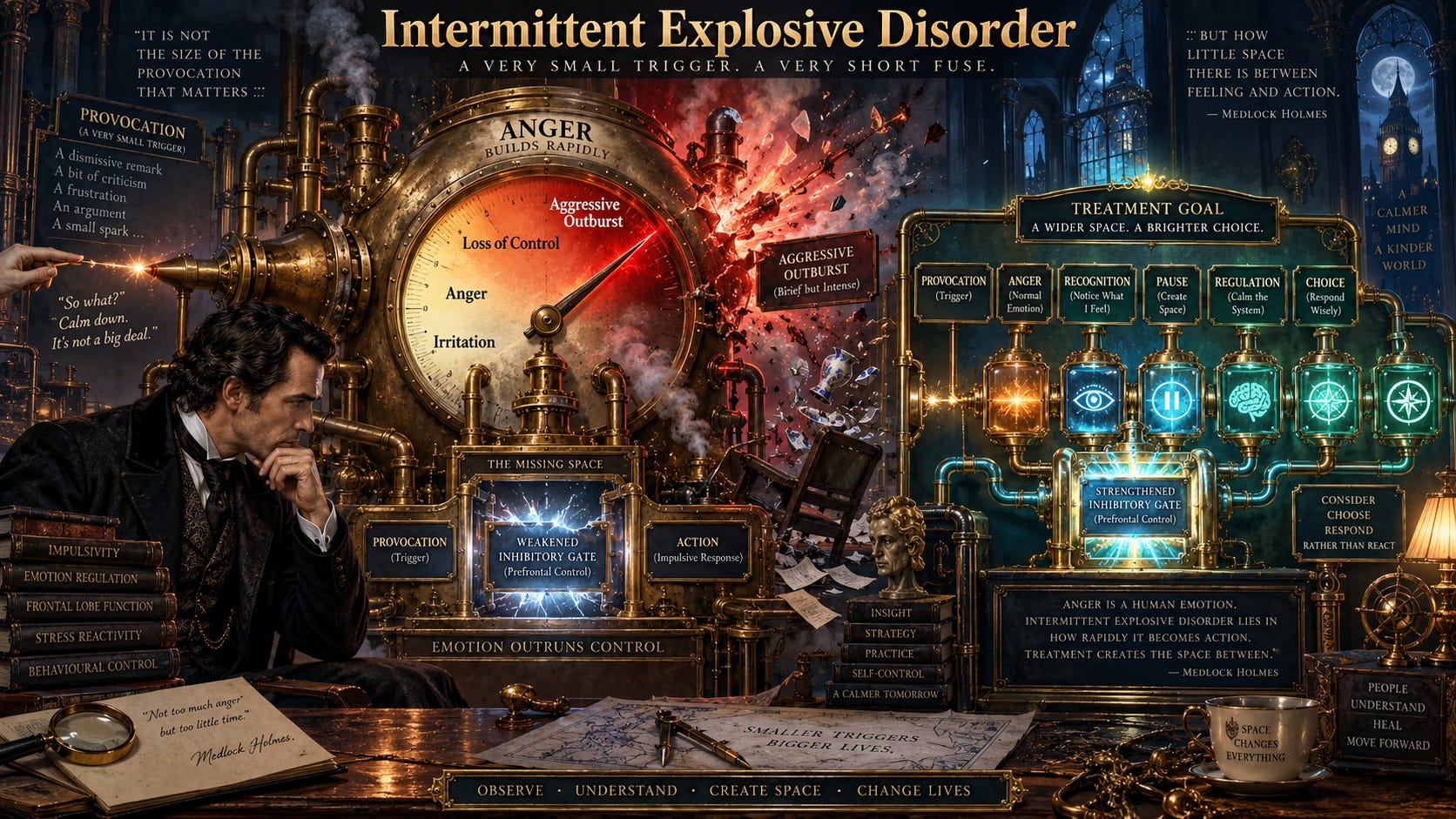
Medlock Holmes enters an immense Neo-Victorian institution known as The Hall of Impulsive Aggression.
At first, the building seems calm.
Then a small bell rings.
Someone makes a dismissive remark.
A door slams.
A criticism is heard.
A minor disagreement begins.
Within seconds, an enormous brass pressure chamber erupts.
The explosion is dramatic, but brief.
Then silence.
The whole event has lasted less than half an hour.
Holmes looks around at the damage and immediately notices something important:
this was not planned.
There was no calculated strategy.
No attempt to gain money.
No effort to intimidate someone for a specific objective.
No long campaign of revenge.
Instead, there was a rapid transition:
PROVOCATION → ANGER → IMPULSIVE AGGRESSION → CONSEQUENCES
That sequence is the core of intermittent explosive disorder, or IED.
The disorder is defined not simply by anger, irritability or aggression, but by recurrent behavioural outbursts representing a failure to control aggressive impulses. These outbursts may take the form of verbal aggression, tantrums, tirades, arguments, physical aggression without injury, or - in more severe episodes - damage to property or assault causing physical injury. The aggression is grossly out of proportion to the provocation, is impulsive or anger-based rather than premeditated, and causes meaningful distress, interpersonal or occupational impairment, or financial or legal consequences.
Holmes stops before a large diagnostic board.
Two separate pathways are engraved into it.
The first describes frequent, lower-severity outbursts:
verbal aggression or noninjurious physical aggression occurring on average twice weekly for 3 months.
The second describes less frequent but more severe aggression:
three episodes within 12 months involving destruction of property or physical assault causing injury.
Both routes lead to the same central chamber:
FAILURE TO CONTROL IMPULSIVE AGGRESSION
But Holmes notices the next criterion is just as important.
The magnitude of the response must be:
GROSSLY OUT OF PROPORTION
to the trigger.
A minor provocation cannot simply be used as justification for a major aggressive act.
The disorder therefore concerns not merely the presence of aggression, but the relationship between:
trigger
and
response.
The next room is labelled:
IMPULSIVE, NOT INSTRUMENTAL
Here Holmes sees two contrasting scenes.
In one, a person carefully plans an assault to obtain power, money or intimidation.
In the other, a person explodes in anger before thinking through the consequences.
Only the second resembles the IED pattern.
This distinction is fundamental.
IED is about:
REACTIVE AGGRESSION
rather than:
PREMEDITATED OR GOAL-DIRECTED AGGRESSION
Holmes then enters the Differential Diagnosis Gallery, where the investigation becomes more difficult.
Aggression is not specific to IED.
It can occur in:
* disruptive mood dysregulation disorder
* antisocial personality disorder
* borderline personality disorder
* ADHD
*…
Site web: drmanaankarray.substack.com


