

Epizódjegyzetek
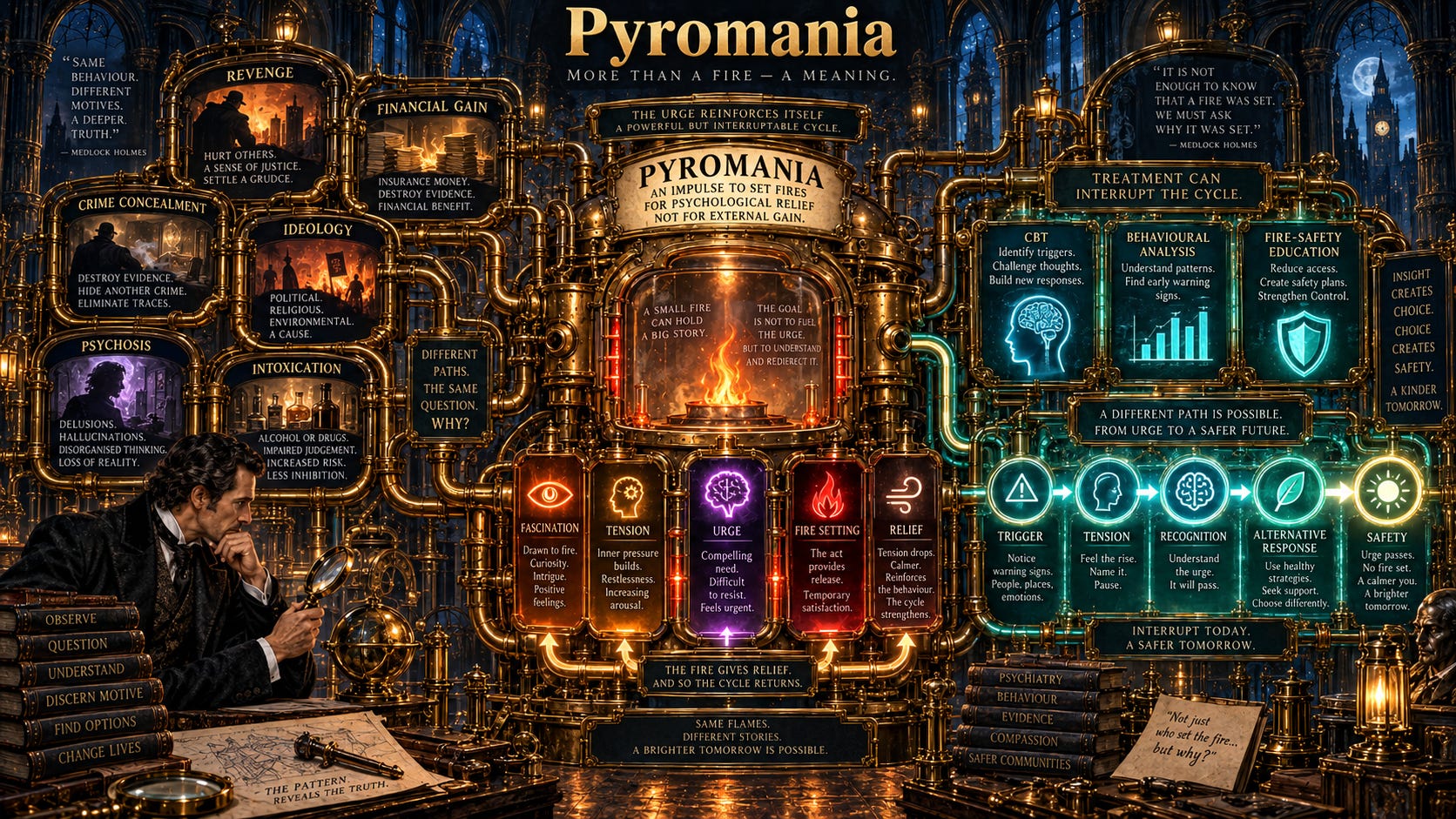
and subsequent pleasure or relief.
Medlock Holmes enters a vast Neo-Victorian fire investigation chamber where one question dominates the room:
WHY WAS THE FIRE SET?
Pyromania is not simply fire setting, and most people who deliberately start fires do not have pyromania. The diagnosis requires repeated, deliberate and purposeful fire setting accompanied by increasing tension or emotional arousal beforehand and pleasure, gratification or relief during the act or while witnessing its aftermath. Individuals may also show an unusual fascination with fire itself - its equipment, institutions, consequences and the people associated with firefighting.
The motive is crucial.
Pyromania excludes fires set for:
* financial gain
* revenge
* anger
* concealment of another crime
* political or ideological expression
* intimidation
* psychosis
* intoxication
* impaired judgement from another neurological or psychiatric disorder.
This distinguishes pyromania from the much broader behaviour of arson or fire setting.
Holmes also has to distinguish pathological behaviour from ordinary developmental curiosity. Children may experiment with matches or flames without having a psychiatric disorder. In young people, assessment must explore developmental level, motive, recurrence, family environment and broader behavioural disturbance.
Pyromania itself appears to be rare. General fire setting is considerably more common, and most recurrent arsonists do not meet diagnostic criteria for pyromania. The disorder appears more frequently in males and usually begins in adolescence or young adulthood. Its course may be chronic or fluctuate over time.
The neurobiology remains poorly understood. Limited reports suggest possible abnormalities in frontal inhibitory control, cognitive flexibility, serotonin and noradrenaline systems, while dopaminergic vulnerability has also been suggested in isolated cases. These findings remain preliminary rather than established biomarkers.
Treatment evidence is similarly limited. There are no approved medications specifically for pyromania and no controlled pharmacological trials. Case reports describe possible benefit from several medications, but findings are inconsistent.
The strongest practical approach is behavioural and psychological treatment. CBT may help identify the sequence:
TRIGGER → TENSION → FIRE-RELATED THOUGHT → URGE → FIRE SETTING → RELIEF
Treatment then creates alternative responses before the behaviour occurs.
Fire-safety education, relaxation strategies, positive reinforcement, behavioural analysis and structured firesetting programmes may also contribute.
Holmes therefore ends the investigation with a simple principle:
“Do not diagnose the fire. Diagnose the motive, the pattern and the reinforcement.”
Key Takeaways
1. Pyromania Is More Than Fire Setting
The disorder requires:
REPEATED DELIBERATE AND PURPOSEFUL FIRE SETTING
Fire setting alone does not establish the diagnosis.
2. Tension Usually Builds Before the Act
A…
Weboldal: drmanaankarray.substack.com


