

Show notes
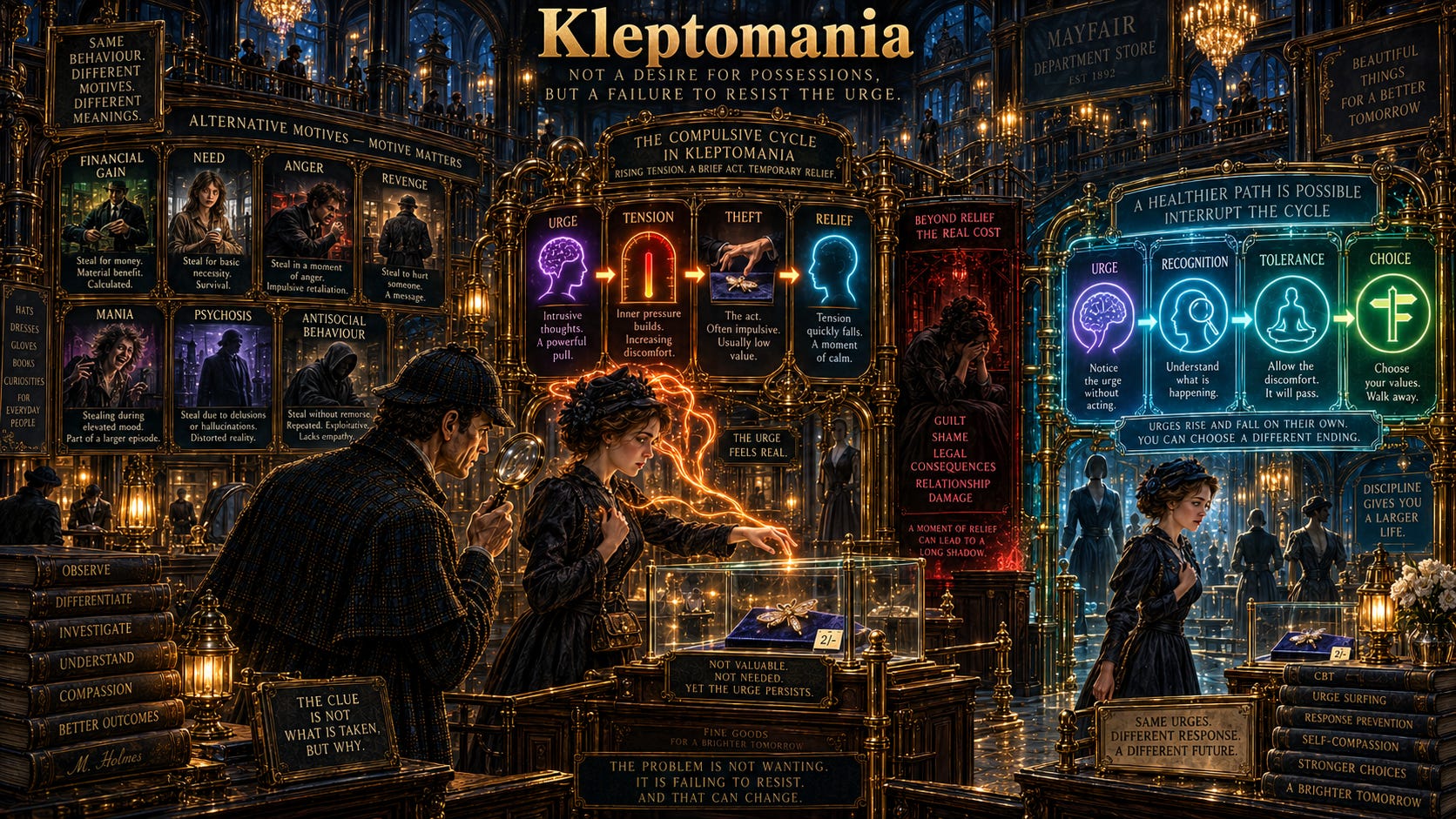
Medlock Holmes enters a vast Neo-Victorian department store where an unusual investigation is underway.
An object has been stolen.
But the person who took it did not need it. The object had little personal importance. They could easily have afforded it. They may not even use it afterwards - sometimes the stolen objects are hidden, hoarded, given away or even secretly returned.
So Holmes asks the question that defines the investigation:
“If they did not need the object, why did they steal it?”
Kleptomania is characterised by a recurrent failure to resist impulses to steal objects that are not needed for personal use or monetary value. Immediately before the theft there is typically increasing tension; during the theft there is pleasure, gratification or relief. Afterwards, however, the person may experience guilt, shame, depression and considerable distress.
The theft is usually not carefully planned. Little attention may be given to the consequences in the moment. The urge itself is often ego-dystonic: the person recognises that the behaviour conflicts with their values and may desperately wish they could stop.
This creates the characteristic cycle:
URGE → TENSION → THEFT → RELIEF → GUILT → REPEATED URGE
But not every act of shoplifting is kleptomania.
Holmes must exclude stealing motivated by:
* financial gain
* genuine need
* anger
* revenge
* delusions or hallucinations
* mania
* conduct disorder
* antisocial personality disorder.
The distinction is crucial because shoplifting describes a behaviour; kleptomania describes the psychopathological mechanism driving it.
The disorder is uncommon in the general population, with an estimated prevalence of approximately 0.3–0.6%, although rates are higher among people arrested for shoplifting. It commonly begins during adolescence, may follow a chronic waxing-and-waning course, and occurs more frequently in women. Comorbidity is extensive, particularly with mood, anxiety, eating, substance use, personality and other impulse-control disorders. OCD is also frequently reported, raising questions about whether kleptomania shares compulsive as well as impulsive mechanisms.
Its neurobiology remains uncertain. Studies suggest possible involvement of impulsivity, executive control, inferior frontal and orbitofrontal circuitry, while serotonin, dopamine, opioid and glutamatergic systems have all been investigated.
Treatment evidence remains limited. SSRIs have produced inconsistent results, whereas naltrexone has some of the strongest pharmacological evidence, including a placebo-controlled trial showing substantially greater symptom remission than placebo. Lithium, topiramate and memantine have also been explored.
Psychological treatment is less well studied, but CBT approaches - including exposure and response prevention - may help patients recognise the urge, tolerate the rising tension and discover that it can decline without stealing.
Holmes therefore does not concentrate on the stolen object.
He…
Website: drmanaankarray.substack.com


