

Show notes
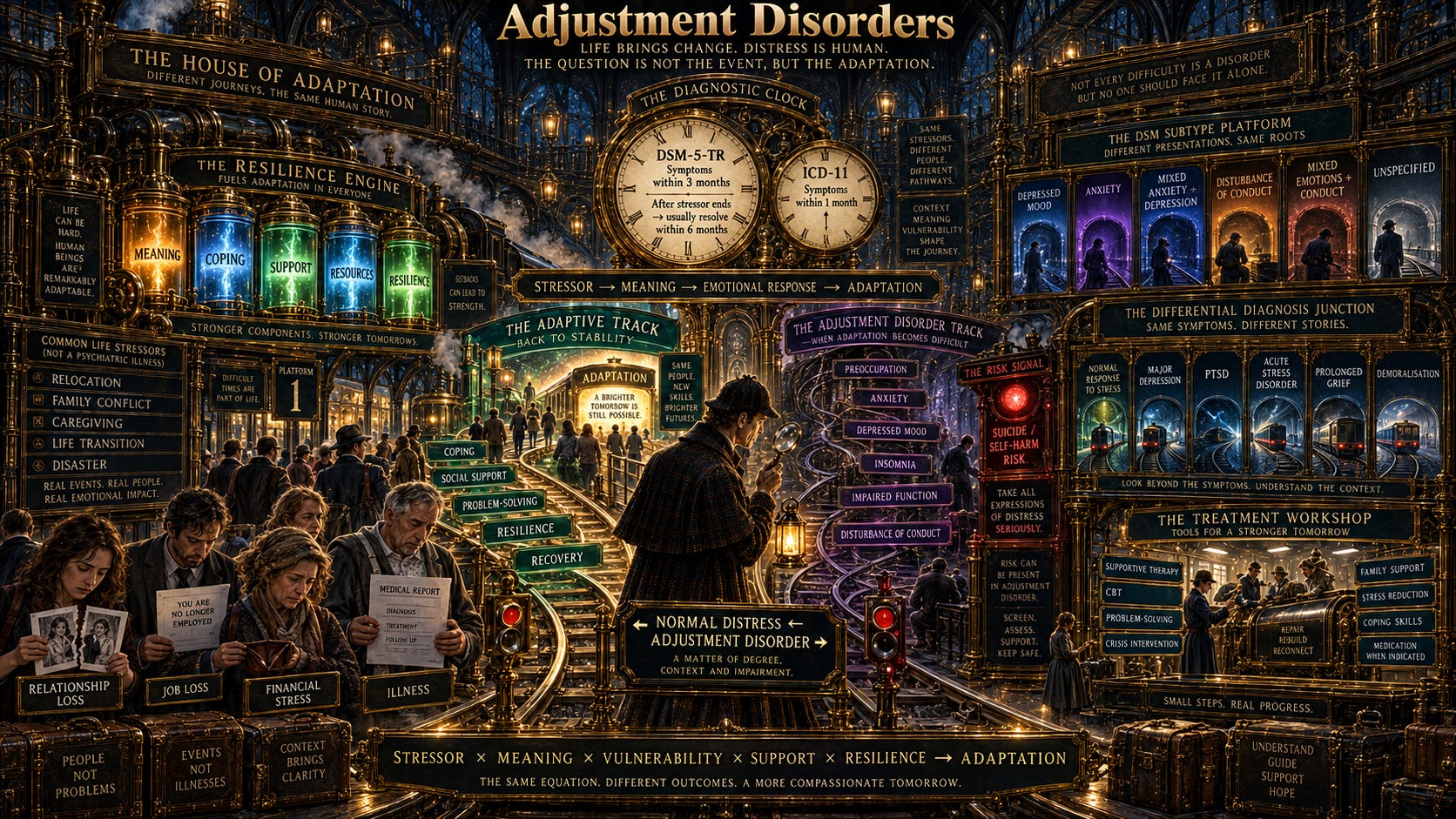
Medlock Holmes enters The House of Adaptation, where people arrive carrying the weight of events that have changed their lives: relationship breakdown, financial hardship, illness, unemployment, conflict, relocation, bereavement and unexpected transitions.
But Holmes immediately encounters psychiatry’s central difficulty with adjustment disorder:
“When does distress become disorder?”
Adjustment disorder is defined by the development of significant emotional or behavioural symptoms in response to an identifiable stressor. Unlike PTSD, the stressor does not have to involve threatened death, serious injury or sexual violence. It may instead be an event encountered routinely in human life - divorce, losing a job, financial problems, illness or major life transition.
In DSM-5-TR, symptoms develop within 3 months of the stressor and cause either distress that is disproportionate to the stressor, taking cultural and contextual factors into account, or significant impairment in functioning. Once the stressor or its consequences have ended, symptoms should not persist beyond 6 months.
Yet this apparently simple diagnosis contains a profound clinical dilemma. There is no precise laboratory test or symptom threshold separating adjustment disorder from an understandable response to adversity. Holmes must understand the person, the stressor, its meaning, their culture, previous vulnerabilities, available supports and capacity for adaptation.
The disorder may present with depression, anxiety, conduct disturbance, or mixtures of these. ICD-11 approaches the diagnosis somewhat differently, emphasising preoccupation with the stressor and failure to adapt, and requiring symptoms to emerge within one month.
Adjustment disorder is often regarded as relatively mild and self-limiting, but that assumption can be dangerous. Suicidal ideation and self-harm can occur, sometimes relatively early and impulsively, making careful risk assessment essential.
Treatment therefore focuses less on simply suppressing symptoms and more on restoring the process of adaptation: understanding the stressor, mobilising social support, strengthening coping and problem-solving, reducing avoidable stress, and helping the person regain functioning. Psychotherapy and psychosocial interventions remain central, while medication may sometimes target significant anxiety, insomnia or depressive symptoms.
Holmes eventually discovers that the stressor is only one part of the equation.
Two people can experience the same event and follow entirely different paths.
The real mystery lies in the relationship between:
STRESSOR × MEANING × VULNERABILITY × SUPPORT × RESILIENCE
Adjustment disorder sits precisely at that intersection - between adversity and adaptation, and between ordinary suffering and psychiatric disorder.
Key Takeaways
1. An Identifiable Stressor Is Essential
Adjustment disorder cannot be diagnosed without a recognisable:
STRESSOR → EMOTIONAL / BEHAVIOURAL RESPONSE
Common stressors include…
Website: drmanaankarray.substack.com

