
Bölüm notları
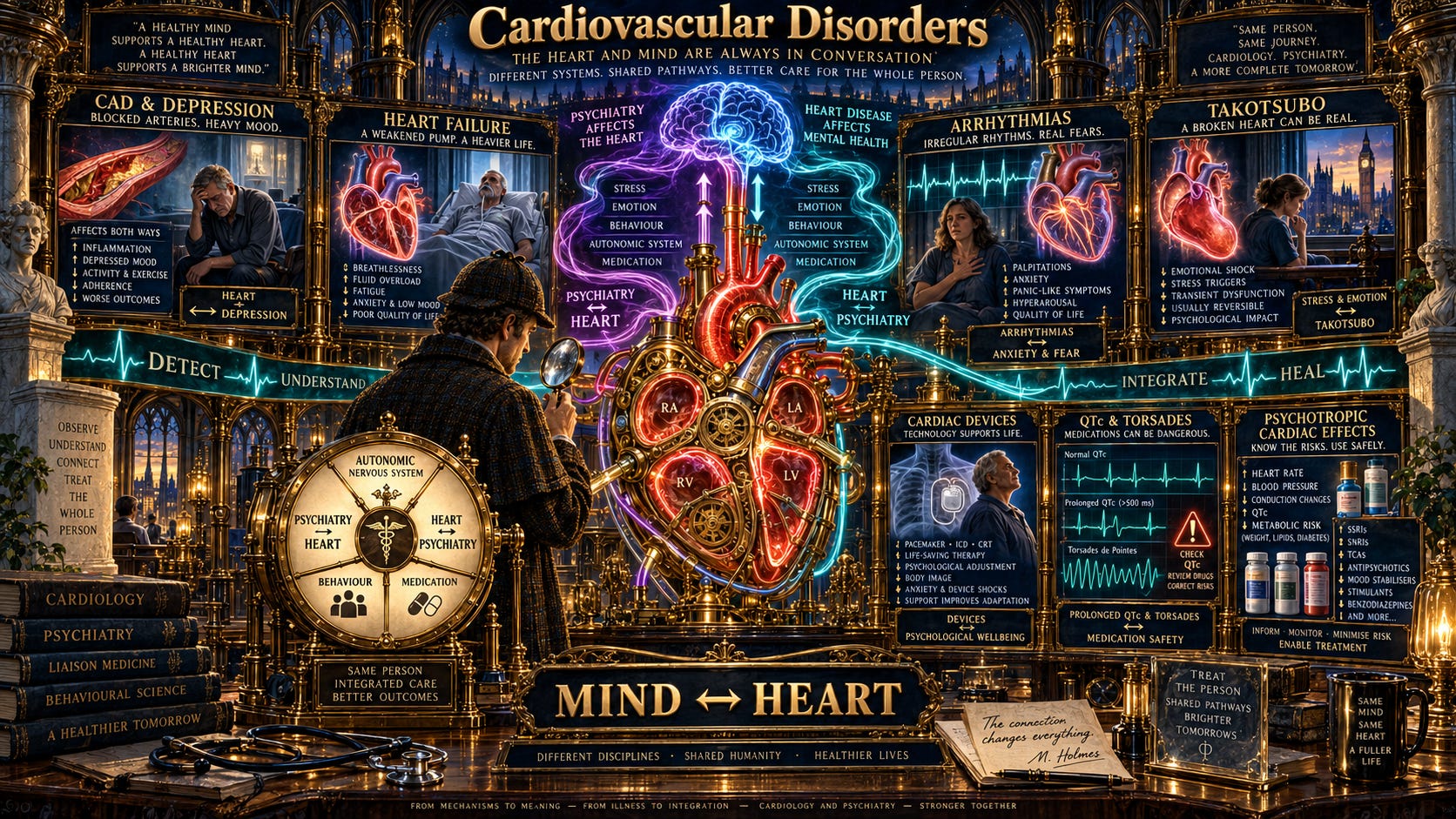
Medlock Holmes enters The Engine Room of the Heart, where an enormous mechanical heart is connected to the brain by networks carrying stress, emotion, behaviour, autonomic signals and medication effects.
The relationship is strikingly bidirectional. Cardiovascular disease can produce anxiety, depression, cognitive disturbance and trauma-related symptoms, while psychiatric disorders and psychological stress can influence cardiovascular risk, recovery and mortality. Behaviour provides another bridge: smoking, inactivity, poor diet and reduced adherence can all become more prominent during psychiatric illness. Cardiovascular disease remains a major cause of death and disability, making these interactions clinically important.
Holmes begins with coronary artery disease (CAD). Depression is strongly associated with both the development and progression of CAD, with behavioural pathways such as smoking, inactivity and poor adherence interacting with possible biological pathways involving autonomic function, the HPA axis, endothelial function and platelet activation. Anxiety, PTSD, chronic stress and low social support also enter the investigation.
The relationship becomes especially important in severe mental illness. People with schizophrenia, schizoaffective disorder and bipolar disorder experience substantial cardiovascular morbidity through overlapping influences: smoking, sedentary behaviour, reduced access to healthcare, metabolic illness and the cardiometabolic effects of some psychotropic medications.
Holmes then enters the chambers of heart failure, transplantation and ventricular assist devices, where psychiatric assessment becomes part of complex cardiovascular treatment. Depression, anxiety, cognition, substance use, adherence, social support and decision-making capacity may all influence care.
But another mystery emerges: sometimes the heart masquerades as the mind. Arrhythmias, syncope and pulmonary thromboembolism can resemble panic or functional symptoms. Conversely, panic disorder, anxiety and somatic symptom disorder can produce chest pain and palpitations that resemble cardiac disease.
The ECG therefore becomes part of the psychiatrist’s toolkit. Psychotropic medications can affect heart rate, conduction, blood pressure and ventricular repolarisation. Holmes pays particular attention to QTc prolongation and torsades de pointes, recognising that risk depends not simply on one medication but on the combination of drug, dose, cardiac disease, age, sex, renal or hepatic dysfunction, electrolyte abnormalities, bradycardia and interacting medications.
By the end, Holmes realises that the heart is neither simply a mechanical pump nor a metaphor for emotion.
It is an organ profoundly influenced by brain, behaviour, environment, illness and treatment.
Key Takeaways
1. Cardiovascular Disease and Psychiatry Have a Two-Way Relationship
The central framework is:
PSYCHIATRIC ILLNESS → CARDIOVASCULAR RISK
and
CARDIOVASCULAR ILLNESS → PSYCHIATRIC…
Web sitesi: drmanaankarray.substack.com


