

Notatki do odcinka
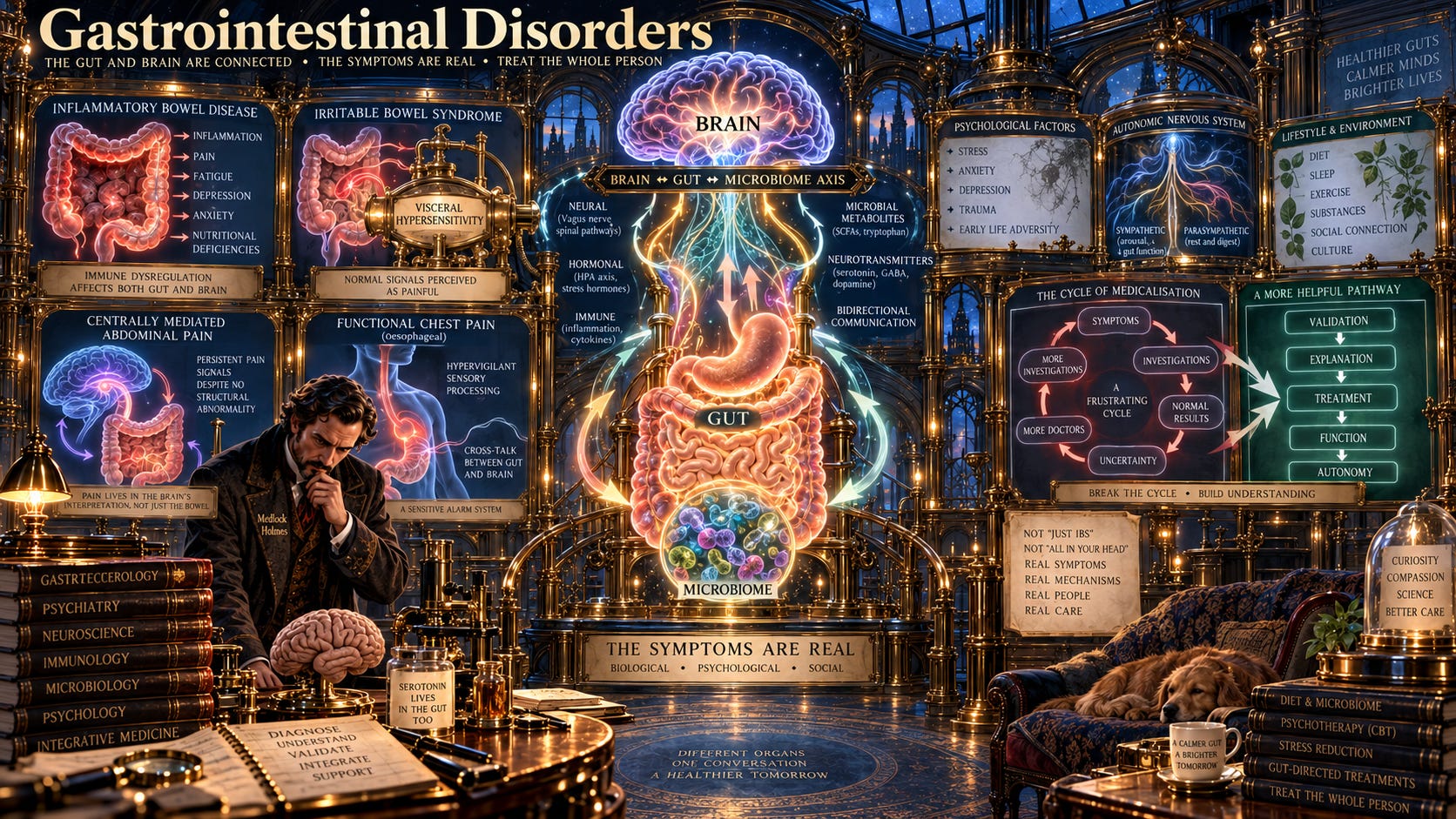
and the extraordinary bidirectional conversation of the brain–gut–microbiome axis.
Medlock Holmes enters The Great Gut–Brain Exchange, an immense Neo-Victorian communication network in which the brain and gastrointestinal tract are joined by constantly moving signals. Messages travel downward through the autonomic nervous system, HPA axis and neuroendocrine pathways, while sensory, immune, hormonal and microbial signals travel back towards the brain.
There is no single direction of causation.
Instead:
BRAIN ↔ GUT ↔ IMMUNE SYSTEM ↔ MICROBIOME
This brain–gut–microbiome axis provides the central framework for understanding why gastrointestinal illness and psychiatric symptoms so frequently coexist. Biological, psychological and social influences are not competing explanations; they are interacting parts of the same system.
Holmes first investigates inflammatory bowel disease, principally Crohn disease and ulcerative colitis. These are inflammatory diseases, yet their consequences extend far beyond the bowel. Depression and anxiety are common, particularly when disease is active, while pain, fatigue, cognitive difficulties, insomnia, fear of incontinence and the experience of repeated hospitalisation or surgery can profoundly affect psychological wellbeing. The relationship may also operate in the opposite direction, with psychological distress influencing symptom experience, self-management and potentially disease outcomes.
Treatment itself can create psychiatric complications. One chamber contains a particularly important clue: corticosteroids. A patient being treated successfully for severe inflammatory bowel disease may develop agitation, confusion, suspiciousness or psychosis. The psychiatrist must therefore investigate not merely the disease but also what has been done to treat it.
Holmes then enters the much larger and more complicated territory of functional gastrointestinal disorders, now commonly conceptualised as disorders of gut–brain interaction. Here, symptoms are genuine even when conventional structural investigations are normal.
The most familiar example is irritable bowel syndrome. Recurrent abdominal pain interacts with defecation and changes in stool frequency or form. But beneath the symptoms Holmes finds multiple mechanisms: altered motility, visceral hypersensitivity, stress-system dysregulation, immune activity, early-life experiences and altered central processing.
Further along lies centrally mediated abdominal pain syndrome, where abdominal pain becomes continuous or nearly continuous and substantially disrupts daily life despite the absence of another condition adequately explaining it.
Another corridor leads to functional chest pain, where recurrent retrosternal pain persists after appropriate cardiac, oesophageal and reflux pathology has been excluded. Here again, hypersensitivity, hypervigilance, autonomic arousal and altered central processing may amplify the experience of bodily signals.
One of the most dangerous…
Strona: drmanaankarray.substack.com


