

Jakson kuvaus
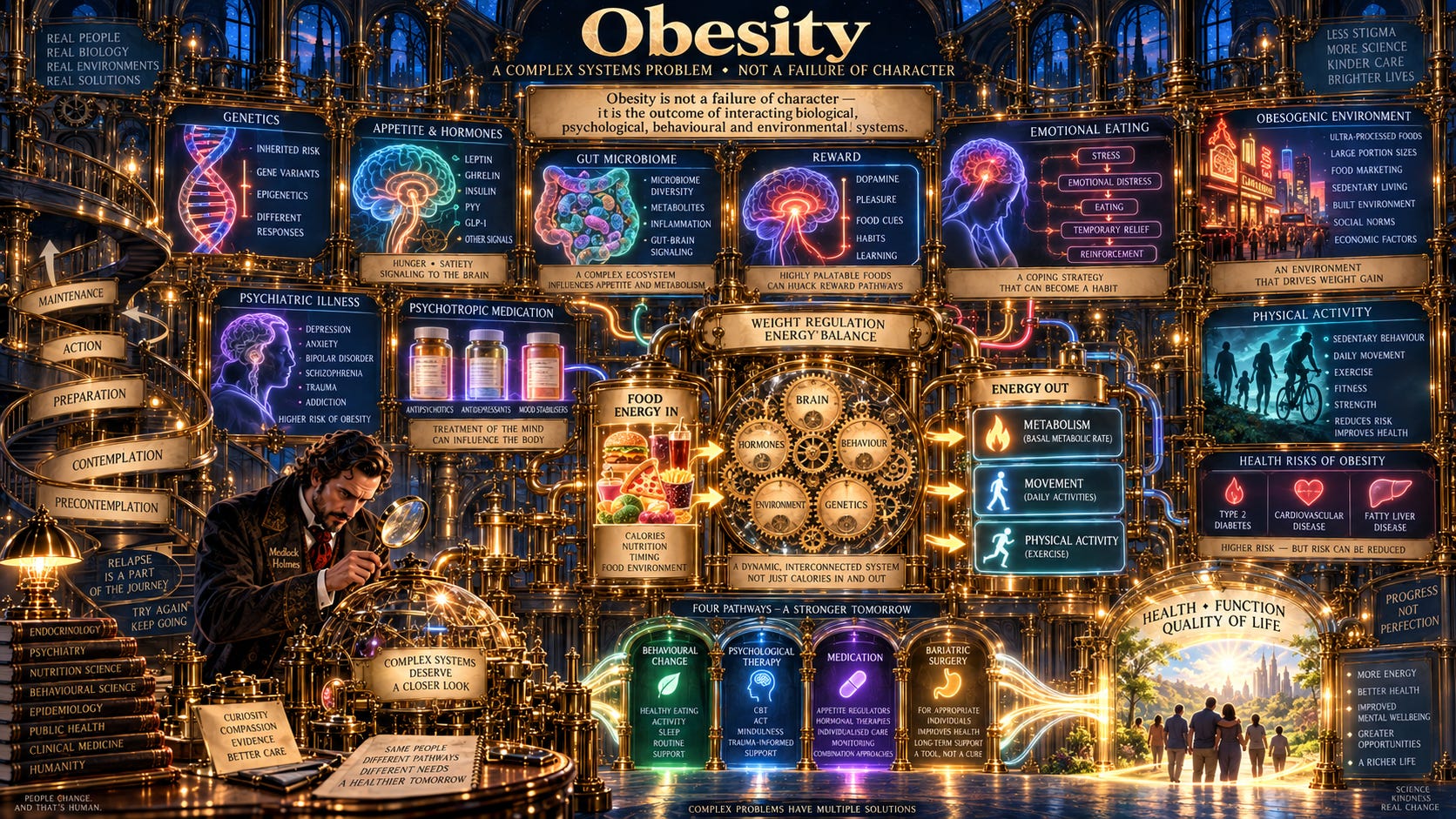
the development and management of obesity.
Medlock Holmes enters The Great Energy Exchange, an immense Neo-Victorian metabolic laboratory where every calorie entering the body passes through a bewildering network of biological, psychological and environmental machinery.
At first, the equation appears almost embarrassingly simple:
ENERGY IN > ENERGY OUT → WEIGHT GAIN
But Holmes quickly discovers that the equation describes what happens, not why it happens.
Behind the balance are hundreds of interconnected mechanisms: genetic susceptibility, appetite hormones, adipose tissue, metabolism, the gut microbiome, reward circuitry, mood, stress, sleep, learned behaviour, medications, food availability and the environment itself. Obesity is therefore not simply a failure of willpower; it is a complex condition emerging from the interaction between biology and the world in which a person lives.
The investigation begins with measurement. Body mass index, calculated as weight in kilograms divided by height in metres squared, remains the most widely used clinical measure. A BMI of 25–29.9 falls within the overweight range, 30 or above within obesity, and above 40 within severe obesity. Yet Holmes notices immediately that BMI is an imperfect instrument: it cannot distinguish muscle from fat or account adequately for fitness, bone density and other dimensions of metabolic health.
More important is what obesity does across the body. The medical map on the wall connects it with hypertension, dyslipidaemia, type 2 diabetes, cardiovascular disease, obstructive sleep apnoea, osteoarthritis, fatty liver disease, reflux, reproductive difficulties and several cancers. Depression and anxiety appear on the same map.
But Holmes refuses to draw a one-way arrow from obesity to mental illness.
Instead:
OBESITY ↔ DEPRESSION
OBESITY ↔ ANXIETY
OBESITY ↔ DISORDERED EATING
and, in severe mental illness:
PSYCHIATRIC ILLNESS ↔ MEDICATION ↔ WEIGHT ↔ PHYSICAL HEALTH
One particularly important chamber contains the psychiatric dispensary. Olanzapine, clozapine, quetiapine, lithium, valproate, mirtazapine and several other psychotropics can contribute to weight gain. The psychiatrist therefore cannot simply prescribe for the mind while ignoring the metabolic consequences for the body.
Another chamber contains food, but Holmes discovers that eating is not always driven by hunger.
For some people:
DISTRESS → EATING → TEMPORARY RELIEF
Repeated often enough, food can become an emotion-regulation strategy. Binge eating, grazing and night eating may further complicate obesity, while highly palatable foods engage reward pathways that have prompted comparisons with addictive processes.
Outside the laboratory lies an even larger clue: the obesogenic environment. Calorie-dense food is inexpensive and readily available, while transport, screens, sedentary employment and energy-saving technologies progressively remove physical activity from everyday life.
Treatment must therefore be equally…
Sivusto: drmanaankarray.substack.com


