

Shownotes
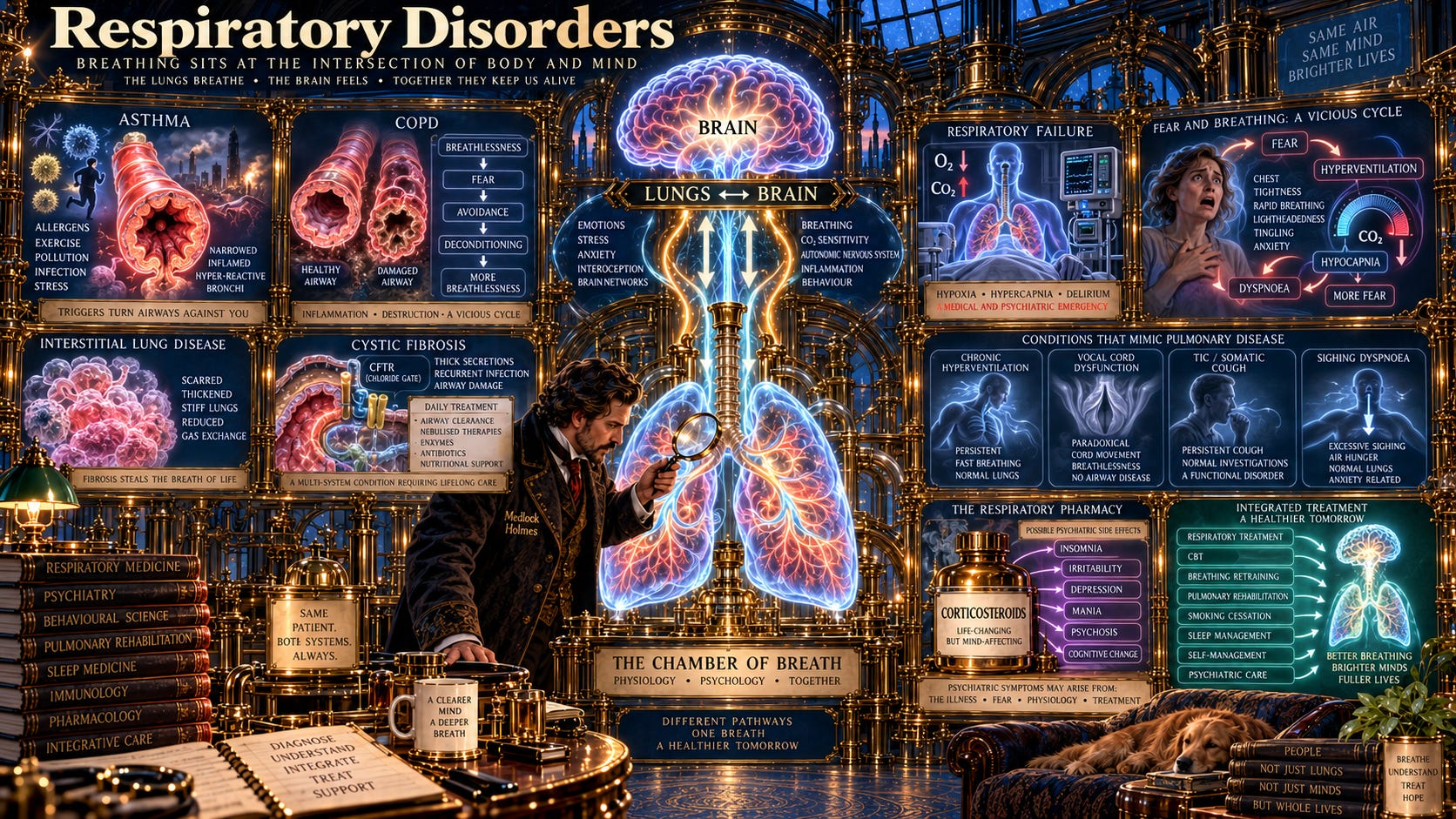
and psychiatric treatment.
Episode Description
Medlock Holmes enters The Chamber of Breath, an immense Neo-Victorian respiratory laboratory where a pair of mechanical lungs expands and contracts beneath an intricate network connecting the lungs, brain, emotions and behaviour.
At first, the mystery appears entirely pulmonary. Asthma narrows reactive airways. COPD progressively restricts airflow. Interstitial lung disease scars the tissue surrounding the alveoli. Cystic fibrosis fills the respiratory system with the consequences of abnormal CFTR function. Respiratory failure produces hypoxia and hypercapnia.
But Holmes quickly discovers that breathing is unlike almost any other bodily function.
It is simultaneously:
AUTOMATIC • VOLUNTARY • PHYSIOLOGICAL • PERCEPTUAL • EMOTIONAL
And this makes respiratory illness particularly important to psychiatry.
Dyspnoea can generate fear. Fear can alter breathing. Hyperventilation can create dizziness, chest tightness, paraesthesia and further breathlessness. Those sensations can then be interpreted catastrophically:
“I CAN’T BREATHE.”
The alarm intensifies.
Breathing accelerates.
Carbon dioxide falls.
Physical sensations increase.
Fear escalates again.
Holmes finds himself confronting one of respiratory psychiatry’s central diagnostic problems:
LUNG DISEASE → DYSPNOEA → FEAR
or
FEAR → HYPERVENTILATION → DYSPNOEA
or, very commonly:
BOTH
The source emphasises this reciprocal relationship: respiratory illnesses commonly involve dyspnoea, hypoxia and disturbed sleep, while severe disease can produce major functional impairment; together these can increase vulnerability to anxiety, depression and other psychiatric problems.
Asthma provides perhaps the clearest example. It is a genuine inflammatory airway disorder characterised by obstruction, inflammation, hyper-responsiveness and airway remodelling. Yet stress and emotion can themselves precipitate bronchoconstriction, while anxiety can alter the perception of airway obstruction. Some anxious patients may interpret benign respiratory sensations as evidence of an impending attack; others may underestimate dangerous obstruction and delay treatment.
The psychiatrist therefore must avoid two opposite mistakes:
“IT’S ALL ANXIETY.”
and
“IT’S ALL THE LUNGS.”
Both can be dangerous.
Holmes next enters the COPD chamber, where breathlessness has become persistent rather than episodic. Depression, anxiety and panic are common, while disability and frightening dyspnoea progressively narrow the patient’s world. Avoidance produces deconditioning; deconditioning makes activity harder; breathlessness increases; fear grows.
The vicious cycle becomes:
DYSPNOEA → FEAR → AVOIDANCE → DECONDITIONING → MORE DYSPNOEA
Pulmonary rehabilitation attempts to reverse this spiral by combining physical exercise with education, self-management, nutrition and psychosocial support.
Further along lies cystic fibrosis, where psychiatric care confronts a different burden: not simply breathlessness…
Website: drmanaankarray.substack.com


