

PSYCH 148: Endocrine and Metabolic Disorders
· 1 ώ. 6 λεπ. · Σεζόν 13 Επεισόδιο 148
Σημειώσεις επεισοδίου
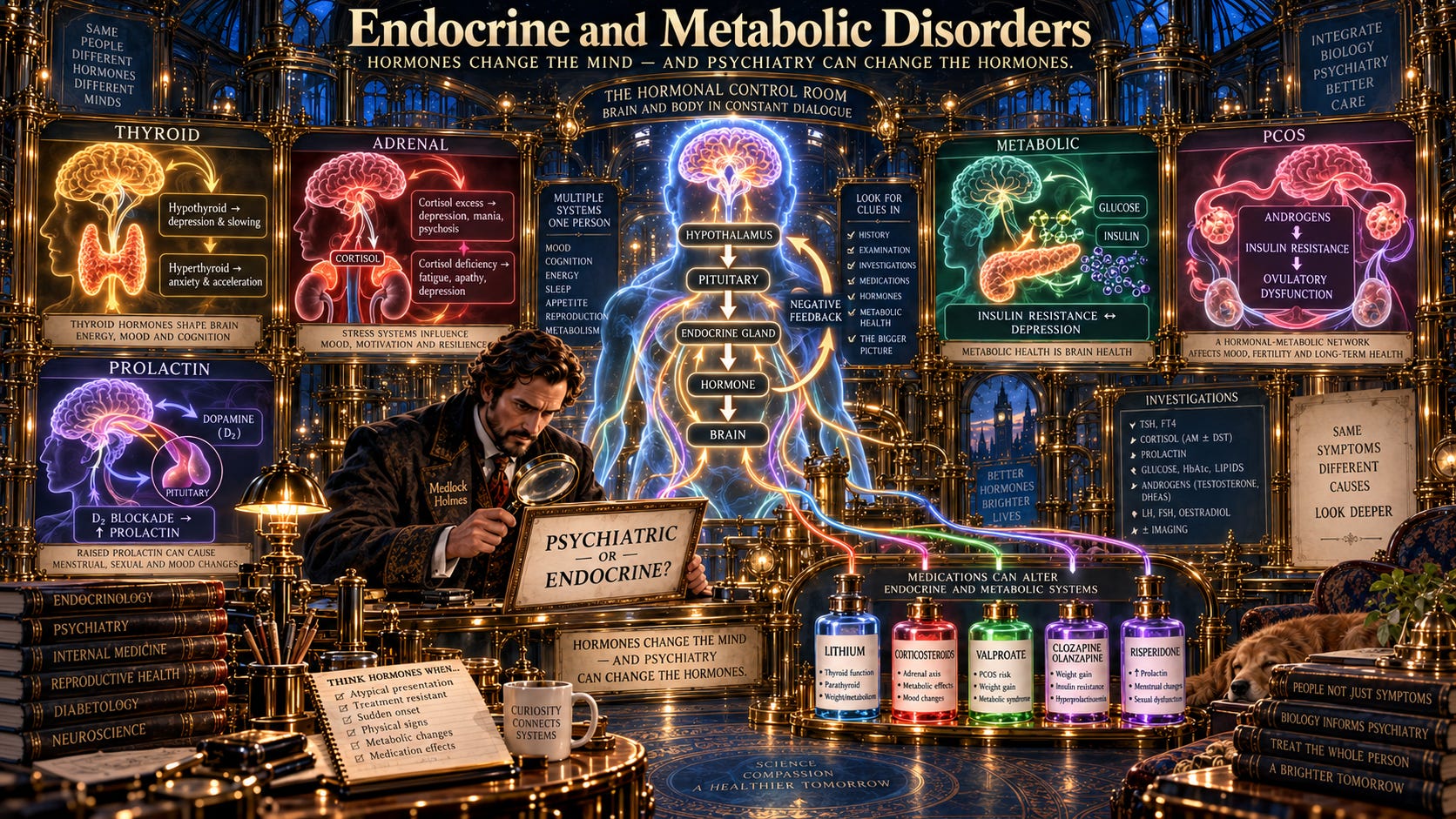
meaning disturbances of thyroid, adrenal, metabolic and reproductive systems can present as depression, anxiety, mania, psychosis or cognitive change.
Episode Description
Medlock Holmes enters The Hormonal Control Room, a vast Neo-Victorian laboratory where the brain and body communicate through an intricate network of chemical messengers.
At its centre stands the hypothalamus, connected to the pituitary gland, the master relay station. From there, illuminated pathways extend towards the:
THYROID • ADRENALS • GONADS • PANCREAS
Every pathway contains a feedback loop.
Hormones travel outward, change the activity of distant organs and the brain, and then signal backwards to regulate their own production.
Holmes quickly discovers the central rule:
HORMONES ↔ BRAIN ↔ BEHAVIOUR
Endocrine disorders can produce psychiatric symptoms early in their course, sometimes before their physical manifestations become obvious. They should therefore remain part of the differential diagnosis when depression, anxiety, cognitive impairment or other psychiatric symptoms are unusual or resistant to treatment.
The first chamber controls the thyroid.
When thyroid activity falls, the entire room appears to slow.
The patient becomes tired. Thought becomes sluggish. Memory and concentration deteriorate. Motivation falls. Mood darkens.
Holmes writes:
HYPOTHYROIDISM → SLOW
LOW ENERGY • APATHY • DEPRESSION • PSYCHOMOTOR SLOWING • COGNITIVE IMPAIRMENT
The resemblance to primary depression is striking.
But Holmes finds clues that the problem may lie elsewhere:
WEIGHT GAIN • COLD INTOLERANCE • CONSTIPATION • DRY SKIN • BRADYCARDIA
And there is another particularly important psychiatric clue:
LITHIUM → HYPOTHYROIDISM
The medication used to stabilise mood can itself alter the endocrine system that influences mood.
Holmes turns another valve.
Now thyroid activity rises excessively.
The machinery accelerates.
Heart rate rises. Hands tremble. The patient sweats. Sleep deteriorates. Thoughts accelerate. Anxiety increases.
HYPERTHYROIDISM → FAST
ANXIETY • IRRITABILITY • INSOMNIA • MOOD INSTABILITY • RESTLESSNESS
In severe illness, even:
PARANOIA • HALLUCINATIONS • DELIRIUM
may emerge.
A patient who appears to have panic disorder, severe anxiety or occasionally a manic-like state may therefore require a thyroid investigation rather than simply another psychiatric prescription.
Holmes moves deeper into the laboratory and reaches the adrenal system.
Here the hypothalamus releases CRH, the pituitary releases ACTH, and the adrenal cortex releases CORTISOL.
CRH → ACTH → CORTISOL
Normally cortisol follows a circadian rhythm and participates in the body’s response to stress.
But when cortisol remains excessively high, Holmes enters the chamber of Cushing syndrome.
The psychological consequences can be profound:
DEPRESSION • IRRITABILITY • ANXIETY • INSOMNIA • COGNITIVE IMPAIRMENT
and sometimes:
MANIA • PSYCHOSIS
Holmes then notices something crucial.
The excess cortisol does not always…
Ιστότοπος: drmanaankarray.substack.com


